Red Dots on a Turkey Shotgun
Have you ever been set up perfectly on a Tennessee gobbler, only to rush the shot and send a cloud of pellets wide of the mark? That frantic moment when a big tom finally struts into range often makes our natural point-and-shoot instincts go awry with traditional bead sights. This guide is all about exploring how a red dot sight on your turkey shotgun can dramatically improve your accuracy and confidence in those critical seconds, helping you fill your tag more consistently.
The Frustration of Traditional Turkey Sights
For generations, hunters have relied on the simple bead sight at the end of their shotgun barrel for turkey hunting. It's traditional, it's rugged, and it's certainly gotten the job done for countless successful hunts. But let's be honest, it's not without its frustrations, especially when that moment of truth arrives and your adrenaline is pumping through your veins like a river in spring flood.
The Challenge of Aligning a Single Bead
The biggest hurdle with a single bead is that it's just that – a single bead. To shoot accurately, you need to align that bead perfectly with your eye and the target. This sounds easy enough in theory, but in the heat of the moment, with a gobbler’s head bobbing and weaving, and your heart pounding, getting that alignment just right can be incredibly difficult. You're trying to quickly mount the gun, get your cheek weld, and simultaneously ensure that bead is exactly where you want the center of your pattern to hit. Any slight shift in head position or a hurried gun mount can throw your shot off by inches, and inches are all it takes to miss a turkey's relatively small vital zone in the head and neck. It’s a precision game, and a single bead leaves a lot of room for error.
Consider a scenario in the deep timber of the Cherokee National Forest Hunting, where shadows are long and a tom might appear and disappear in the undergrowth quickly. You’ve got mere seconds to get on target before he slips away. With a bead, you might find yourself struggling to differentiate that small, dark bead against the equally dark background of the woods, especially if the light isn’t perfect. It adds a layer of mental and visual clutter to an already high-pressure situation.
The Guesswork of Pattern Placement
Another common frustration stems from the inherent nature of a shotgun pattern. While the bead points generally down the barrel, it doesn't give you a precise indication of where the absolute center of your pattern will impact. You pattern your gun at the range, of course, and you know where your gun should shoot. But in the field, with varying distances and angles, that single bead offers little in the way of a definitive aiming point. You're essentially "painting" the target with the bead, hoping the core of your pattern lands where it needs to be.
This often leads to shots that are either too high, too low, or slightly off-center, resulting in wounded birds or complete misses. I've had many hunting buddies lament missing a bird that was "right there" only to realize their gun was shooting a bit differently than they thought under pressure. The bead simply doesn't give you the visual feedback necessary for pinpoint accuracy, which is especially critical when you're aiming for the small, vulnerable head and neck of a turkey. It’s not like a rifle where you have front and rear sights forming a clear sight picture. With a shotgun bead, you’re relying heavily on muscle memory and instinct, which can betray you when the stakes are highest.
Understanding Red Dot Sights for Turkey Hunting
So, what exactly is a red dot sight, and how does it address these frustrations? Imagine looking through a small window and seeing a bright, illuminated dot hovering directly on your target, no matter your head position or how you're canting the gun. That's essentially the magic of a red dot sight. It simplifies the aiming process, making it much more intuitive and faster to get on target accurately.
How a Red Dot Sight Works
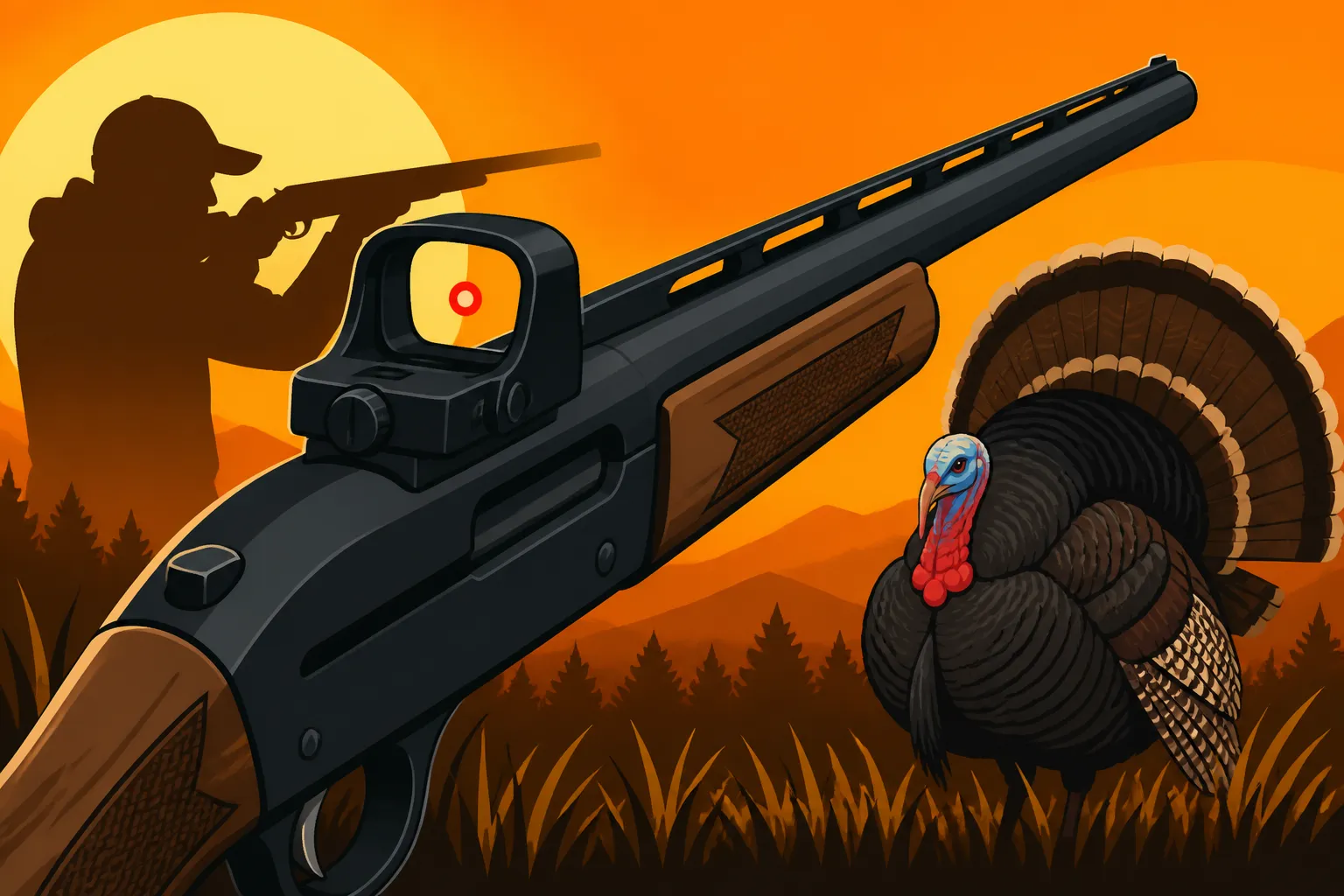
At its core, a red dot sight is a non-magnifying optic that uses a light-emitting diode (LED) to project an illuminated reticle – usually a dot, but sometimes a circle or a crosshair – onto a special lens. This dot appears to float out in front of the sight, directly on your target, creating a single, precise aiming point. The key here is that it's "parallax-free" or nearly so, within reasonable hunting distances. This means that as long as you can see the dot on the target, that's where your shot will go, regardless of whether your eye is perfectly centered behind the optic. This is a huge advantage over traditional iron sights, where consistent eye alignment is absolutely critical.
Many modern red dots, especially those designed for rugged use, are built to withstand abuse. They're often waterproof, fog-proof, and recoil-resistant, which is crucial for a hard-hitting turkey load. The technology is pretty robust now, meaning you can trust these optics even in harsh Tennessee Spring Turkey Opening Day weather conditions or if you happen to bump your gun trekking through the woods. The simplicity of the single aiming point makes target acquisition incredibly fast, allowing you to react quicker when that tom finally commits.
Types of Red Dot Sights Suitable for Shotguns
When you start looking at red dots, you'll quickly notice there are a few different styles, but generally, for shotguns, you'll be looking at either tube-style or open-reflex (miniature) sights.
-
Tube-Style Red Dots: These look somewhat like a miniature rifle scope, with a cylindrical housing. They often offer a larger objective lens for a wider field of view and excellent durability due to their enclosed design. Brands like Aimpoint and some models from Vortex (which I've seen some of my GoHunt buddies swear by for durability) make excellent tube-style optics. They're generally robust and have long battery lives, which is great for extended seasons. The main drawback might be their slightly larger footprint and weight compared to the open-reflex models.
-
Open-Reflex (Miniature) Red Dots: These are compact, low-profile sights that sit directly on top of the receiver. They have an open frame with a single lens where the dot is projected. These are incredibly popular for turkey guns because they add minimal bulk and weight, which is a big plus when you're still-hunting the Cumberland Plateau Ridgelines or covering a lot of ground in search of a hot bird. Trijicon RMRs, Burris FastFires, and Vortex Venom/Viper are common examples. Their small size makes them less prone to snagging on brush, and they offer a very unobstructed field of view. However, being open, the emitter can sometimes get crud in it, though most are still very resilient to the elements. For turkey hunting, where the shot is typically under 50 yards and quick target acquisition is key, both types can excel, but many lean towards the miniature open-reflex sights for their low profile and light weight.
The Unmistakable Advantages of Red Dots for Turkey Hunters
Once you switch to a red dot on your turkey shotgun, you'll likely wonder how you ever hunted without one. The benefits aren't just theoretical; they translate directly to better performance in the field, making you a more confident and effective turkey hunter.
Rapid Target Acquisition and Follow-Up Shots
One of the most immediate and impactful advantages of a red dot sight is the speed at which you can acquire your target. Unlike a traditional bead, which requires you to align your eye, the bead, and the target, a red dot only asks you to put the dot on what you want to hit. There's no front-to-back alignment needed. This "point-and-shoot" simplicity is game-changing. When a gobbler steps out unexpectedly or decides to strut just a few yards closer than you anticipated, those precious seconds saved can mean the difference between a successful harvest and a heartbreaking miss.
Imagine a situation where you're Calling a Tennessee Gobbler Off the Roost, and he pitches down, appearing right at the edge of your effective range. With a red dot, you can quickly mount your gun, place that bright, unmistakable dot on his head, and pull the trigger with confidence, often before he even fully realizes you're there. This speed is also beneficial if you happen to miss or if there's a second bird, allowing for much faster and more accurate follow-up shots, though hopefully, you won't need one! The clarity of the red dot cutting through cover is something a simple bead can't match.
Enhanced Accuracy and Precision
This is where red dots truly shine for turkey hunters. Because the dot is a precise, illuminated aiming point, it takes almost all the guesswork out of where your pattern will impact. Once you've properly Patterning a Turkey Gun at 40 Yards with your chosen load and choke, you'll know exactly where that dot needs to be for a clean, ethical shot on a turkey's head and neck. This precision minimizes the chances of wounding a bird due to an off-center pattern.
The "parallax-free" nature means that even if your head isn't perfectly centered behind the sight, as long as you see the dot on the target, that's where your pattern will go. This forgiveness is huge in real-world hunting scenarios where you might be contorted in an awkward position behind a tree or hunkered down in a ground blind. It removes a significant variable from the aiming process, allowing you to focus purely on the target. For hunters who spend hours scouting potential Scrape Lines Along a Logging Road and setting up carefully, this added precision ensures that their hard work pays off when the moment arrives.
Superior Performance in Low Light and Heavy Cover
Turkey hunting often means being out in the woods before first light and staying until last light. It means setting up in dense cedar thickets, under thick hardwoods, or along shady creek bottoms. These are exactly the conditions where a traditional bead sight can become a dim, almost invisible smudge. Trying to aim accurately with a dark bead against a dark background is an exercise in frustration.
A red dot sight completely eliminates this problem. The illuminated reticle provides a bright, clear aiming point that stands out against any background, regardless of how dim the ambient light is. Most red dots also have adjustable brightness settings, allowing you to fine-tune the dot's intensity to match the conditions – bright enough for midday sun, or dim enough for those shadowy pre-dawn setups. This makes hunting in challenging lighting conditions far more effective and less stressful. Whether you're hunting the Hunting West Tennessee Bottomland Deer where shadows can be deep, or perched on a ridgeline, the red dot will give you an undeniable aiming point every time.
Setting Up and Sighting In Your Red Dot
Getting your red dot mounted correctly and zeroed in is a crucial step that ensures you're ready for the field. It’s not a complicated process, but taking your time here will pay dividends when that big tom struts into view.
Mounting Your Red Dot Sight
The first step is attaching the red dot to your shotgun. Most modern turkey shotguns come with a Picatinny rail or are drilled and tapped, allowing for easy installation of a rail adapter. If your shotgun doesn't have these, you might need to have a gunsmith drill and tap your receiver, or explore saddle mounts that clamp onto the receiver. Many red dot manufacturers, or even aftermarket companies, offer specific mounting plates designed to fit popular shotgun models directly onto their footprint (e.g., a Venom mount for a specific Mossberg model).
When mounting, always follow the manufacturer's instructions for torque specifications to avoid damaging the sight or the firearm. Use a thread-locking compound (like blue Loctite) on the screws to prevent them from loosening under the recoil of heavy turkey loads. A loose sight will quickly lead to inaccurate shooting and frustration. Ensure the sight is positioned comfortably for your eye relief – most red dots offer generous eye relief, so placement isn't as critical as with magnified scopes, but you still want it to feel natural when you shoulder the gun.
The Critical Process of Zeroing Your Red Dot
Zeroing your red dot is perhaps the most important step before you hit the woods. This is where you confirm that your point of aim (the red dot) matches your point of impact (the center of your shotgun's pattern). You can't just slap it on and assume it's good to go.
- Start Close: Begin by bore-sighting your shotgun, if possible, or start with your initial shots at a very close range, say 10-15 yards. This will ensure your shots are at least on paper and save you a lot of frustration and expensive turkey loads.
- Patterning Board Time: The real work happens at your desired hunting distance – typically 30, 40, or even 50 yards, depending on your setup. You'll need a large patterning board or paper targets with a clear aiming point. Shoot at least three shots, aiming precisely with your red dot each time. Observe where the densest part of your pattern (the "core") is hitting relative to your aim point.
- Adjust and Repeat: Use the windage (left/right) and elevation (up/down) adjustment screws on your red dot to move the point of impact. Most red dots have click adjustments that correspond to a certain change at 100 yards, so you'll need to do a little math for closer ranges, or simply make small adjustments and observe the shift. After each adjustment, shoot another group of three and re-evaluate. The goal is to get the center of your pattern to align perfectly with your red dot at your chosen distance. This might take several shots and some patience, but it's time well spent. Remember, different turkey loads, even from the same manufacturer, can pattern differently, so always zero with the exact load you intend to hunt with. This is also important if you're experimenting with different Turkey Shotguns and Chokes setups.
Choosing the Right Red Dot for Your Tennessee Turkey Hunt
With so many red dots on the market, picking the right one can feel a bit overwhelming. But by focusing on a few key features, you can narrow down the choices and find an optic that will serve you well in the Tennessee woods.
Durability and Weather Resistance
Tennessee weather can be fickle during spring turkey season. One day it's sunny and warm, the next it's a cold, driving rain. Your red dot needs to be able to handle it all. Look for sights that are advertised as waterproof, fog-proof, and shockproof. A sealed unit will prevent moisture from getting inside and fogging up the lens or damaging the electronics. Shockproofing ensures the sight can withstand the heavy recoil of turkey loads and the inevitable bumps and knocks that come with hunting in rugged terrain like the North Cumberland Wildlife Management Area.
Pay attention to the materials used in the housing – aircraft-grade aluminum is common and offers a good balance of strength and weight. Brands like Aimpoint and Trijicon are renowned for their bulletproof durability, often tested to military standards. While they might come with a higher price tag, the peace of mind knowing your optic won't fail you in a critical moment is often worth the investment. For hunters relying on the latest scouting data, platforms like GoHunt can help pinpoint areas where weather might be more extreme, reinforcing the need for tough gear.
Battery Life and Reliability
The last thing you want is for your red dot to die on you in the middle of a hunt. Modern red dots have significantly improved battery life, with many offering thousands of hours of runtime on a single battery. Some high-end models even feature motion-activated "shake awake" technology or automatic shut-off features to conserve power. These features can be incredibly useful, ensuring your sight is always ready when you are.
It's always a good practice to start each season with fresh batteries in your red dot, and perhaps carry a spare in your Turkey Vests With a Kickstand Seat or pack. Look for models that use commonly available battery types, making replacements easy to find. Reliability extends beyond just battery life; it also encompasses the consistency of the reticle. You want a crisp, clear dot that doesn't flicker or distort, even on its lowest brightness settings. This becomes especially apparent when you're trying to make out a distant gobbler in the shadows during Roost Hunting Tennessee Gobblers.
Dot Size and Reticle Options
Red dots typically come with various dot sizes, measured in Minutes of Angle (MOA). A 1 MOA dot covers 1 inch at 100 yards, a 2 MOA dot covers 2 inches, and so on. For turkey hunting, a dot size between 2 MOA and 5 MOA is generally preferred.
- Smaller Dots (2-3 MOA): Offer more precise aiming for smaller targets like a turkey's head and neck, especially at longer ranges (40-50 yards). They can be slightly harder to pick up quickly in certain situations.
- Larger Dots (4-5 MOA): Are very fast to acquire and excellent for close-range, fast-action shots. While they cover a bit more of the target, for a turkey's head at typical ranges, they still provide plenty of precision.
Some red dots also offer different reticle options beyond a simple dot, such as a circle-dot reticle (like an EOTech or some Holosun models). These can be very fast to acquire and the outer circle can serve as a crude range estimation tool or a quick reference for your pattern spread. Ultimately, the best dot size and reticle style will come down to personal preference and how quickly and accurately you can acquire and place the dot on your target during practice sessions.
Table: Red Dot vs. Traditional Bead Sight for Turkey Hunting
To help visualize the differences, here's a quick comparison of red dot sights versus traditional bead sights for turkey hunting.
| Feature / Consideration | Traditional Bead Sight | Red Dot Sight |
|---|---|---|
| Target Acquisition Speed | Can be slow, requires careful alignment of bead, eye, and target. | Very fast, "put the dot on it" simplicity, single aiming point. |
| Precision at Range | Relies on muscle memory and instinct, guesswork for exact pattern center. | Pinpoint aiming, dot indicates precise center of pattern, parallax-free at range. |
| Low Light Performance | Difficult to see against dark backgrounds, especially at dawn/dusk. | Illuminated reticle is highly visible in all lighting conditions, adjustable brightness. |
| Field of View | Unobstructed view of the target area. | Generally good, but optic housing can slightly obscure peripheral vision. |
| Durability | Extremely durable, simple, no electronics to fail. | Generally very durable, but electronics can fail; waterproof/shockproof critical. |
| Mounting Requirements | Built-in, no mounting needed. | Requires a Picatinny rail or specific mounting plate on receiver. |
| Cost | Minimal (built-in component). | Added expense, varies from budget to high-end models. |
| Eye Relief | Unlimited. | Generous, but specific to optic design. |
Tips for Hunting Tennessee Turkeys with a Red Dot
You've got your red dot mounted, zeroed, and ready to go. Now, how do you make the most of it in the field? Hunting with a red dot isn't drastically different from hunting with a bead, but a few considerations can optimize your success.
Practice Makes Perfect
Just like with any new gear, practice is paramount. Don't just zero your red dot and head straight to the woods. Spend time practicing mounting your shotgun and quickly acquiring targets with the red dot. Practice from different positions you might encounter while hunting – sitting against a tree, kneeling, or even from inside a ground blind. The more comfortable and instinctive it becomes, the better you'll perform when a real gobbler shows up.
One exercise I often recommend is to set up a target (a turkey head silhouette works great) at varying distances and practice shouldering your gun and putting the dot on the target as quickly and smoothly as possible. Pay attention to your cheek weld – while a red dot is forgiving, a consistent mount will always lead to better consistency. You might even want to try some dry-fire practice at home, ensuring your dot is perfectly still on the target as you pull the trigger. This helps build muscle memory and reinforces the single, precise aiming point the red dot provides. Consider reviewing articles like Run-and-Gun Turkey Tactics on Public Land to combine your newfound aiming precision with agile hunting strategies.
Understanding Your Effective Range
Even with a red dot, a shotgun is still a shotgun. The effective range for an ethical turkey kill remains limited by your choke and load combination, usually out to 40-50 yards, sometimes a bit further with specialized loads and tight chokes. The red dot helps you aim precisely within that effective range, but it doesn't extend the range itself. Your primary goal is to get that bird as close as possible, regardless of your sighting system.
Use the clarity of your red dot to confirm the range before taking a shot, if possible. If you use a Rangefinders in Thick Cumberland Cover during scouting, you'll already have some reference points. Knowing your specific gun's pattern density at various ranges is crucial. A red dot won't turn a sparse pattern into a dense one. Continue to be patient, use good calling strategies, and choose your shots wisely. The red dot simply ensures that when you do take a shot, your pattern is perfectly centered on the vital zone. This is key for ethical hunting, particularly in areas where Making the Most of a Two-Bird Season Limit is crucial for harvest management.
Battery Management and Care
Always check your red dot's battery before heading into the field, especially if it's been sitting for a while. As mentioned earlier, starting the season with a fresh battery is a smart move. If your red dot has manual brightness adjustments, remember to turn it off when not in use to conserve battery life. If it has an automatic shut-off or "shake awake" feature, familiarize yourself with how it works.
Keep the lenses clean. Dust, pollen, and fingerprints can obscure your view and the dot itself. A lens pen or a microfiber cloth is an invaluable tool for keeping your optics pristine. Store your shotgun and red dot in a safe, dry place when not in use. While most modern red dots are built tough, proper care will extend their lifespan and ensure they perform reliably for many seasons to come. Using mapping tools like GoHunt to mark your stands and track your movements also reminds you of where you put your gear away after a long day in the woods, helping to prevent loss or damage.
Combining with Other Turkey Gear
Your red dot is just one piece of your turkey hunting puzzle. It works best when integrated with your other gear. For instance, if you're Decoy Placement for Pressured Tennessee Birds, think about how the red dot allows for a precise shot even if the bird approaches at an unexpected angle. When selecting your Turkey Calls Worth Carrying in Tennessee, remember that the red dot ensures your calling efforts are rewarded with a clean shot.
Ultimately, a red dot sight is a tool designed to remove uncertainty from the aiming process, allowing you to focus more on the hunt itself and less on aligning tiny beads. For many Tennessee turkey hunters, it's become an essential piece of gear that has significantly boosted their confidence and success rates in the spring woods.
Disclaimer
This article is for general informational purposes only and does not constitute professional advice. Laws, prices and regulations vary by location and change over time. Consult a qualified professional for guidance on your specific situation.