Thermal and Night Vision Rules in Tennessee
The world of hunting technology is always pushing boundaries, and for many Tennessee hunters, the emergence of thermal and night vision optics has sparked a lot of questions. It's totally understandable to feel a bit lost in the maze of regulations surrounding these advanced tools. One minute you're seeing incredible footage of hunters dropping hogs in the dark, the next you're wondering if using that same gear for a deer hunt could land you in hot water. This guide is here to untangle the confusion, providing clear, straightforward answers about when and how you can legally use thermal and night vision equipment for hunting here in the Volunteer State.
Understanding Tennessee's Regulations on Night Hunting Equipment
Navigating the rules for advanced hunting optics can feel like trying to hit a moving target sometimes. Technology evolves so fast, and state wildlife agencies work hard to keep up, balancing hunter opportunity with responsible game management. Let's start with the basics of what we're even talking about.
The Basics of Thermal and Night Vision for Hunting
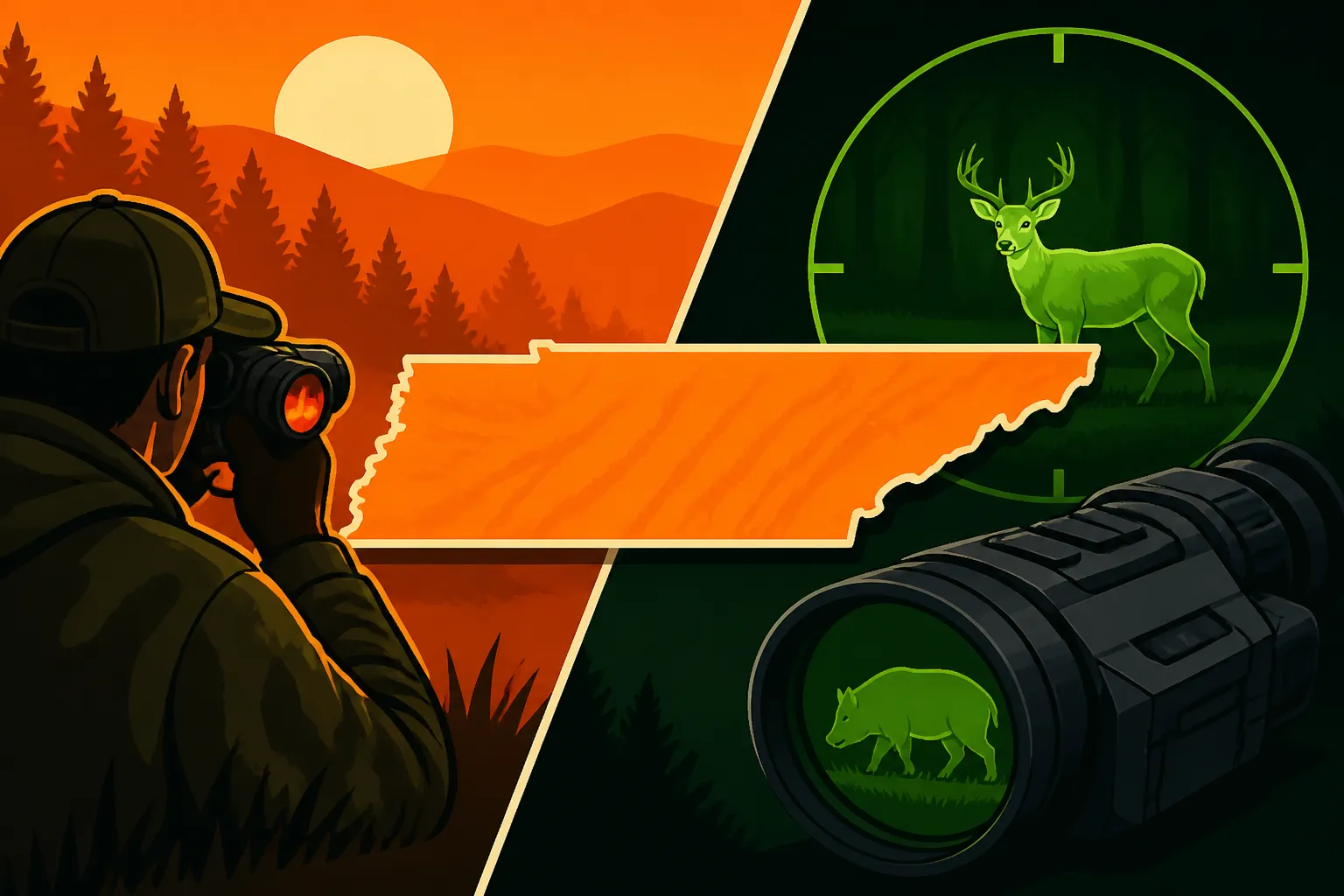
When we talk about thermal and night vision, we're discussing two distinct but equally impressive technologies designed to give you an edge in low-light or no-light conditions. Night vision optics, often seen with that characteristic green glow, work by intensifying any available ambient light – starlight, moonlight, even distant city glow. They essentially take a tiny bit of light and amplify it thousands of times, allowing your eyes to perceive images in near darkness. Think of it as turning up the brightness dial on a very dim scene.
Thermal vision, on the other hand, is a whole different beast. It doesn't rely on light at all. Instead, it detects differences in heat signatures. Every living creature, and even inanimate objects, emits some degree of thermal energy. A thermal device picks up these heat differentials and translates them into a visual image, often displaying hotter objects (like a deer's body) in bright colors against cooler backgrounds. This means you can spot a deer in a dense thicket, a coyote hiding in tall grass, or a wild hog partially obscured by brush, even on the darkest, cloudiest night, simply by its heat signature. For hunters, these tools offer the incredible potential to extend awareness beyond what the human eye can perceive, but with that power comes a responsibility to understand and abide by the law.
General Rules for Hunting Hours in Tennessee
Before we dive into specific exceptions for advanced optics, it’s absolutely critical to lay the groundwork with Tennessee's standard hunting hours. For the vast majority of game species in our state, hunting is allowed only during daylight hours, defined as 30 minutes before official sunrise to 30 minutes after official sunset. This "civil twilight" period is a long-established standard across wildlife management. It's designed to ensure hunters have enough natural light to clearly identify their target, confirm what’s beyond it, and make a safe, ethical shot.
These sunrise and sunset times are precisely calculated by the Tennessee Wildlife Resources Agency (TWRA) and are usually published in their annual hunting guides and often available through official apps or services like GoHunt. They vary slightly throughout the year and depending on your exact location in the state. For instance, the sunrise in Johnson City might be a few minutes different than in Memphis. Adhering to these standard hours is non-negotiable for species like deer, turkey, and most small game. Any deviation from this fundamental rule is a very specific exception, and that's exactly what we'll explore next when discussing night vision and thermal. Without first understanding this bedrock rule, the exceptions simply won't make sense.
If you’re planning a hunt during the cooler, shorter days of late season, understanding Tennessee Public Land Hunting Hours becomes even more important, as those 30-minute windows around sunrise and sunset can feel quite brief.
Specific Game Species and Night Vision Restrictions
This is where the rubber meets the road. The legality of using thermal and night vision equipment hinges entirely on what you're hunting. Tennessee has clear distinctions, and misunderstanding them can lead to serious trouble.
Deer and Turkey Hunting
Let's be unequivocally clear on this point: the use of thermal or night vision equipment to hunt, spot, or locate white-tailed deer or wild turkey in Tennessee is strictly, 100% prohibited. No exceptions. This rule applies to every single part of their respective seasons, whether you're stalking during Bowhunting Tennessee's Long Archery Season or hunting with a rifle during Tennessee's Gun Deer Season Into January. It doesn't matter if the device is mounted on your firearm, used handheld for spotting, or even part of a remote surveillance system. If you are actively hunting deer or turkey, leave your night vision and thermal optics at home.
The reasoning behind this strict prohibition is multi-faceted. Primarily, it's about maintaining fair chase. Deer and turkey are naturally active during twilight hours, and giving hunters the ability to pursue them in total darkness would fundamentally alter the balance of the hunt, creating an unfair advantage. It's also a critical safety measure. Positive identification of a target in low or no light is incredibly difficult, even with advanced optics. Misidentifying a deer, or worse, mistaking another hunter or a protected animal for game, is a risk the TWRA isn't willing to take. Furthermore, it's a vital game management tool to prevent overharvesting of these cherished species. So, if your target is a big gobbler in the spring or a rutting buck in November, traditional methods and legal daylight hours are your only options.
Predator and Furbearer Hunting Exceptions
Now for the good news: Tennessee does allow the use of thermal and night vision for certain species, primarily those classified as nuisance wildlife, predators, or furbearers. This is a crucial distinction that many hunters are keen to understand, as these tools can be incredibly effective for managing populations of animals that are active mostly after dark.
The poster child for legal night hunting with advanced optics in Tennessee is the coyote. Because coyotes are considered a year-round nuisance species that can significantly impact deer fawn recruitment and livestock, hunters are permitted to pursue them day or night, year-round, using artificial lights, thermal, and night vision devices. This is a common and popular activity for many Tennessee hunters looking for additional opportunities to be in the woods and contribute to local wildlife management. If you're serious about coyote hunting, a quality thermal scanner is almost a necessity for spotting these elusive animals in the dark. For more specifics, check out Night Hunting Rules for Tennessee Coyotes.
Beyond coyotes, wild hogs are another species for which these liberal rules often apply. Wild hogs cause immense agricultural damage and habitat destruction across the state, making their control a high priority. While the rules can sometimes be a bit more nuanced depending on specific land types (private vs. public) or local initiatives, the general trend is towards allowing methods that aid in their effective removal. Many landowners and hunters utilize thermal optics to target hogs that typically move under the cover of darkness. It's always best to verify the precise rules for hog hunting in your specific county or WMA, but the allowance of night vision and thermal is a common provision. More information on the challenges posed by these animals can be found in Hog Hunting Tennessee's Wild Boar.
For other furbearers like foxes and bobcats, the rules can be more restrictive. While they are often managed as furbearers with specific seasons, the general prohibition on night hunting for most game often applies to them unless explicitly stated otherwise. Again, the key takeaway is always to consult the current TWRA regulations for the specific species you intend to hunt. This information is usually detailed in the annual hunting guide.
To help visualize these differences, here's a general guide:
| Game Species | Legal to Use Thermal/Night Vision | General Hunting Hours | Notes |
|---|---|---|---|
| White-tailed Deer | No | 30 min before sunrise – 30 min after sunset | Strictly prohibited for hunting, spotting, or locating. |
| Wild Turkey | No | 30 min before sunrise – 30 min after sunset | Strictly prohibited for hunting, spotting, or locating. |
| Coyote | Yes | Year-round, 24/7 | Legal for hunting, spotting, and locating. Artificial lights also allowed. |
| Wild Hog | Check Specific Regulations | Check Specific Regulations | Often permitted for control, but rules can vary by area and land type. Always verify. |
| Fox, Bobcat, Raccoon, Opossum | Check Specific Regulations | Check Specific Regulations | Generally restricted to daylight hours for hunting, but specific trapping or depredation permits may exist. |
This table provides a general overview. Always consult the latest official TWRA regulations for the most accurate and up-to-date information. Rules can change annually.
Practical Considerations and Ethical Hunting with Night Vision
Even when you're operating well within the legal boundaries, using thermal and night vision for hunting requires a heightened sense of awareness and adherence to ethical principles. These tools are powerful, and with great power comes great responsibility.
Safety and Responsibility
Hunting in any condition demands an unwavering commitment to safety, but when you introduce low-light or no-light scenarios, that commitment must be amplified. The primary concern when using thermal or night vision is absolute positive target identification. While a thermal scope can highlight a heat signature, it doesn't always provide the clear, detailed image needed to definitively identify the species, let alone ensure it's a legal target. What looks like a coyote through a green-tinted night vision device could potentially be a domestic dog or even a protected species.
Always be 100% sure of your target, and what lies beyond it, before you even think about squeezing the trigger. A bullet travels far, and in the dark, without the benefit of natural light to illuminate the background, the risks of a ricochet or an unintended strike increase exponentially. Many experienced night hunters employ a multi-step verification process: first, they might use thermal to locate a heat signature, then switch to a more powerful, legal white light (where permitted for the species) to visually confirm the animal before taking a shot. This "spot-and-verify" method adds an essential layer of safety. Always be aware of your surroundings, your hunting partners, property lines, and any potential human habitation in the area. The silence of the night can be deceptive, making a clear understanding of your shooting lanes and backstops even more critical.
Scouting and Property Lines
While direct hunting of deer and turkey with thermal or night vision is forbidden, these devices can be incredibly valuable tools for legal scouting and observation, even for restricted species, provided you're not actively hunting them. For example, if you're trying to figure out Where Cumberland Plateau Bucks Bed, using a handheld thermal monocular during the offseason to observe their nocturnal patterns or travel routes can provide invaluable intel for your legal daylight hunt later in the year. Seeing how deer move through fields or along creek bottoms after dark can inform where you set your treestands or plan your approach during legal hunting hours.
Similarly, a thermal device can help you understand the density and movement patterns of coyotes on your property without having to set foot outside after dark. This information can then be used to plan a more effective night hunt when it's legal to pursue them. When scouting, however, the same rules apply as with hunting: respect property lines. You might spot a beautiful buck with your thermal device at night, but if it's on your neighbor's land, you cannot pursue it, nor should you trespass to get a closer look. Utilizing a good mapping application like those found on GoHunt, with its detailed property overlays, can be a game-changer for ensuring you always know exactly where you stand and where those boundaries lie. This becomes particularly important when you're studying Reading Aerial Photos for Cumberland Plateau Deer to understand terrain and cover.
Using these technologies ethically for observation and scouting can significantly deepen your understanding of local wildlife behavior, giving you a legitimate and lawful edge when hunting season opens.
Navigating the Legal Landscape and Staying Compliant
The single most important takeaway from any discussion on hunting regulations is the absolute necessity of staying informed. Laws change, and ignorance is rarely an acceptable excuse.
Checking the Latest Regulations
Hunting regulations are not etched in stone; they are living documents that evolve. The Tennessee Wildlife Resources Agency (TWRA) constantly reviews and updates its rulebook based on scientific data, population trends, harvest reports, public feedback, and technological advancements. This means that what was perfectly legal last year might have changed this year, or what applies to one WMA might be different on another. Relying on old hunting guides, forum posts, or hearsay from a buddy is a recipe for trouble, especially when it comes to specialized equipment like thermal and night vision.
Before every hunting season, and certainly before investing in or using any new piece of equipment, make it your personal responsibility to consult the official TWRA website or pick up their latest annual hunting and trapping guide. These resources are the definitive source for current laws, season dates, bag limits, and legal methods of take for every species. While services like GoHunt offer fantastic resources for hunters, including summaries of regulations, always cross-reference with the official TWRA publications to ensure you have the most accurate and current information. It’s also wise to check for any special WMA regulations if you plan to hunt public land, as these areas often have their own specific rules on top of statewide laws. Knowing about Tennessee WMA Permit Requirement might even be a small detail that makes a big difference.
Consequences of Non-Compliance
Let's not sugarcoat it: violating Tennessee's hunting laws, particularly those pertaining to illegal methods of take or hunting outside of legal hours, carries significant consequences. These are not minor slaps on the wrist. Depending on the severity of the offense, and whether it involves a protected species or a commercially valuable one, penalties can range from substantial fines and mandatory court appearances to the confiscation of your hunting equipment (including those expensive thermal or night vision optics), and even jail time.
Beyond the immediate financial and legal burdens, a wildlife violation can also result in the suspension or permanent revocation of your hunting license in Tennessee. And thanks to interstate wildlife compacts, such a revocation can often mean you lose your hunting privileges in many other states across the country as well. Imagine being unable to hunt for several years because you didn't take a few minutes to confirm the rules. That's a profound impact on a cherished pastime. The TWRA's wildlife officers are dedicated to protecting the state's natural resources and ensuring fair and ethical hunting for everyone. They enforce these laws diligently, and it's always in your best interest to know and follow them. For a deeper dive into potential repercussions, you can look into Tennessee Wildlife Violation Penalties. Your hunting legacy depends on your commitment to ethical and legal practices.
Disclaimer
This article is for general informational purposes only and does not constitute professional advice. Laws, prices and regulations vary by location and change over time. Consult a qualified professional for guidance on your specific situation.