Night Hunting Rules for Tennessee Coyotes
The relentless increase in coyote populations across Tennessee presents a real challenge for landowners and wildlife managers alike. These adaptable predators can be incredibly elusive during daylight hours, leading many hunters to wonder if taking to the fields under the cloak of darkness is a viable option. For those grappling with coyote depredation on their property or simply looking for an exciting and effective way to manage these smart canines, understanding the nuanced rules surrounding night hunting in Tennessee is absolutely essential. This comprehensive guide will meticulously break down the specific regulations, legal equipment, and critical safety considerations for hunting coyotes after the sun goes down, helping you navigate the complexities and hunt responsibly.
Understanding Tennessee's General Night Hunting Regulations
When most folks think about hunting in Tennessee, they picture crisp mornings, deer stands overlooking a hardwood bottom, or chasing gobblers through spring woods. Night hunting, for the vast majority of game animals, is strictly prohibited – and for very good reason, primarily safety and preventing poaching. However, coyotes are a notable exception, classified as a nuisance species in many areas due to their impact on deer, turkey, and small game populations, as well as livestock. This special classification means they fall under a different set of rules compared to white-tailed deer or wild turkeys. It's crucial not to confuse the general prohibition with the specific allowances for coyotes.
Navigating these regulations requires careful attention to detail, as breaking them, even unintentionally, can lead to serious legal consequences. The Tennessee Wildlife Resources Agency (TWRA) is very clear about what you can and cannot do, and ignorance of the law is never an excuse. Always double-check the most current regulations handbook, which you can usually find on the TWRA website or pick up at any license agent.
Legal Hours and Prohibited Times
Unlike most game species, coyotes in Tennessee can indeed be hunted at night. This isn't a free-for-all, however. There isn't a specific "coyote season" in the traditional sense, as they can be hunted year-round. The primary distinction comes down to method and location, particularly concerning the use of artificial lights or night vision. While you can technically hunt coyotes 24/7 on private land where it's explicitly allowed, the methods you employ are where the regulations get specific.
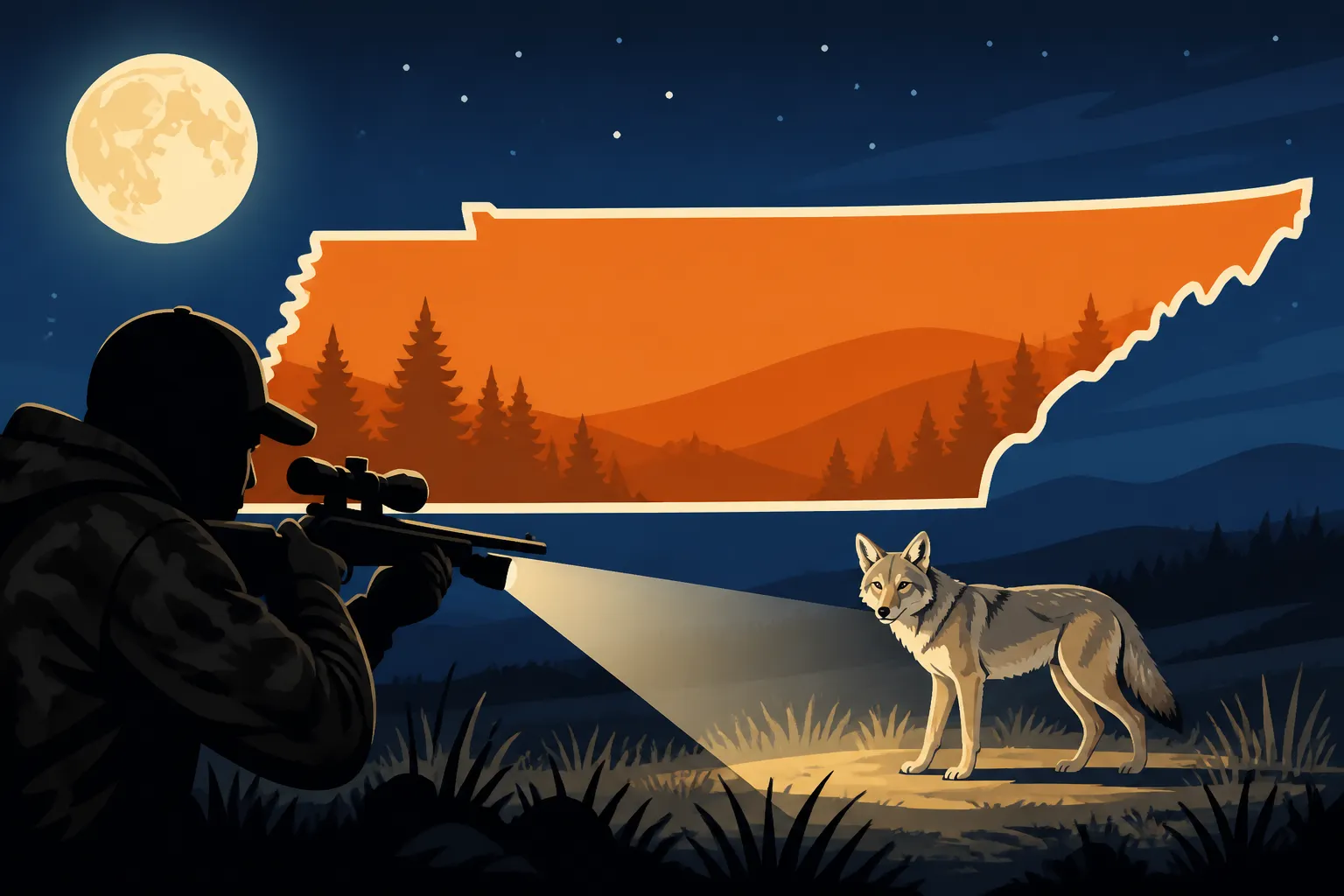
On private land, the use of artificial lights to hunt coyotes is generally permitted, but it's not without caveats. You can't just cruise down a road with a spotlight and shoot from your vehicle. The lights must be handheld or weapon-mounted, and the act of hunting must be conducted safely and legally. This means being aware of your surroundings, identifying your target absolutely clearly, and having a safe backstop. Public lands, like most Wildlife Management Areas (WMAs), typically have much stricter rules regarding night hunting and often prohibit it entirely for any species. For detailed information on specific times for general hunting activities, you might find our guide on Tennessee Public Land Hunting Hours helpful, though remember coyotes have special exemptions.
Equipment Restrictions and Legal Weapons
When it comes to the tools of the trade for night hunting coyotes, Tennessee has fairly liberal rules compared to other states, but there are still important distinctions. For instance, while high-powered rifles are generally legal for hunting coyotes during the day, the discussion around night hunting often introduces new variables like suppressors, night vision, and thermal optics. Rifles are permitted, as are shotguns, muzzleloaders, and archery equipment. The choice often comes down to personal preference, the terrain you're hunting, and the distances you expect to engage coyotes.
Perhaps the most significant difference from other types of hunting is the legality of artificial lights and advanced optics. Tennessee allows the use of artificial light, night vision, and thermal imaging devices when hunting coyotes on private land. This is a game-changer for night hunting, as it allows for proper target identification and shot placement in conditions where traditional optics would be useless. However, these devices must be used in conjunction with legal hunting methods. You can't use them from a vehicle or public road, and you must adhere to all other safety regulations. For those interested in comparing weapon types, our article on Tennessee Legal Firearms for Deer Hunting can offer some context, though remember coyote rules are unique.
Here's a quick summary of generally legal equipment for night coyote hunting on private land:
| Equipment Type | Legality for Night Coyote Hunting (Private Land) | Notes |
|---|---|---|
| Rifles | Legal | Most common choice, various calibers allowed. Ensure safe backstop. |
| Shotguns | Legal | Effective at closer ranges, especially with predator loads. |
| Muzzleloaders | Legal | Less common for night hunting but permitted. Requires careful handling in low light. |
| Archery Equipment | Legal | Vertical bows and crossbows are allowed. Requires close range and excellent target identification. |
| Artificial Lights | Legal | Handheld or weapon-mounted. Used for target identification and illumination. Avoid shining on roads or residences. |
| Night Vision Devices | Legal | Highly effective for spotting and identifying coyotes in darkness. |
| Thermal Imaging Devices | Legal | Excellent for detecting heat signatures from coyotes. Often used for initial spotting before identification with other means. |
| Electronic Calls | Legal | Extremely effective for luring coyotes. Wide range of predator sounds available. |
| Suppresors/Silencers | Legal | Permitted with proper federal registration (ATF Form 4). Reduces noise pollution and spooks fewer animals. |
Public vs. Private Land Considerations
This is perhaps the most critical distinction to understand when planning a night coyote hunt. On private land, with explicit permission from the landowner, night hunting for coyotes is generally permitted using the methods and equipment discussed. This means you need to have a clear understanding of property boundaries and ensure you have permission, preferably in writing. It's not enough to assume; you must ask. Given the sensitive nature of hunting at night, a quick conversation with a landowner detailing your intent and methods will go a long way in maintaining good relationships. Our guide on Tennessee Trespass and Permission Law offers critical insights into the importance of securing proper access.
Public hunting lands, including most Tennessee Wildlife Management Areas (WMAs) and national forests, are a different story. The vast majority of these areas prohibit night hunting of any kind, for any species, including coyotes. The reasons are primarily safety, minimizing disturbance to other wildlife, and managing public access. There might be extremely rare exceptions or special seasons on specific WMAs, but these are typically quota hunts or very limited windows for specific species like hogs. Always, always consult the specific WMA regulations before even considering a night hunt on public ground. A general rule of thumb: if it's public land, assume night hunting is forbidden unless you can find an explicit, recent regulation stating otherwise for the specific area and species. Using resources like GoHunt or the TWRA app can help you check specific WMA rules. For those who enjoy Scouting Tennessee Public Land Before Season, remember that night hunting considerations are entirely separate.
Specific Rules for Coyotes at Night
The general hunting regulations in Tennessee are extensive, but specific exemptions and allowances for coyotes at night are what make this type of hunting possible. It's not just about what gear you can use, but how you use it and the intent behind it. The TWRA's goal is to allow landowners and hunters to manage nuisance species effectively while still upholding principles of fair chase, safety, and preventing accidental harm to non-target animals. These specific rules are designed to strike that balance.
One of the biggest frustrations for hunters is the varying interpretations and the sheer volume of rules. For coyotes, the key is to remember their classification as an unprotected, nuisance species often leads to more flexible regulations compared to regulated game. This flexibility, however, doesn't translate to recklessness. Every action taken during a night hunt needs to be deliberate and within the bounds of safety and the law.
Using Artificial Lights and Night Vision Devices
This is the cornerstone of effective night coyote hunting. As mentioned, Tennessee allows the use of artificial lights, night vision, and thermal imaging for coyotes on private land. But let's get into the specifics. Artificial lights can be weapon-mounted flashlights, headlamps, or handheld spotlights. Many dedicated predator hunters prefer red or green lights, as these colors are thought to be less alarming to coyotes and preserve the hunter's night vision better than white light. The light's purpose is to illuminate the target for positive identification and accurate shot placement. You're not allowed to use a vehicle to chase or spotlight coyotes with the intent to shoot from or immediately adjacent to the vehicle. Your setup needs to be stationary or involve active stalking on foot.
Night vision devices, which amplify ambient light, and thermal imaging devices, which detect heat signatures, have revolutionized night hunting. They allow hunters to spot animals that would be invisible to the naked eye, even with a strong spotlight. This greatly enhances safety by allowing for positive identification of coyotes versus other nocturnal animals like deer, raccoons, or domestic pets. Using these devices still requires adherence to all other safe hunting practices, including knowing your target and what lies beyond it. Integrating tools like GoHunt with aerial imagery can help you identify potential backstops and safe shooting lanes even before you head out.
Electronic Calls and Decoys for Night Hunting
Just like during the day, electronic calls are incredibly effective for luring coyotes at night. Tennessee permits the use of electronic calls for coyotes, and this is a huge advantage. These devices can replicate a wide range of sounds, from distress cries of rabbits or fawns to coyote howls and barks, which can draw in curious or territorial coyotes. At night, with reduced visibility, sound becomes even more critical for attracting these predators.
Many hunters will combine electronic calls with visual decoys, though decoys are less common for night hunting. A simple flapping rabbit decoy or even a glowing eye decoy can add a visual element that might seal the deal when a coyote approaches the call. When calling at night, positioning is key. You want the sound to draw the coyote past a clear shooting lane, ideally with a good backdrop, and where you have an elevated position or can remain concealed. Consider using a ground blind if you plan to call from a stationary position; our article on Using a Ground Blind on Tennessee Public Land provides setup tips, which can be adapted for private land night hunts. Remember, coyotes are smart; they'll often try to circle downwind to scent you, so planning your setup for the prevailing wind is paramount. Coyote Calling in Tennessee Farm Country offers more in-depth strategies that can be applied to both day and night scenarios.
Safety Considerations and Best Practices
Night hunting, by its very nature, carries increased risks. Visibility is limited, sounds are amplified, and target identification can be challenging even with the best equipment. Therefore, safety must be your absolute top priority.
- Positive Target Identification: Never, ever shoot at movement or a "pair of eyes" without 100% positive identification of your target as a coyote. Other animals, including deer, opossums, and even domestic dogs or cats, are active at night. Night vision or thermal devices are excellent for spotting, but always confirm with an illuminated, clear visual before pulling the trigger.
- Know Your Backstop: In the darkness, it's incredibly difficult to see what's beyond your target. You must have a clear understanding of the terrain, potential hazards (houses, roads, livestock), and ensure any shot you take has a safe, elevated, or impenetrable backstop. Scouting your chosen hunting location during daylight is non-negotiable for night hunting.
- Communicate: If you're hunting with a partner, maintain clear communication. Use radios (FRS/GMRS) or pre-arranged signals. Wear a small amount of reflective material if moving, or ensure your partner knows your exact location if stationary.
- Permission and Notification: Always inform the landowner, and ideally nearby neighbors, of your intent to hunt coyotes at night. Explain your methods (lights, calls) so they aren't alarmed by unexpected activity or sounds. This builds trust and prevents misunderstandings.
- Be Prepared for the Unexpected: Carry a powerful flashlight, a first-aid kit, and a fully charged cell phone. Tell someone where you are going and when you expect to return. Getting lost or injured in the dark is far more dangerous than during the day.
- Adherence to Laws: Always carry your valid Tennessee hunting license and any required permits. Understand all other applicable laws, such as those related to firearms discharge near residences. Violating regulations, even if accidental, can lead to stiff Tennessee Wildlife Violation Penalties.
Navigating Public and Private Land for Night Hunting
The legal landscape for night hunting coyotes differs dramatically between public and private lands in Tennessee. Misunderstanding this distinction is one of the quickest ways to run into trouble. While the desire to manage coyote populations is strong across the state, public safety and established land management principles take precedence on shared lands. This section will delve deeper into these access considerations, emphasizing the critical importance of proper authorization.
The sheer volume of rules can be overwhelming, leading some hunters to simply give up before they start. However, with species like coyotes that impact so many other game animals and livestock, finding responsible ways to hunt them, including at night, is a valuable skill. Whether you're dealing with agricultural depredation or simply aiming to reduce predator pressure on your local deer herd, understanding where and how you can apply these methods is crucial. The key lies in diligent research and communication.
Getting Permission on Private Land
Hunting coyotes at night on private land is where most of the legal, effective night hunting occurs in Tennessee. The fundamental requirement is explicit permission from the landowner. This isn't just a courtesy; it's a legal necessity. For night hunting, it's highly recommended to get this permission in writing. A simple, signed note detailing who is allowed to hunt, for what species, during what timeframe, and confirming permission for night hunting and the use of artificial lights/night vision, can save a lot of headaches.
When approaching a landowner, be professional and transparent. Explain why you want to hunt coyotes (e.g., "I've seen their numbers impacting fawns on your property" or "They're a problem for local livestock"). Clearly state that you intend to hunt at night and will be using lights, night vision, and possibly electronic calls. Discuss your safety protocols, like having a safe backstop and notifying them when you'll be out. This open communication builds trust and assures the landowner that you are a responsible hunter. Remember, many landowners are struggling with high Tennessee Coyote Range and Density and might welcome the help. Using mapping tools like GoHunt or the TWRA app can help you clearly delineate property boundaries, which is critical for staying on the correct side of Finding Tennessee Property Lines when hunting in the dark.
Public Land Restrictions and WMAs
As a general rule, night hunting, including for coyotes, is prohibited on most public lands in Tennessee, especially Wildlife Management Areas (WMAs), state parks, and national forests. The primary reason is public safety and preventing conflicts with other users (hikers, campers, other hunters) who might be out after dark. There are also concerns about minimizing disturbance to other wildlife populations.
While the TWRA recognizes the impact of coyotes, their management strategies on public land typically focus on daylight hunting, or specific, limited quota hunts for other nuisance species like wild hogs where night hunting might be a component. Always consult the specific WMA Proclamation or regulations for the public land you intend to hunt. These documents will explicitly state any prohibitions or special allowances. Do not rely on general rules for private land when on public property. If the regulations do not explicitly state that night hunting for coyotes is allowed, you should assume it is forbidden. This is a situation where being overly cautious is always the best approach. Even though there are no specific statewide Tennessee Coyote Hunting Season Rules for night hunting, individual WMAs can and do impose their own restrictions. For comprehensive information about all public lands in the state, our guide to Public Hunting Land in Tennessee can serve as an excellent starting point, but always drill down to site-specific rules.
Responsible Hunting and Reporting
Beyond the letter of the law, responsible night hunting for coyotes involves an ethical approach. It means making clean, humane shots, minimizing disturbance, and respecting both wildlife and other people. This includes:
- Minimizing Disturbance: While you're targeting coyotes, try to minimize disturbance to other wildlife. Avoid excessive calling if it's not producing results, and move quietly through the landscape.
- Ethical Shots: Only take shots you are confident will be lethal and humane. Night hunting equipment aids in this, but practice with your gear in low-light conditions to ensure proficiency.
- Respecting Neighbors: Even on private land, sound travels. Be mindful of residences, livestock, and other people in the vicinity. A suppressor, if you have one and it's legally registered, can be a great asset for reducing noise pollution, especially in more populated areas.
- Carcass Management: While there are no specific harvest reporting requirements for coyotes, responsibly dispose of any carcasses. If you're not keeping the fur, ensure the carcass is placed somewhere it won't be a nuisance or health hazard.
- Stay Updated: Regulations can change. It's your responsibility to stay informed. Check the TWRA website annually for updates to hunting proclamations. Using platforms like
GoHuntcan sometimes provide access to updated regulations summaries, but cross-referencing with the official TWRA documents is always the gold standard. Knowing How Many Coyotes Tennessee Has and their impact can help you understand the importance of your role in responsible management.
Disclaimer
Please remember that hunting regulations can change frequently. While this guide provides comprehensive information based on current knowledge, it is your responsibility to consult the most recent Tennessee Wildlife Resources Agency (TWRA) hunting guide and proclamations before engaging in any hunting activity. Always confirm local, state, and federal regulations for your specific hunting area and species. This content is for informational purposes only and does not constitute legal advice.