Tennessee Elk Zone Nonresident Eligibility
It’s a dream many hunters share: the thrill of pursuing elk in big country, hearing a bull bugle, and bringing home some of that incredible meat. And if you're not a Tennessee resident but have heard whispers of our growing elk herd and the success of the restoration efforts in the North Cumberland, it's only natural to wonder if you can throw your hat in the ring. The reality, unfortunately, is a tough pill to swallow for our out-of-state hunting friends when it comes to elk. This guide is here to shed light on Tennessee's nonresident elk eligibility, or rather, the lack thereof, and explain why things are structured the way they are.
The Clear Reality of Nonresident Elk Hunting in Tennessee
Let's cut right to the chase, because I know that’s what most folks are really wondering. For the vast majority of non-Tennessee residents, the dream of drawing a coveted Tennessee elk tag remains just that – a dream. The simple, unvarnished truth is that Tennessee's elk hunting opportunities are exclusively reserved for residents. It's a hard fact to hear if you're coming from out of state with hopes of chasing bugling bulls here in the Volunteer State, but it's crucial to understand this upfront to avoid any disappointment.
Why Tennessee's Elk Hunt is Resident-Only
This isn't a decision made lightly, and it's certainly not meant to exclude anyone arbitrarily. The reasons behind Tennessee's resident-only elk hunt are deeply rooted in the history and ongoing conservation efforts surrounding our state's elk population. When the Tennessee Wildlife Resources Agency (TWRA) embarked on the monumental task of How North Cumberland Elk Were Reintroduced, the goal was to bring a native species back from extirpation. This was a massive undertaking, requiring significant resources, careful planning, and dedicated habitat management in the North Cumberland Plateau region.
From the initial reintroduction efforts starting in 2000, bringing elk from states like Kentucky and Canada to their new home in Tennessee, every step has been about establishing a sustainable, healthy herd. The initial animals were carefully monitored, protected, and given every chance to thrive. The hunting opportunities that eventually arose were designed as a management tool, but first and foremost, as a reward and privilege for the Tennessee residents whose license fees and conservation efforts have directly funded and supported this restoration for over two decades. With a still-growing, but relatively small, herd compared to western states, maintaining resident-only status helps to control harvest pressure and ensure the herd continues to expand and solidify its presence across the designated elk zone.
The Exclusivity Even for Tennessee Residents
While the nonresident eligibility is essentially zero, it's worth noting that even for Tennessee residents, drawing an elk tag is an extremely rare and highly competitive endeavor. The TWRA issues a very limited number of permits each year, typically around 19 public land tags plus a mobility-impaired tag, to manage the herd within the Tennessee Elk Quota Hunt Rules. These numbers are tiny when you consider the hundreds, if not thousands, of residents who apply annually.
The application process is a lottery system, and hopeful residents often apply for years, even decades, before their name is finally drawn. This level of exclusivity underscores the preciousness of each tag and further explains why opening it up to nonresidents, at least at this stage of the herd's recovery, simply isn't feasible from a biological management or public sentiment perspective. It’s a hunt designed to celebrate a major conservation success for the state, and the opportunity is seen as a hard-earned privilege for those who call Tennessee home. Even a successful resident has beaten incredible odds to earn that chance to be Preparing for a North Cumberland Elk Hunt.
Understanding the Tennessee Elk Restoration Zone
Even if hunting isn't an option for nonresidents, understanding the Tennessee Elk Restoration Zone can provide valuable context for why the rules are structured the way they are. This isn't just a randomly designated area; it's a strategically chosen landscape that offers the best possible habitat for elk to thrive, and it's where all the conservation efforts are concentrated.
The Geographic Scope of Elk Country in Tennessee
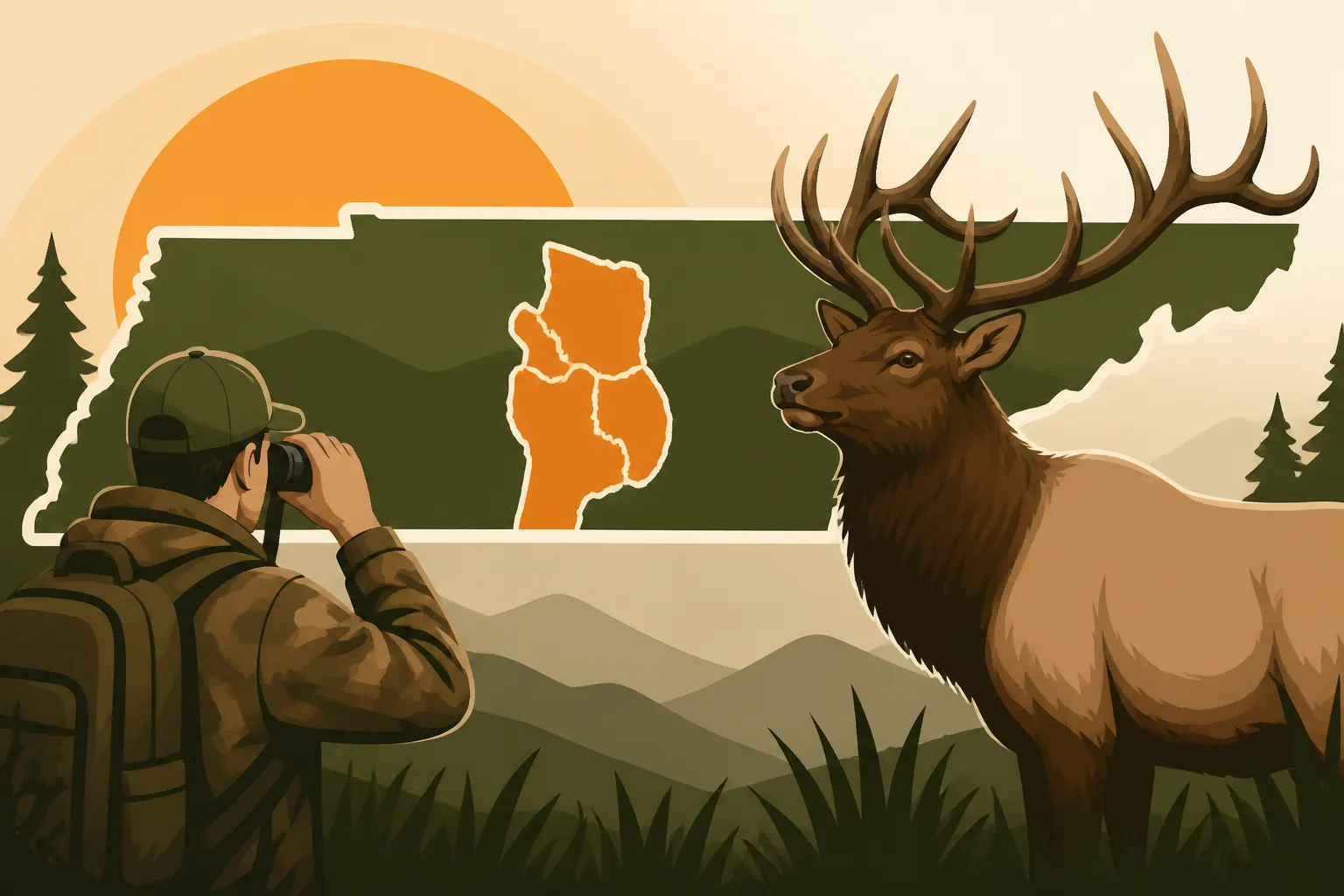
The Tennessee Elk Restoration Zone primarily encompasses portions of five counties in the northeastern part of the state: Anderson, Campbell, Claiborne, Scott, and Morgan. This vast expanse of mountainous terrain, dense forests, and reclaimed surface mines on the Cumberland Plateau provides the ideal environment for elk. These areas boast diverse forage, ample cover, and the remoteness necessary for a large, wild species like elk to establish strongholds.
You'll find much of this zone within the bounds of the North Cumberland Wildlife Management Area (WMA), a sprawling public land unit managed specifically for wildlife, including elk. The sheer scale of this WMA, covering hundreds of thousands of acres, is what allows for a viable elk population to exist and grow, making it the heart of Tennessee's Restored Elk Herd. The TWRA works tirelessly with landowners and other agencies to ensure habitat suitability, conducting prescribed burns, planting food plots, and managing timber to create optimal conditions for elk and other wildlife. For more details on the specific areas, you can check the Tennessee Elk Zone Boundaries Explained.
The Ongoing Success Story and Herd Management
The return of elk to Tennessee is truly a remarkable conservation success. From a small group of reintroduced animals, the Tennessee Elk Herd Size Today has grown steadily, a testament to the dedication of the TWRA and its partners. This success, however, requires continuous, careful management. Hunting plays a crucial role in this, serving as a tool to maintain herd health, control population numbers in specific areas, and mitigate potential conflicts with agriculture.
Because the herd is still relatively young and expanding, every management decision is made with the long-term health and growth of the population in mind. Limiting harvest to a select few residents allows biologists to closely monitor the impacts of hunting and make adjustments as needed. This meticulous approach ensures that Tennessee's elk will continue to be a thriving part of our natural heritage for generations to come, a luxury that simply wouldn't be possible with unrestricted or nonresident hunting at this stage.
Alternatives for Nonresidents and Supporting Elk Conservation
While the hunting dream might be on hold, nonresidents aren't entirely shut out from experiencing Tennessee's elk. There are meaningful ways to engage with and support our magnificent elk herd, allowing you to be part of the conservation story even without pulling a tag.
Elk Viewing Opportunities
One of the most rewarding ways for nonresidents to experience Tennessee's elk is through wildlife viewing. The North Cumberland WMA offers fantastic opportunities to see elk in their natural habitat, particularly during the early morning and late evening hours. Areas like Hatfield Knob are specifically managed for elk viewing, with designated parking and viewing areas. During the rut in late September and early October, the sounds of bugling bulls echoing through the mountains are an unforgettable experience.
Many nonresidents make the trip to the North Cumberland each year specifically to witness this spectacle. It's a chance to connect with these magnificent animals and appreciate the conservation efforts that brought them back. Imagine standing silently, the crisp mountain air filling your lungs, and then hearing the primal call of a bull elk – it's an experience that rivals many hunts in its intensity and natural beauty. You can find more information on specific viewing locations and best times in our guide to Elk Viewing in the North Cumberland Zone.
Supporting Tennessee's Conservation Efforts
Even without a hunting license, nonresidents can directly contribute to the ongoing health and expansion of Tennessee's elk herd. The TWRA relies heavily on funding from hunting and fishing license sales, but there are other avenues for support. Donations to wildlife conservation groups that work in Tennessee, or direct contributions to TWRA's elk management fund, help ensure that habitat projects, population monitoring, and enforcement efforts continue.
Consider purchasing a "conservation license plate" if you're a Tennessee resident, or simply making a donation to organizations dedicated to wildlife. Every dollar helps in managing land, conducting research, and educating the public about these incredible animals. Your financial support, whether large or small, plays a vital role in keeping Tennessee's elk herd thriving, a legacy we can all be proud of.
Exploring Other Tennessee Hunting Opportunities
If you're a nonresident hunter dead set on experiencing Tennessee's diverse hunting landscape, there are still plenty of options. While elk is off the table, Tennessee offers robust opportunities for other species, including white-tailed deer, wild turkey, and various small game. Nonresidents can purchase licenses for these hunts, and many of our WMAs and public lands provide excellent access.
For example, Tennessee boasts a long and productive deer season, with Tennessee's Deer Season Structure Explained offering archery, muzzleloader, and gun opportunities. Our spring turkey hunting is also phenomenal, with a strong population across the state. If you're looking to apply for deer or turkey tags in other states, or even just scout for those hunts on Tennessee's public lands, a platform like GoHunt can be a useful tool for planning your adventures. Just remember to always check the latest regulations for Tennessee Hunting Licenses and What They Cost and specific game seasons.
An accurate rifle with the right scope is a cornerstone of deer hunting, whether you're climbing mountains in East Tennessee, still-hunting through the Cumberland Plateau, or sitting a West Tennessee river bottom. But choosing the right setup—especially that rifle scope—can feel like walking through a minefield of technical jargon and endless options. You want something reliable, clear, and perfectly suited to the diverse shot opportunities Tennessee offers, from those close-range timber pokes to longer shots across food plots.
This guide is designed to help you cut through the clutter and pick the ideal rifle scope for your Tennessee deer hunting adventures. We’ll break down magnification, objective lens size, reticle types, and even talk about how much you should realistically spend. By the end, you'll have a clear path to finding the scope that brings confidence to your shoulder.
Understanding Magnification for Tennessee Deer Hunting
The magnification of your rifle scope is often the first number you see (like 3-9x, 4-12x, or a fixed 6x). It dictates how "zoomed in" your target appears. For Tennessee deer hunting, where environments can vary wildly from dense woods to open fields, having the right range of magnification is crucial. Too much magnification can be a hindrance in thick cover, while too little might leave you guessing on those longer shots.
The Sweet Spot: 3-9x and 4-12x Variable Scopes
For the vast majority of Tennessee deer hunters, a variable scope in the 3-9x or 4-12x range is truly the sweet spot. These scopes offer an excellent balance of versatility for the diverse terrain we encounter.
- 3-9x Magnification: This is often considered the classic deer hunting scope, and for good reason. At 3x, you get a wide field of view, which is incredibly helpful when a deer pops up quickly in dense woods or when you're still-hunting through thick timber on the Cumberland Plateau. It allows for fast target acquisition and provides enough magnification for shots out to 150-200 yards, which covers most deer hunting scenarios in Tennessee. It's lightweight, compact, and generally very forgiving to use.
- 4-12x Magnification: If your hunting grounds include more open fields, powerline cuts, or larger food plots, a 4-12x scope offers a bit more reach. The 4x low end is still very manageable for closer shots, providing a decent field of view, while the 12x high end gives you the confidence to make ethical shots out to 250-300 yards. This extra magnification can really help identify antler points or ensure precise shot placement when that big buck finally steps out at the far end of a soybean field.
Many hunters will actually set their variable power scope to a lower magnification (like 3x or 4x) when they're walking or expecting a quick, close shot, and then crank it up if a longer opportunity presents itself. It’s about being adaptable to whatever the Tennessee woods throw at you.
Fixed Power Scopes and Higher Magnification Considerations
While variable scopes dominate the market, some hunters still prefer fixed power scopes, typically in the 4x or 6x range. These scopes offer simplicity, often superior optical clarity for their price point, and bomb-proof reliability due to fewer moving parts.
- Fixed 4x or 6x: For hunters who primarily hunt thick cover, especially in places like the Cherokee National Forest where shot distances are rarely over 100 yards, a fixed power scope can be an excellent, rugged choice. They are incredibly bright and clear. The downside, of course, is the lack of versatility for varying distances.
- Higher Magnification (14x and beyond): For most Tennessee deer hunting, scopes with a maximum magnification beyond 12x or 14x are generally overkill. While they might seem appealing for extreme long-range shooting, the practical applications for deer hunting in our state are limited. Higher magnification scopes are heavier, bulkier, and can severely narrow your field of view, making it difficult to find a deer that's moving or close by. The mirage effect on hot days can also become a noticeable issue. Unless you're specifically targeting deer in very expansive, open agricultural landscapes from a fixed position, it's best to stick to the more versatile mid-range options.
Think about your primary hunting environment. Are you in tight hardwoods where a shot might be 40 yards? Or do you have long visibility across a winter wheat field? Matching your scope's magnification to your typical shot distances and cover density is far more important than just having "more power."
Objective Lens Size and Light Gathering
The objective lens is the large lens at the front of your scope. Its size, measured in millimeters, directly impacts how much light the scope can gather. This is critical for dawn and dusk hunting, which are prime times for deer activity, especially during the Hunting the Rut in Early November when bucks are most active.
Common Objective Lens Sizes for Deer Hunting
You'll typically see objective lens sizes ranging from 32mm to 50mm on deer hunting scopes. Each has its pros and cons in terms of light gathering, weight, and mounting height.
- 32mm-40mm (e.g., 3-9×40): A 40mm objective lens is arguably the most common and versatile choice for a deer hunting rifle scope. It strikes an excellent balance, gathering plenty of light for legal shooting hours without making the scope overly bulky or requiring excessively high scope rings. A 40mm objective paired with a 3-9x magnification provides a bright, clear image right up until legal shooting light fades, which is often crucial when deer make their appearance in the shadowy edges of a woodlot. Smaller 32mm objectives are common on more compact or lightweight rifles, offering good performance but slightly less low-light capability.
- 44mm-50mm: Larger objective lenses, like 44mm or 50mm, gather more light and can provide a brighter image in very low light conditions. This can be a significant advantage during those last few minutes of shooting light when a trophy buck finally steps out. However, they come with a few trade-offs. They are generally heavier, can make the scope feel top-heavy, and often require higher scope rings to clear the barrel, which can affect your cheek weld and shooting comfort. While the extra light gathering is noticeable, the practical gain within legal shooting hours is often marginal for most hunters compared to a well-designed 40mm scope.
Remember, a larger objective lens doesn't magically create light; it just captures more of the ambient light available. The quality of the glass and coatings in the scope often has a greater impact on low-light performance than objective lens size alone.
Exit Pupil and Low Light Performance
The "exit pupil" is the diameter of the light beam that leaves the eyepiece and enters your eye. A larger exit pupil makes it easier to quickly find the full field of view, which is a major benefit in low-light scenarios or when a deer is moving fast. You can calculate the exit pupil by dividing the objective lens size by the magnification. For example, a 3-9×40 scope at 3x magnification has an exit pupil of 40/3 ≈ 13.3mm. At 9x, it's 40/9 ≈ 4.4mm.
Your eye's pupil can dilate to about 5-7mm in low light conditions (this varies with age). A scope with an exit pupil larger than your eye's pupil ensures you're getting all the light the scope can offer. This is why a 3-9×40 scope set at 3x or 4x (exit pupils of 13.3mm and 10mm respectively) is so effective in low light – it’s literally funneling more light to your eye than your eye could gather on its own. As you increase magnification, the exit pupil shrinks, which is why higher magnifications become less effective as light fades. For critical low-light hunting, focus on scopes that maintain a decent exit pupil (ideally 5mm or more) at your chosen magnification setting. This attention to detail will help you make the most of those crucial first and last minutes in the woods.
Reticle Types and Features
The reticle is the aiming pattern inside your scope. What used to be a simple crosshair has evolved into a dizzying array of options, each designed for specific applications. For deer hunting in Tennessee, you'll want a reticle that is clean, easy to see, and ideally offers some simple holdover points for varying distances without being overly cluttered.
Duplex and Basic Crosshair Reticles
The standard duplex reticle is still a fantastic choice for deer hunting, especially for those who prefer simplicity. It features thicker posts that narrow down to fine crosshairs in the center, making it easy to pick up in varying light conditions.
- Simplicity and Speed: A basic duplex is fast. In a high-pressure hunting situation, the last thing you want is to be fumbling with complex calculations. You put the crosshairs on the deer, and you shoot. This is especially true for the majority of shots taken in Tennessee, which typically fall within 150 yards. It’s uncluttered and reliable, exactly what you need for quick target acquisition when a deer bursts out of a thicket.
- Low Light Visibility: The thicker portions of the duplex reticle are a huge advantage in low light, guiding your eye directly to the center. While fine crosshairs can disappear against a dark background like a deer's hide or deep shadows, the duplex remains visible, allowing for confident aiming even as light fades.
For many hunters, a quality scope with a simple duplex reticle is all they'll ever need. Don't feel pressured to get the latest, most complex reticle if it doesn't suit your hunting style or typical shot distances.
BDC, MOA/MRAD, and Illuminated Reticles
Beyond the basic duplex, there are several other reticle types that offer additional features, which can be useful depending on your hunting style and typical shot distances.
- BDC (Bullet Drop Compensator) Reticles: BDC reticles feature a series of dots or hash marks below the main crosshair, designed to provide aiming points for different distances (e.g., 200, 300, 400 yards). They can be incredibly useful for hunters who anticipate longer shots across open country or powerlines. However, they are caliber and load specific, meaning the holdover points will only be accurate with a particular bullet and muzzle velocity. While you can usually find generalized BDC reticles, for true precision, you’ll want to confirm your specific cartridge’s ballistics with the reticle’s markings. For most shots out to 200-250 yards in Tennessee, knowing your rifle’s point of impact and a single holdover estimate is often sufficient.
- MOA/MRAD Reticles: These reticles feature precise hash marks that correspond to angular measurements (Minutes of Angle or Milliradians). They are incredibly versatile for precise range estimation and holdover adjustments, especially when paired with matching turrets. However, they come with a steeper learning curve and require a deeper understanding of ballistics. While excellent for long-range shooting, they are often overkill for typical deer hunting distances in Tennessee and can appear cluttered if you're not accustomed to them. Unless you're specifically setting up a rifle for shots beyond 300 yards and are dedicated to practicing with these systems, a BDC or duplex is likely more practical.
- Illuminated Reticles: An illuminated reticle features a battery-powered light that illuminates the center crosshairs or dots, making them glow red or green. This is a game-changer in extremely low light or against very dark backgrounds (like a black bear or dark timber). It prevents the reticle from "washing out" and disappearing, allowing for precise aim when natural light is minimal. The key is finding one with adjustable brightness settings, so it doesn't become too bright and distract you in varying conditions. For deer hunting in areas like the Cherokee National Forest where deer often move through deep shadows, or during Late-Season Food Sources for Tennessee Whitetails when light is limited, an illuminated reticle can provide that extra bit of confidence.
Choosing a reticle involves balancing simplicity with functionality. Consider your hunting environment, expected shot distances, and comfort level with different aiming systems.
Key Scope Features and Durability
Beyond magnification and reticles, several other features contribute to a scope's overall performance and suitability for Tennessee deer hunting. Durability, lens coatings, and parallax adjustment are all important considerations for a reliable piece of gear that will stand up to the elements and field use.
Durability: Waterproofing, Fogproofing, and Shockproofing
Your rifle scope is going to get wet, bumped, and potentially exposed to drastic temperature changes in Tennessee. That’s just a fact of hunting here. Ensuring your scope is built to withstand these conditions is paramount.
- Waterproofing: Look for scopes that are advertised as "waterproof" and ideally "submersible." This means they are O-ring sealed and purged with an inert gas (like nitrogen or argon) to prevent moisture from entering. A sudden downpour while you're Sitting a Field Edge in Late Season shouldn't compromise your optics.
- Fogproofing: The same nitrogen or argon purging that prevents water ingress also prevents internal fogging when you move from a warm truck into cold, damp woods. Nothing is more frustrating than having your scope fog up internally just as a deer steps out.
- Shockproofing: Your scope needs to handle the recoil of your rifle and the inevitable bumps and knocks it will receive in the field. Reputable manufacturers build scopes with robust internal components and strong one-piece tubes to ensure they hold zero even after being jostled on an ATV or dropped on a hike. Choosing a quality brand, even at a moderate price point, usually guarantees this level of durability. Brands like Leupold, Vortex, and Bushnell (their higher-end lines) have proven track records for toughness in the field.
Investing in a scope with these fundamental durability features means you won't have to worry about your optics failing you when it matters most, whether you're climbing up a muddy ridge or wading through a creek bottom.
Lens Coatings and Clarity
The clarity of your scope's image directly impacts your ability to identify game, pick out antler details, and place your shot precisely. This clarity is largely determined by the quality of the glass and the lens coatings applied to it.
- Fully Multi-Coated Lenses: This is the gold standard. It means all air-to-glass surfaces have multiple layers of anti-reflective coatings. These coatings maximize light transmission, reduce glare, and enhance contrast and color fidelity. The result is a brighter, sharper, and clearer image, especially in challenging lighting conditions. Don't settle for "coated" or "multi-coated" if you can get "fully multi-coated" within your budget.
- Glass Quality: While coatings are important, the inherent quality of the glass itself matters greatly. Higher-end scopes use premium ED (Extra-low Dispersion) glass, which further reduces chromatic aberration (color fringing) and improves resolution. While these often come with a higher price tag, they truly make a difference in image crispness, especially at higher magnifications. When Glassing a Powerline Cut at Last Light, that superior clarity can mean the difference between seeing a deer or just a dark blob.
Good lens coatings and quality glass translate into a visible difference in the field. A brighter, clearer image allows you to identify game more accurately, assess shot opportunities with greater confidence, and simply enjoy your time in the woods more.
Parallax Adjustment (and Why It Matters Sometimes)
Parallax is the apparent movement of the reticle relative to the target when your eye moves off-center from the scope's optical axis. At short distances or high magnifications, it can cause significant aiming errors.
- Fixed Parallax Scopes: Most common hunting scopes (like 3-9×40) have their parallax fixed at a standard distance, typically 100 or 150 yards. For the vast majority of deer hunting shots in Tennessee, this is perfectly adequate. As long as you maintain a consistent cheek weld, parallax will not be a significant issue within those ranges.
- Adjustable Parallax Scopes: Scopes with adjustable parallax (often indicated by a side focus knob or an adjustable objective ring) allow you to correct for parallax at various distances. This is more critical for scopes with higher magnifications (10x and above) and for very precise shooting, such as varmint hunting or extreme long-range deer hunting. For a standard deer hunting setup in Tennessee, where most shots are well within 200 yards, adjustable parallax is generally not a must-have feature and can add unnecessary complexity and cost. However, if you plan to use a higher magnification scope for Tennessee Muzzleloader Season Tactics or for shooting out to 300+ yards, it becomes a valuable tool for ensuring pinpoint accuracy.
The need for parallax adjustment largely depends on your specific hunting style and equipment. For a general-purpose deer rifle, a fixed parallax scope set at 100-150 yards is usually all you need.
Price vs. Performance and Making Your Choice
When it comes to rifle scopes, the old adage "you get what you pay for" often holds true, especially concerning glass quality and durability. However, that doesn't mean you need to break the bank to get an excellent scope for Tennessee deer hunting. It's all about finding the sweet spot that offers the best performance for your budget and specific needs.
Budgeting for Your Rifle Scope
A good rule of thumb is to spend at least as much on your scope as you did on your rifle, or at least a significant percentage. This isn't a hard and fast rule, but it emphasizes that a cheap, low-quality scope can severely hinder the performance of even the most accurate rifle.
- Entry-Level (Under $200): Scopes in this range can get you started, but often come with compromises in glass clarity, low-light performance, and long-term durability. While they might hold zero initially, they may not stand up to years of abuse in the field or maintain clarity in challenging conditions. Good for a backup rifle or very occasional use.
- Mid-Range ($200-$500): This is where most Tennessee deer hunters will find excellent value. Brands like Vortex (Crossfire II, Diamondback series), Leupold (Freedom series), Bushnell (Prime, Nitro series), and Nikon (now mostly out of the scope market, but older models are good) offer scopes with fully multi-coated lenses, good low-light performance, and solid durability. You'll find scopes in the 3-9×40 or 4-12×40/44 range that will perform admirably in almost any Tennessee deer hunting scenario. This is often the best balance of features, performance, and cost.
- High-End ($500+): As you move into this range, you'll see significant improvements in optical clarity, resolution, edge-to-edge sharpness, and advanced features like illuminated reticles, precise turrets, and superior light transmission. Brands like Zeiss, Swarovski, Meopta, Nightforce, and the higher-end lines of Leupold and Vortex (Viper PST, Razor HD) offer scopes that are truly exceptional. While perhaps not strictly necessary for typical deer hunting distances, they provide an unparalleled viewing experience and often come with robust warranties and build quality that will last a lifetime. If you spend significant time in the field, especially in varied conditions, the investment here can be worth it.
Consider your overall hunting budget. It's better to have a moderately priced rifle with a good quality mid-range scope than an expensive rifle hobbled by a cheap, unreliable optic.
Matching the Scope to Your Hunting Style and Rifle
Ultimately, the "best" rifle scope is the one that best fits your specific hunting style, the rifle you’re mounting it on, and the typical conditions you hunt in.
- Lightweight vs. Heavy: If you're going to be still-hunting Cumberland Plateau ridges or covering miles on public land in the Cherokee National Forest, a lighter, more compact scope (like a 3-9×40) might be preferable to a heavy, high-magnification optic.
- Close vs. Open Country: For thick timber, a wide field of view at low magnification is key. For open fields, a bit more magnification and perhaps a BDC reticle can be advantageous.
- Rifle Balance: A scope should balance well on your rifle. A massive scope on a lightweight rifle can feel awkward and throw off your natural point of aim.
- Personal Preference: Some hunters prefer a simple reticle, others like the versatility of a BDC. Some appreciate the crispness of an illuminated dot. There’s no one-size-fits-all, so handle different scopes if you can, and see what feels most natural to your eye and shooting style.
Remember that Rifle Scopes for Low-Light Hollows demand quality, but that doesn't necessarily mean the most expensive. Focus on clarity and reliability in your chosen magnification range, and you’ll have a setup that instills confidence every time you shoulder your rifle in the Tennessee woods.
Final Thoughts on Your Tennessee Deer Scope
Choosing the right rifle scope for your Tennessee deer hunting adventures is a personal decision, but by focusing on practical considerations like appropriate magnification, effective light gathering, and reliable durability, you can narrow down the choices significantly. The 3-9×40 or 4-12×40/44 remains a top recommendation for its versatility, offering excellent performance across the diverse landscapes of our state, from dense bottomlands to sprawling ridges.
Ultimately, the best scope is one you trust, one that performs flawlessly when that critical moment arrives. Take the time to research, compare, and handle different models. Invest wisely in quality optics, and you'll be rewarded with clear sight pictures, confident aiming, and many successful hunts in the Tennessee deer woods. Now get out there and enjoy our incredible hunting opportunities!
Disclaimer
Please note that hunting regulations, seasons, and licensing requirements can change. Always consult the latest Tennessee Wildlife Resources Agency (TWRA) regulations before planning any hunting trip. This guide is for informational purposes only and does not supersede official TWRA guidelines.