Sleds and Drags for Ridge Country
You've just dropped a beautiful whitetail buck on a steep Cumberland Plateau ridge, and the initial rush of excitement is slowly giving way to a sinking feeling as you look at the seemingly impossible task of getting it out. The sheer exhaustion and logistical nightmares of retrieving a deer from deep within Tennessee's rugged ridge country can sometimes feel more challenging than the hunt itself. This guide is here to walk you through the nitty-gritty of using game sleds and drags, offering practical advice and strategies to make that arduous journey from the kill site to your truck a whole lot smoother.
The Unique Challenge of Ridge Country Retrieval
Tennessee's ridge country, whether you're hunting the Cumberland Plateau or the foothills of the Smokies, offers incredible opportunities for deer hunters. But with those breathtaking views and prime habitat comes a serious logistical challenge when it's time to get your harvest out. This isn't flat farm country where a quad can easily get to your downed game.
Steep Terrain and Uneven Ground
Anyone who has spent time hunting the ridges of Middle and East Tennessee knows the struggle. One moment you're traversing a relatively flat bench, the next you're staring down a near-vertical slope covered in loose rock and slick leaves. This isn't just tiring; it's genuinely dangerous, especially when you're trying to manage the weight and bulk of a deer. A few hundred pounds of dead weight on a steep incline can quickly turn into an uncontrolled slide, potentially injuring you or damaging your valuable game meat. The relentless up-and-down nature of these areas makes every step a calculated effort, and a simple drag can become an epic struggle against gravity. You might be able to read the land well enough to find Where Cumberland Plateau Bucks Bed, but getting one out of there is a different story entirely.
Dense Cover and Obstacles
Beyond the elevation changes, Tennessee's ridge country is often characterized by thick, unforgiving cover. We're talking about briar patches that seem to cling to your clothes with malevolent intent, downed timber that forms impenetrable walls, and thick stands of saplings that grab at your deer's antlers. Trying to maneuver a deer, even with a good drag or sled, through this kind of obstacle course is a test of patience and physical endurance. What looks like a straight line on a map with tools like GoHunt can quickly become a winding, frustrating path requiring constant re-routing and brute force to clear. Each snag and hang-up drains your energy and adds precious time, turning a short quarter-mile drag into what feels like a marathon.
Distance from Access Points
Another significant hurdle is the sheer distance often separating your kill site from the nearest accessible road or trail. Hunters often hike deep into public lands, away from the crowds, to find unpressured game. This strategy pays off in successful hunts, but it comes at a cost when it's time to haul out your deer. What might be a relatively easy two-mile walk with just your pack becomes an entirely different beast when you add a 150-pound whitetail to the equation. The further you are from your vehicle, the more critical it becomes to have an efficient and reliable method for game retrieval. This is where proper planning and the right gear can truly save you from an overnight stay with your prize. Understanding How Far to Walk From a Forest Road can heavily influence your extraction strategy.
Understanding Game Retrieval Tools: Sleds
When it comes to efficiently moving a deer, especially across rough or rocky terrain, sleds are often the unsung heroes. They reduce friction, distribute weight, and can protect your game from abrasion. Choosing the right sled depends on your hunting style, the terrain, and how far you plan to drag your harvest.
Hard-Sided Sleds: Durability and Capacity
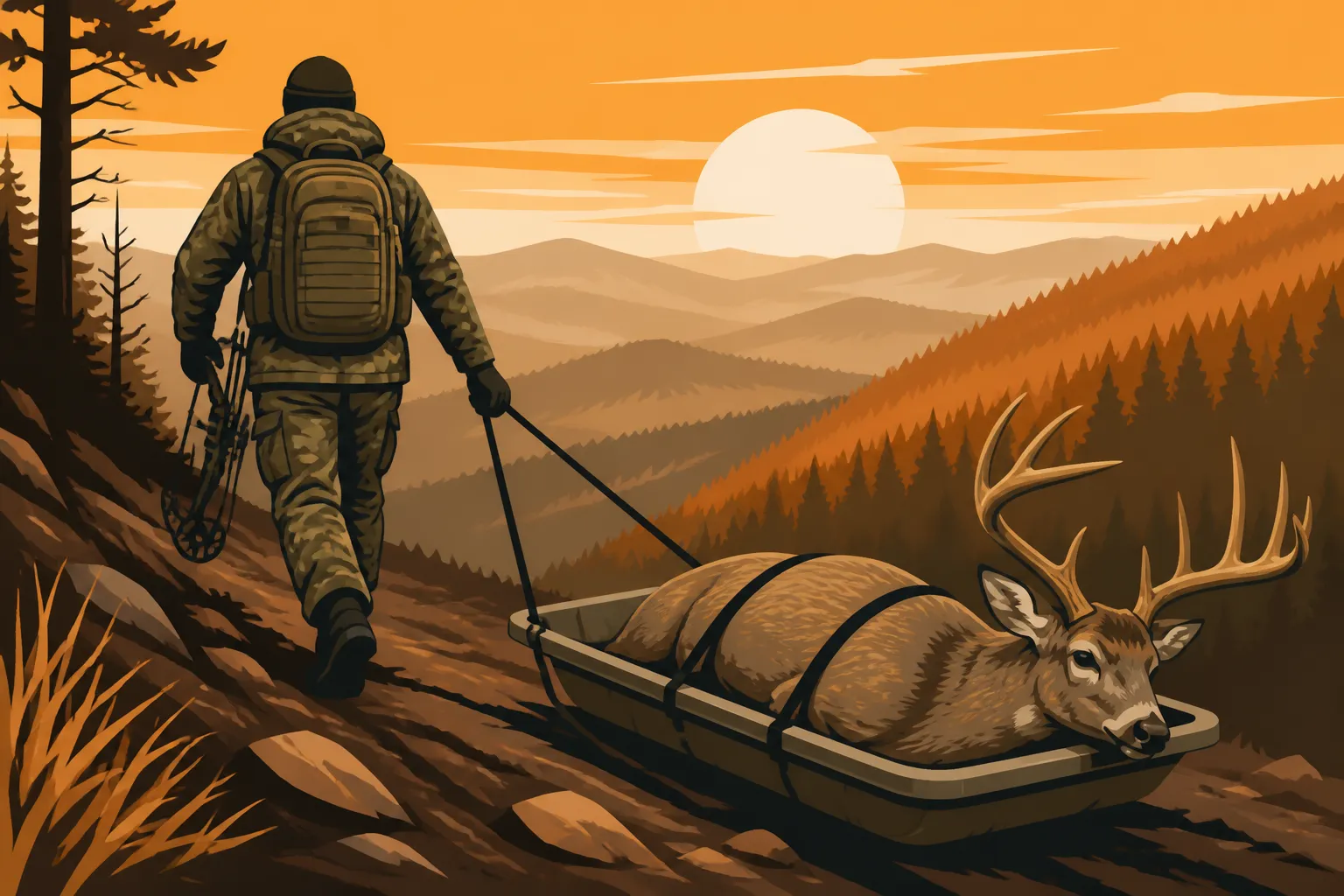
Hard-sided sleds are typically made from durable, high-density polyethylene or similar rugged plastics. These are the workhorses of game retrieval, designed to take a beating and keep on sliding. Their rigid structure means they maintain their shape, making it easier to load and secure your deer. They excel in situations where you might encounter a mix of snow, mud, or rocky ground, as the slick bottom glides over obstacles that would snag a softer drag. Many feature molded ridges or runners on the bottom to help them track straight and prevent them from spinning out on slopes. While they can be a bit bulkier to carry in to your hunting spot, their capacity to handle even larger deer, including quartered elk if you're lucky enough to draw a tag for Hunting Tennessee's Restored Elk Herd, makes them invaluable. They protect the meat from dirt, sticks, and sharp rocks, ensuring a cleaner product when you get back to camp for Butchering a Deer at Camp.
One common complaint about hard-sided sleds is their bulk. You can't exactly stuff one into your Packs for a Cherokee Forest Day Hunt. This means you typically have to carry it in separately or stash it somewhere beforehand, which isn't always feasible, especially on deep public land hunts where you're Finding Ground Others Walk Past. However, for those who hunt areas with predictable access points or can make a dedicated trip, the benefits of a hard-sided sled often outweigh this minor inconvenience. They are particularly effective when Dragging a Deer Out of a Steep Hollow, as they distribute the weight evenly and prevent the deer from snagging.
Flexible/Roll-Up Sleds: Portability and Versatility
On the other end of the spectrum are the flexible or roll-up sleds. These are often made from thinner, yet still incredibly tough, plastic or heavy-duty tarp-like material. Their primary advantage lies in their portability. Many can be folded or rolled up into a compact size, easily stashed in a backpack or lashed to the outside of your frame pack. This makes them an excellent choice for hunters who venture far from roads and need a retrieval solution that doesn't add significant bulk or weight to their kit on the way in.
While not as robust as their hard-sided counterparts, flexible sleds are surprisingly durable. They're designed to flex over uneven terrain and through dense brush, conforming to the contours of the ground rather than digging in. They still provide a slick surface to reduce friction and protect the carcass from dirt and debris. They might not handle the absolute heaviest loads as smoothly as a rigid sled, but for most Tennessee whitetails, they do an admirable job. Think about those long, winding drags through a mix of hardwoods and pines — a flexible sled can weave through tighter spots and over smaller obstacles without getting hung up as easily.
Sled Accessories: Harnesses and Ropes
A sled, no matter how good, is only as effective as the means by which you pull it. This is where quality harnesses and ropes come into play. A sturdy drag rope is essential, but pulling a heavy deer solely by hand, especially uphill or over long distances, is a recipe for quick exhaustion and potential injury. Chest or shoulder harnesses are game-changers. These allow you to use the powerful muscles of your legs and core, rather than just your arms and back, distributing the strain more efficiently.
Look for harnesses with padded shoulders and waist straps for comfort, and quick-release buckles for safety. Connecting the harness to the sled with a strong, abrasion-resistant rope is crucial. Some hunters even incorporate a short section of bungee cord or an elastic strap into the tow line. This acts as a shock absorber, smoothing out the pull and preventing jarring stops, which can be a huge relief on your body during long, strenuous drags, especially if you're Recovering a Deer From a Steep Hollow. Investing in a good harness is just as important as the sled itself, transforming a grueling task into a manageable one.
Understanding Game Retrieval Tools: Drags
Sometimes a sled isn't practical or necessary, or perhaps the terrain is too steep and unforgiving. In these situations, dedicated deer drags and other simple dragging solutions come to the forefront. These tools prioritize minimalism and direct control, which can be invaluable in certain ridge country scenarios.
Deer Drags and Harnesses
The most basic and perhaps most common game retrieval tool is the simple deer drag, often just a rope with a handle or a specialized harness that attaches directly to the deer's head or antlers. These are incredibly lightweight and compact, easily stowed in any hunting pack. For shorter drags, or when navigating extremely tight cover where a sled would constantly get hung up, a direct drag can be more efficient. The beauty of a deer drag is its simplicity – there are no moving parts to break, and it provides a direct connection to the animal, allowing for precise maneuvering around trees and rocks.
Modern deer drags often feature ergonomic handles that provide a comfortable grip, reducing strain on your hands. Some even come with integrated shoulder harnesses, similar to those used with sleds, allowing you to engage your larger muscle groups for a more powerful and less fatiguing pull. When considering a direct drag, the key is to attach it securely to the deer's head or antlers. Pulling by the front legs can work but is less efficient and can lead to the deer's head digging into the ground. Pulling by the head or neck keeps the body elevated slightly, reducing friction and making it easier to guide the animal.
Skid Plates and Protective Covers
While a direct drag is minimalist, it does expose the deer's hide and meat to the elements and terrain. This is where skid plates or protective covers can bridge the gap between a full sled and a bare drag. These are essentially reinforced pieces of durable fabric or thin plastic designed to be placed under the deer, particularly the chest and belly area, before you begin dragging. They typically have attachment points to tie them to the deer or to your drag rope.
The main benefit of a skid plate is to protect the underside of the carcass from abrasions, punctures, and dirt as you pull it over rough ground. This is especially useful in rocky areas or through thorny brush where the hide could otherwise be severely damaged, compromising the meat or making skinning more difficult. They reduce friction, making the drag easier, and keep the meat cleaner. Think of them as a localized, minimalist sled that focuses on protecting the most vulnerable parts of the animal. They are a good compromise when you want some of the benefits of a sled without the bulk, allowing you to focus on Still-Hunting Cumberland Plateau Ridges without worrying about bulky retrieval gear.
DIY Dragging Solutions
Sometimes, you find yourself in the woods with a downed deer and absolutely no dedicated retrieval gear. Necessity, as they say, is the mother of invention. Many seasoned Tennessee hunters have a few DIY tricks up their sleeve for just such occasions. The most basic involves using your belt, bootlaces, or a spare rope from your pack to fashion a crude drag harness. Tying a rope around the deer's antlers or neck and then looping it over your shoulder or around your waist can work in a pinch, though it's far less comfortable than a purpose-built harness.
Another common field expedient involves using a hunting jacket or an emergency blanket as a makeshift sled. Lay the jacket out, place the deer on it, and then tie the sleeves or corners together to create a crude pouch or bundle that you can pull. While not ideal, these methods can be lifesavers when you're caught unprepared. Always remember that prevention is better than cure: a small, roll-up flexible sled or a compact drag rope with a comfortable handle takes up minimal space and ensures you're never left entirely to the mercy of the mountainside. Before venturing out, it's wise to consider your kit, perhaps using a mapping tool like GoHunt to assess the terrain and potential drag routes, which can inform your gear choices.
| Feature | Game Sled (Hard-Sided) | Game Sled (Flexible/Roll-Up) | Deer Drag (Direct) | Skid Plate/Protective Cover |
|---|---|---|---|---|
| Portability | Bulky, less portable (carry-in often separate) | Highly portable, rolls/folds into backpack | Extremely portable, fits in pocket/pack | Portable, folds into pack |
| Durability | Very high, rigid, handles rough terrain | High, flexible, conforms to obstacles | Depends on rope/handle quality, minimal protection | High, protects carcass |
| Friction | Very low, glides easily over surfaces | Low, reduces friction significantly | Medium to High, direct contact with ground | Low, reduces friction on underside |
| Protection | Excellent, fully encases/protects carcass | Good, protects bottom and sides from debris | Minimal, carcass exposed to ground | Good, protects underside of carcass |
| Terrain | Best for varied terrain, rocky, snowy, open | Good for varied terrain, dense brush, tight spots | Best for short distances, extremely dense cover, steep | Good for rocky, brushy terrain (underneath) |
| Ease of Use | Easy to load, can be awkward to maneuver in tight spots | Easy to load, highly maneuverable | Easy to attach, requires more effort to pull | Easy to attach, used in conjunction with a drag |
| Cost | Moderate to higher | Low to moderate | Very low | Low |
Choosing the Right Tool for Tennessee Ridge Country
The choice between a sled, a drag, or a combination of both isn't always straightforward. It often comes down to a careful assessment of several factors unique to your hunt and the specific conditions of Tennessee's varied landscapes. There's no one-size-fits-all answer, so thinking through these points beforehand can make all the difference when you're standing over your hard-earned deer.
Considering Game Size and Weight
This is perhaps the most obvious factor. A hefty, mature Cumberland Plateau buck is a different proposition than a smaller antlerless deer taken during the Hunting the August Antlerless-Only Archery Hunt. For larger game, particularly those pushing well over 150 pounds field-dressed, the friction-reducing benefits of a sled become incredibly significant. A hard-sided sled can make a 200-pound deer feel like 100 pounds, while a direct drag of the same animal might feel like 300. The wider surface area of a sled distributes the weight, preventing the carcass from digging into soft ground or snagging on every root and rock.
For smaller deer, especially if you're hunting an area with relatively gentle slopes or closer access, a quality deer drag with a comfortable harness might be perfectly sufficient. If you plan to quarter your animal in the field – a common practice for very large deer or when faced with extreme distances – then a drag or a flexible sled combined with game bags will be your go-to. Remember, a larger animal means more bulk and more weight, demanding a tool that maximizes efficiency and minimizes your physical output.
Terrain Analysis and Route Planning
Before you even head into the woods, and certainly once you have a deer down, a thorough analysis of the terrain and careful route planning are paramount. This is where modern tools like GoHunt, with its topographical maps and satellite imagery, truly shine. Take the time to identify the easiest path out. It's rarely a straight line. Look for:
- Natural Funnels: Creek beds (if not too deep or rocky), old logging roads, or game trails can provide smoother, less obstructed paths.
- Contour Lines: Instead of dragging straight up or down a steep hill, look for a route that follows a gentler contour, even if it means a longer path. Zig-zagging across a slope is often far less exhausting than a direct assault.
- Obstacles: Identify dense briar patches, rockslides, or thick stands of timber and plan to go around them, even if it adds a few extra minutes. Getting hung up repeatedly is a major energy drain.
- Downed Timber: A large fallen tree can be a formidable barrier. Sometimes it's easier to lift the deer over it (especially with a partner) than to try to drag it around in thick cover.
Knowing the terrain you'll be covering will inform your choice. If it's a relatively open hardwood ridge with rolling hills, a drag might suffice. If it's a jumble of rocks, thick laurel, and steep ravines, a sled is almost a necessity. This pre-planning can save you hours of struggle and prevent you from getting into a dangerous situation, especially when navigating Wind and Thermals on a Ridge System which can make navigation tricky.
Solo Hunter vs. Group Dynamics
Hunting alone is a rewarding experience, but it significantly impacts game retrieval. As a solo hunter, you're responsible for 100% of the effort. This makes lightweight, efficient tools crucial. A flexible, roll-up sled or a very good deer drag with a chest harness becomes a priority. You simply don't have the luxury of sharing the load or having someone help clear obstacles. Field quartering might also become a more attractive option for solo hunters dealing with large animals and long distances.
If you're hunting with a group, the dynamics change dramatically. A larger, hard-sided sled becomes a viable option since two or more people can share the burden of carrying it in (or retrieving it later) and certainly the effort of pulling it out. With multiple people, you can assign roles: one person pulls the sled, another clears brush and small obstacles, and a third keeps an eye on the route and offers encouragement. Teamwork makes even the most daunting drag manageable. Deer drives on Deer Drives With Three or Four Hunters often involve a larger group, and a retrieval strategy can be pre-planned. The ability to rotate pullers or lift the deer over large obstacles is a huge advantage. Always communicate clearly, establish a pace everyone can maintain, and take frequent breaks.
Techniques for Effective Game Retrieval
Having the right gear is only half the battle; knowing how to use it effectively is the other. Smart techniques can significantly reduce the physical toll of game retrieval and ensure your precious venison arrives at camp in prime condition. It’s all about working smarter, not harder, especially after a long day chasing deer on Hunting the Tennessee Rut in Early November.
Optimizing Your Drag Route
I mentioned route planning earlier, but let's dive a bit deeper into optimizing that route once your deer is on the ground. The first thing you need to do is not rush. Take a deep breath, admire your harvest, and then spend 5-10 minutes scouting out the best path. Don't assume the way you walked in is the best way out – it rarely is when you're laden down.
Look for areas of less dense vegetation, natural depressions that offer a downhill slope, or existing game trails that might parallel your general direction. If you're using a GPS or a mapping app like GoHunt, mark your downed deer, then trace potential routes back to your vehicle, looking for contours that minimize elevation changes. Remember, gravity is your friend on the downhill, but your sworn enemy uphill. Try to find routes that leverage downhill sections as much as possible, even if it means a slightly longer overall distance. Use natural features like logging roads or old ATV trails whenever possible. Even a slightly smoother path can save enormous effort over a long drag.
Teamwork and Communication
If you're lucky enough to be hunting with a partner or a group, leverage that collective strength. When dragging, one person can take the lead, pulling the sled or deer directly. The second person can be positioned behind the deer, pushing or lifting when needed, especially over logs, rocks, or through thick brush. This rear position is also excellent for guiding the deer, preventing it from snagging on trees or veering off course.
Constant communication is key. Call out obstacles, signal when you need a break, and encourage each other. Establish a cadence – a steady, rhythmic pull and pause – that everyone can maintain. If you have three or more people, you can rotate the lead pulling position, giving everyone a chance to rest their primary pulling muscles. This also allows one person to scout ahead or clear the path. Remember, an efficient drag is a coordinated effort. Don't be afraid to take a five-minute water break every quarter-mile, especially on those warm early season days, to prevent total exhaustion.
Field Dressing for Easier Transport
Proper field dressing isn't just about preserving the meat; it's also a crucial step in making the animal significantly easier to transport. Removing the internal organs (gutting) immediately reduces the deer's weight by a considerable margin – often 20-30% of its live weight. This weight reduction directly translates to less effort required for dragging or sledding. When Field Dressing a Deer in Cold Weather, the organs also retain a lot of heat, so removing them quickly aids in cooling the carcass, which is essential for meat quality.
Beyond just gutting, there are other strategies. If you're faced with an exceptionally large deer, extreme distances, or very rough terrain, consider the "gutless method" or quartering the animal in the field. The gutless method involves removing the meat from the deer without gutting it, then packing out the quarters and backstraps in game bags. This is often the preferred method for backpack hunters or when dealing with an elk or a very large bear. While it takes more time and skill upfront, packing out boned-out meat in a frame pack is often far less strenuous and safer than dragging a whole animal for miles over challenging terrain. Make sure you understand Deboning Venison Before Leaving the CWD Zone if you are hunting in one of those areas.
Safety and Preparation for Retrieval
Game retrieval is physically demanding, and it's easy to push your limits, especially after the adrenaline of a successful hunt wears off. Prioritizing safety and thorough preparation can prevent accidents, injuries, and even dangerous situations in the backcountry.
Physical Conditioning and Hydration
Let's be real: hunting Tennessee's ridge country is a workout in itself. But dragging a deer out amplifies that tenfold. Being in reasonably good physical condition before the season starts is not just about making the hunt more enjoyable; it's a critical safety measure for retrieval. Regular exercise, particularly focusing on leg and core strength, can make a huge difference. You don't need to be a marathon runner, but some consistent physical activity will pay dividends.
Equally important is staying hydrated throughout your hunt. Even on cooler days, you're expending energy and losing fluids. Carry plenty of water, and if you're planning a multi-day hunt, consider a water filter or purification tablets. Dehydration can lead to fatigue, muscle cramps, impaired judgment, and even heatstroke, all of which are dangerous when you're hours deep in the woods with a heavy load. Pack some high-energy snacks too – jerky, granola bars, nuts – to replenish your fuel stores during breaks.
Emergency Gear and Communication
No matter how prepared you think you are, unexpected things can happen. A twisted ankle, a sudden storm, or getting disoriented in unfamiliar terrain can quickly turn a successful retrieval into an emergency. Always carry essential emergency gear, especially if you're venturing into remote areas like the Cherokee National Forest.
This includes:
- First Aid Kit: A comprehensive kit for treating cuts, blisters, sprains, and other common hunting injuries. Consider a more robust First Aid Kits for Remote Cherokee Forest Ground for longer trips.
- Navigation Tools: Beyond your phone (which might lose service or run out of battery), carry a physical map and compass, and know how to use them. A handheld GPS unit is also a reliable backup.
- Illumination: A headlamp with spare batteries is non-negotiable, especially if you anticipate finishing your drag after dark.
- Fire Starter: Waterproof matches, a lighter, or a ferro rod can be crucial for warmth and signaling in an emergency.
- Whistle: For signaling if you get separated from partners or need to alert others to your location.
- Communication Device: A fully charged cell phone is a start, but if you're in an area with spotty service, consider a satellite messenger or a two-way radio to stay in contact.
Always tell someone your hunting plan, including where you'll be, your expected return time, and who to contact if you don't check in. This simple step can literally save your life if something goes wrong.
Respecting Private Property Boundaries
While much of Tennessee's ridge country offers extensive public hunting opportunities, private land often borders these areas. It's critical to know and respect these boundaries, not only to avoid legal trouble but also to maintain a positive public image for hunters. Before you embark on your retrieval, confirm your location using a reliable mapping tool like GoHunt or onX. If your downed deer is near or on private land, you must obtain permission from the landowner before crossing their property line, even just to retrieve game.
Retrieving game from private property without permission is trespassing and can lead to fines, loss of hunting privileges, and even confiscation of your game and equipment. It's a frustrating situation to be in, but approaching landowners respectfully and explaining your predicament can often lead to a favorable outcome. It's a good practice to scout the area beforehand and identify potential private land boundaries, especially if you're Scouting Tennessee Public Land Before Season, so you're not caught by surprise after the shot. Always err on the side of caution and gain permission if there's any doubt about where your deer has fallen.
Disclaimer
This article is for general informational purposes only and does not constitute professional advice. Laws, prices and regulations vary by location and change over time. Consult a qualified professional for guidance on your specific situation.