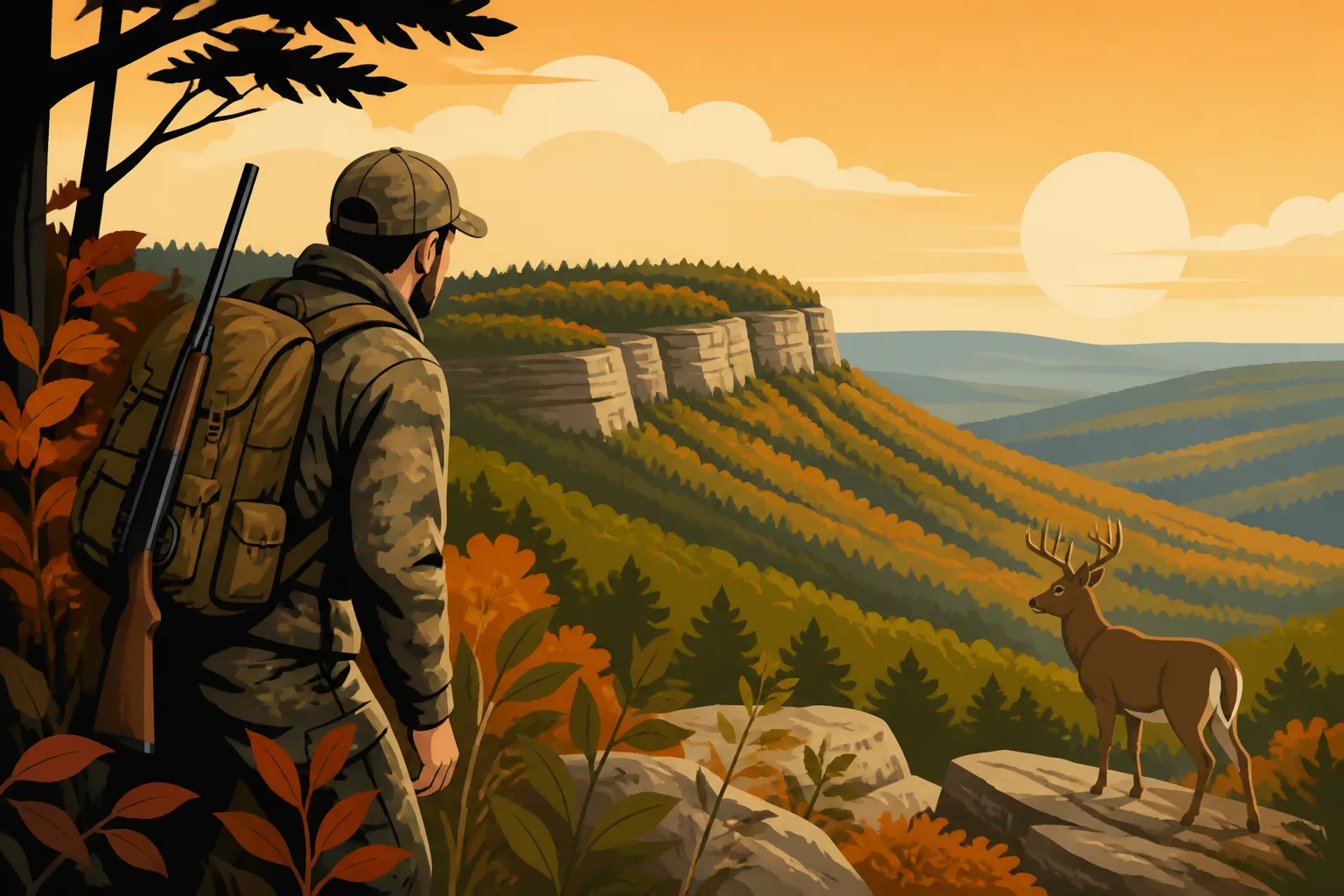
Still-Hunting Cumberland Plateau Ridges
It’s a familiar frustration for many Tennessee hunters: you’re on the Cumberland Plateau, surrounded by big timber and endless ridges, and you know deer are there, but how do you effectively hunt them without spooking everything in a square mile? Still-hunting these expansive, often rugged areas can feel like searching for a needle in a haystack, especially when you factor in swirling winds and the sheer amount of ground to cover. This comprehensive guide is designed to peel back the layers of mystery around still-hunting the Cumberland Plateau, offering practical, boots-on-the-ground strategies to increase your chances of success.
Understanding the Cumberland Plateau's Unique Challenges for Still-Hunters
The Cumberland Plateau isn't like the flat agricultural lands of West Tennessee or the dense suburban woodlots. It's a vast, diverse landscape that demands a specific approach from still-hunters. Ignoring its unique characteristics will quickly lead to empty game bags and frustrated treks back to the truck.
The Rugged Terrain and Its Demands
Let's be honest, hunting the Cumberland Plateau is a workout. You're dealing with elevation changes, rocky outcrops, steep ravines, and often, an understory that varies from open woods to thick, thorny hell-holes. This isn't a stroll in the park; it's a grind. The ground itself is often covered in crunchy leaf litter, especially after a dry spell, making silent movement a supreme challenge. Many hunters resort to sitting in a stand simply because the thought of moving quietly through this terrain feels impossible. However, those willing to put in the effort and adapt their technique can unlock vast tracts of public land that stationary hunters rarely touch. Think about the sheer scale of places like Catoosa Wildlife Management Area or Royal Blue WMA; these aren't small woodlots. They require covering ground, but doing so intelligently.
Beyond the physical demands, the terrain dictates deer movement in profound ways. Deer often use the contours of the land for travel and concealment. They’ll follow benches that wrap around hillsides, drop into deep draws to cross from one ridge to another, and bed on points that offer commanding views. Understanding these predictable travel patterns, often influenced by the easiest path of resistance or the best thermal advantages, is key to success here. Your still-hunting strategy needs to be as dynamic as the landscape itself.
Reading the Ridge Systems for Deer Movement
The Cumberland Plateau is defined by its extensive ridge and valley systems. A ridge isn't just a simple high spot; it's a complex network of features that deer utilize daily. You’ve got primary ridges, secondary spurs, saddles, benches, and draws, all interconnected. The trick is to learn how deer interpret and use these features for feeding, bedding, and travel. For instance, a flat bench half-way down a steep ridge offers a perfect bedding spot, providing shelter and an escape route down or across. Saddles, the low points between two higher elevations on a ridge, are notorious travel corridors, naturally funneling deer through them.
Learning to Reading a Ridge for East Tennessee Deer involves more than just looking at a topo map; it's about interpreting how sunlight, wind, and vegetation interact with the terrain to create prime deer habitat. A good mapping app, like one that integrates with GoHunt data, can become your best friend here, allowing you to identify these micro-features even before you step foot in the woods. Look for where several terrain features converge, such as a bench intersecting a draw that leads to a saddle. These are high-percentage areas where you can slow down even further, observing meticulously before taking another step.
Mastering the Art of Silent Movement
Still-hunting is about more than just walking slowly; it's an art form that blends deliberate movement with intense observation. You’re not just looking for deer; you’re looking for sign, for nervous flicks of an ear, for the subtle outline of a deer through the trees before it sees you.
Cadence and Observation
The biggest mistake most aspiring still-hunters make is moving too fast. We're often conditioned to cover ground, especially on large public tracts. But still-hunting requires a complete paradigm shift. Imagine this: you take five slow, deliberate steps, then stop. For the next two to five minutes, you become a statue, scanning every direction, slowly turning your head, and using your binoculars. Then, repeat. This "stop-and-go" cadence allows you to detect deer that are either bedded, feeding, or moving slowly themselves. It also gives any nearby deer time to settle down if they heard your previous steps.
Focus your observation on areas where deer might logically be: thickets, drainages, the edges of clear-cuts, or areas with good mast crops. Pay attention to changes in cover and elevation. Often, the deer you see while still-hunting aren't the ones you actively look for, but the ones you spot out of your peripheral vision, or after you've been still for long enough for them to relax and move. It's during these extended pauses that your eyes start to pick up details – a horizontal line in a vertical forest, a patch of brown that isn't bark, or the subtle twitch of a tail. This patient approach is critical to success.
Gear for Stealth
Your gear selection can make or break a still-hunt. Every item you carry, from your backpack to your boots, needs to be evaluated for its noise potential.
- Clothing: Layers are crucial for temperature regulation, but they must be quiet. Avoid noisy synthetics. Wool or fleece are excellent choices for their warmth-to-weight ratio and quietness. Ensure your outer layer can shed burrs and stickers without making a racket. Brands like Sitka Gear and Kuiu offer specialized quiet fabrics, but even budget-friendly fleece from local sporting goods stores can work well.
- Boots: Footwear is paramount. You need boots that offer good ankle support for the uneven terrain but are also flexible enough to allow you to "feel" the ground beneath your feet. A stiffer, heavy-duty boot might be great for extreme conditions, but it often hinders silent movement. Look for a boot with a soft, quiet sole that still provides traction. If you want to know more about specialized footwear for the terrain, consider checking out this guide on Boots for Walking Tennessee Ridges.
- Backpack: Keep it minimal. A lightweight daypack with only essentials is ideal. Make sure zippers don't jingle and any loose items inside are secured to prevent rattling. Consider using silencers on zipper pulls.
- Optics: Binoculars are essential for scanning. Choose a pair with good low-light performance and a comfortable harness to keep them secure and quiet against your chest. A good rangefinder can also be helpful for confirming distances, especially if you get a shot opportunity.
- Weapon: Whether it's a rifle, shotgun, or bow, ensure slings don't squeak, and any accessories are tightly secured. For archers, quiver placement is vital; some prefer a detachable quiver for stalking, carrying arrows in a quiet pocket or backpack sleeve.
Using a platform like GoHunt to scout areas virtually can also help you identify thick bedding areas or travel corridors where silence is even more critical. Knowing what you're walking into allows you to adjust your gear and pace accordingly.
| Still-Hunting Pace | Movement Duration | Observation Duration | Scenario | Best Use |
|---|---|---|---|---|
| Ultra Slow | 5-10 seconds | 3-5 minutes | Entering bedding areas, thick cover | High-pressure zones, searching for bedded deer |
| Slow | 15-30 seconds | 1-2 minutes | Open timber, following subtle sign | Cruising for feeding deer, covering ground slowly |
| Moderate | 30-60 seconds | 30-60 seconds | Moving between known high-traffic areas | Quickly getting to a hotspot, less precise observation |
Note: These are general guidelines. Adjust your pace constantly based on terrain, cover, wind, and deer sign.
Decoding Deer Sign on Cumberland Ridges
Still-hunting isn't just about moving quietly; it's about moving intelligently. This means constantly reading the story the deer leave behind on the landscape. The Cumberland Plateau is a vast puzzle, and deer sign provides the clues to their daily lives.
Fresh Tracks and Rub Lines
As you move, keep your eyes peeled for fresh tracks. On the sometimes-rocky, leaf-covered ground of the Plateau, tracks can be harder to find than in softer soil, but drainages, creek beds, and muddy seeps will often reveal them. Look not just for individual tracks, but for well-used trails, especially those paralleling a ridge line or crossing a saddle. Freshness is key: look for sharp edges, minimal leaf litter inside the track, and any accompanying droppings or disturbed vegetation. Tracking a specific deer can be incredibly effective, but it demands extreme patience and focus.
Rub lines, particularly during the pre-rut and rut, are like neon signs announcing a buck's presence and travel patterns. Bucks will rub trees along primary travel routes, often on the downwind side of ridges or just off the crest. A cluster of fresh rubs, especially if they’re on larger trees, indicates a buck that’s frequently passing through. Follow the direction of the rubs to understand his preferred path. You might find a single rub line extending for hundreds of yards or a cluster of rubs in a specific area where a buck is spending time. Pay close attention to the height of the rubs too; higher rubs often indicate a more mature deer. For more information on deer movement during this critical time, check out Hunting the Rut in Early November.
Bedding Areas and Escape Routes
Locating bedding areas is paramount for still-hunting success, especially on the Plateau where deer often bed high to maximize their senses. Deer bed in places that offer them cover, warmth/coolness, and, most importantly, security. On the Cumberland Plateau, this often means thickets on southern-facing slopes for warmth in winter, or northern slopes with dense cover in warmer weather. Ridge points, benches, and thick cedar groves are classic Where Cumberland Plateau Bucks Bed.
When still-hunting, approach potential bedding areas from a downwind or crosswind direction, moving at your slowest pace. Look for oval depressions in the leaves, often with some droppings nearby. If you jump a deer from its bed, try to observe its escape route. Deer usually have a preferred escape path, often utilizing thick cover or a quick drop into a steep hollow. Understanding these routes can help you intercept them on future hunts or even, with careful planning, predict where a jumped deer might pause if you're quick and quiet enough to circle ahead. The idea is to predict their movement, not react to it. Mapping tools, like those found with GoHunt, can assist in identifying these potential bedding areas and planning your approach and escape routes.
The Critical Role of Wind and Thermals
If there's one factor that can absolutely make or break your still-hunt on the Cumberland Plateau, it's understanding and utilizing the wind and thermals. The rolling terrain creates complex air currents that can quickly betray your presence, even to the most relaxed deer.
Morning and Evening Thermal Shifts
Thermals are essentially air currents that rise and fall with temperature changes. In the morning, as the sun warms the earth, air begins to rise, carrying your scent up the slopes. This means if you're still-hunting uphill in the morning, your scent will likely be carried ahead of you and above any deer you're trying to sneak up on. Conversely, in the evening, as the air cools, it sinks down the slopes, carrying your scent downhill.
Understanding these shifts is vital for planning your route. In the morning, you generally want to still-hunt down a ridge or slope, letting your scent be carried below you. In the evening, you want to still-hunt up the ridge, as your scent will be carried above. However, the Cumberland Plateau's steep hollows and draws can create localized swirling thermals, especially at dawn and dusk. It’s never a perfect science, which is why constantly monitoring the wind with a wind checker is crucial. Don't just assume the wind is doing what it's "supposed" to do.
Playing the Wind on the Ridge
Beyond thermals, the prevailing wind is your constant companion and adversary. On broad, open ridge tops, the wind might be fairly consistent. However, as soon as you drop into a saddle, cross a point, or enter a deep draw, the wind can swirl unpredictably. This is where most hunters get busted. The wind might be hitting the face of a ridge, splitting, and creating eddies in a ravine.
When still-hunting, always try to keep the wind in your favor – coming from the deer towards you. This often means making wide arcs to stay on the downwind side of prime deer habitat or constantly adjusting your direction of travel. Never, ever hunt with the wind at your back on a still-hunt. If the wind is constantly swirling, you might need to adjust your strategy to focus on areas where the wind is more consistent or move at an even slower, more observational pace. A little puff bottle or milkweed seeds are invaluable tools to test the wind every few minutes. For a deeper dive into these complex air currents, you might want to read Wind and Thermals on a Ridge System.
Strategic Approaches to Still-Hunting Specific Features
The Cumberland Plateau isn't homogenous. It's a patchwork of diverse terrain features, each requiring a slightly different still-hunting approach. Recognizing and adapting to these features is what separates an average still-hunter from a consistently successful one.
Working Saddles and Funnels
Saddles are natural low points on a ridge line, creating easy travel corridors for deer. They are essentially funnels, concentrating deer movement between two higher points. This makes them prime locations for still-hunting, but also high-pressure areas where deer are often more alert. When approaching a saddle, assume deer are already there or will be moving through it. Approach slowly, utilizing cover, and take extra time to observe before exposing yourself.
Deer will often move through saddles to access different feeding areas or to cross from one bedding ridge to another. Look for heavy trails, fresh scrapes, and rubs within and around the saddle. These areas often have varied vegetation, providing both cover and food sources. Because of the concentrated movement, still-hunting through a saddle often requires an even slower cadence, with more prolonged periods of observation. Consider how you can use the topography around the saddle to your advantage, perhaps approaching from a lower bench that offers a crosswind advantage, or using a finger ridge to keep your outline broken. Learning to Hunting a Ridge-Top Saddle for Rutting Bucks can greatly improve your success here.
Hunting Ridge Points and Benches
Ridge points are protrusions from the main ridge line, often offering commanding views into the valleys below. Deer love to bed on these points, especially during the middle of the day, as they can monitor their downwind side and see anything approaching from below. When still-hunting a ridge point, approach from the upwind or crosswind side, slowly cresting or moving around the point's edge. Look for thick cover, downed trees, or areas where sunlight penetrates in cooler weather.
Benches are flat or relatively flat sections that run horizontally along a hillside. They can be narrow or wide, and deer use them extensively for travel and feeding. Benches provide easier walking than the steep slopes above or below, making them natural deer highways. They are also prime spots for secondary bedding areas, especially if there's good cover or a break in the terrain. When still-hunting a bench, move parallel to it, constantly scanning the terrain above and below. Deer might be bedded just off the bench, or traveling along it. These areas can sometimes be more open, demanding even greater attention to your movement and concealment. Remember to scout these areas for historical sign. Using tools like GoHunt, you can analyze topographical maps to identify these benches and plan your approach. This type of Scouting Tennessee Public Land Before Season is invaluable.
Adapting to Pressure and Seasonal Changes
The Cumberland Plateau, particularly its public lands, sees its fair share of hunting pressure. Successful still-hunting means not only understanding deer but also understanding other hunters and how they influence deer behavior. Furthermore, deer patterns shift dramatically with the changing seasons, demanding constant adaptation from the still-hunter.
Dealing with Public Land Hunter Traffic
Public land pressure is a real concern on the Cumberland Plateau. Opening weekend of gun season, in particular, can feel like a deer drive across the entire WMA. The key to still-hunting success in these conditions is to anticipate where other hunters will go and, more importantly, where they won't go. Most hunters stick to established trails, logging roads, and easily accessible ridge tops. This means the deer, pushed by this pressure, will often retreat into the thickest, nastiest, steepest, and most inaccessible cover.
This is where still-hunting truly shines. Instead of joining the crowds, target those ignored areas: a deep, steep hollow between two popular ridges, a gnarly clear-cut, or a dense laurel thicket on a north-facing slope. These are the sanctuaries deer retreat to. Your job is to slowly, quietly, and meticulously work these areas. You might not cover much ground, but the ground you do cover will have a higher concentration of pressured deer. This often means walking an extra mile or two, navigating dense tangles, and earning every step. For strategies on how to do this effectively, look into Finding Ground Others Walk Past.
Late-Season Food Sources and Cover
As the season progresses from early archery through muzzleloader and into the late gun season, deer patterns change significantly, driven primarily by food availability and thermal cover. Early in the season, deer are often spread out, keying in on soft mast like persimmons and hard mast like acorns. Still-hunting then involves slowly working through areas with good mast crops.
By late season, most of the preferred mast is gone, and deer shift their focus to remaining green browse, honeysuckle thickets, or agricultural food sources if available near the edges of the Plateau. They also prioritize thermal cover in colder weather, bedding in thick evergreen stands like cedars or pines, or on sunny, south-facing slopes. Still-hunting in late season means adjusting your focus to these specific food and cover types. You might still-hunt a dense cedar thicket from one end to the other, or slowly pick apart a steep, sunny hillside where deer are soaking up warmth. Knowing Late-Season Food Sources for Tennessee Whitetails becomes incredibly important for identifying these hotspots. The deer are conserving energy, so they're often not moving far; your slow, deliberate approach can catch them off guard.
Still-Hunting Movement and Observation Guide
This table outlines a general guideline for adjusting your still-hunting tactics based on the type of cover and deer activity you anticipate on the Cumberland Plateau.
| Cover Type / Terrain Feature | Still-Hunting Pace | Observation Focus | Key Considerations |
|---|---|---|---|
| Open Timber (Ridge Tops) | Slow to Moderate | Distant movement, horizontal lines, ear flickers | Maintain silent foot placement; long pauses are critical |
| Thick Brush / Clear-Cuts | Ultra Slow | Immediate surroundings, individual branches, shadows | Listen for subtle sounds; be ready for close encounters |
| Saddles / Funnels | Ultra Slow | Trails, fresh sign, approaching deer | Wind swirls are common; expect alert deer |
| Benches / Terraces | Slow | Deer bedded above/below, trails along bench | Movement parallel to contour; check wind constantly |
| Steep Hollows / Draws | Ultra Slow | Beds, escape routes, concentrated sign | Thermals are unpredictable; extreme caution with wind |
| Bedding Areas | Crawl (Extremely Slow) | Deer body parts, subtle movements, sounds | Maximize cover; anticipate quick shots; approach downwind |
Disclaimer
Hunting is an inherently dangerous activity. Always prioritize safety, wear appropriate blaze orange as required, and be absolutely certain of your target and what lies beyond it. This guide provides information for educational purposes and is not a substitute for proper hunter education, local regulations, or personal judgment. Always consult the latest Tennessee Wildlife Resources Agency (TWRA) regulations before hunting.