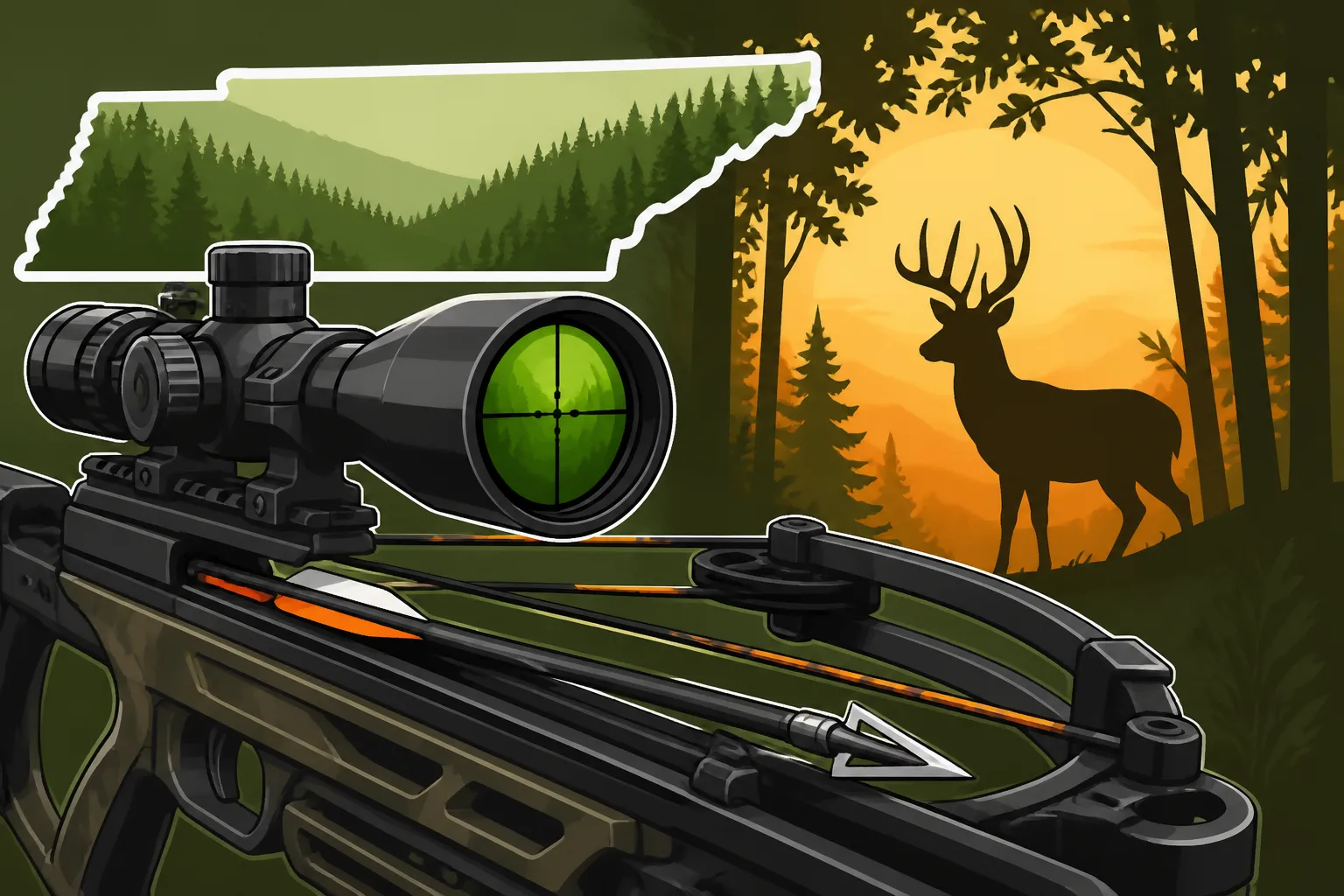
Crossbow Scopes for Tennessee Timber Ranges
Navigating the dense, often shadowy timber of Tennessee with a crossbow can feel like a game of hide-and-seek, especially when you're trying to pick out a deer at legal shooting light. The low light, thick undergrowth, and unpredictable shot distances present unique challenges that can quickly turn a promising hunt into a frustrating missed opportunity. This guide will walk you through what truly matters in a crossbow scope when you're hunting Tennessee's woods, helping you find that perfect balance of clarity, durability, and practical features to make your next timber hunt a success.
Understanding the Unique Challenges of Tennessee Timber
Hunting in Tennessee's timbered regions, whether it's the steep ridges of the Cumberland Plateau or the river bottoms of West Tennessee, demands a specific approach to your gear. It's not like hunting open fields where long-range visibility is king. Here, the challenge is often much closer and much more about dealing with obstacles and fleeting light.
Variable Light Conditions and Dense Canopy
If you've spent any time deep in a Tennessee hardwood forest, you know how quickly the light can change. Even on a bright, sunny afternoon, step under the dense canopy of oaks and hickories, and it can feel like dusk. This is especially true in places like the Cherokee National Forest, where towering pines and mature hardwoods create a perpetual twilight. You might be watching a scrape line or a deer trail, and suddenly a deer steps out of the shadows, almost invisible against the dark timber.
The frustration is real when you can see the deer with your naked eye, but your scope presents a dark, muddled image, making it impossible to confidently place your shot. Or worse, your reticle disappears into the background. This variable light isn't just about dawn and dusk; it's a factor throughout the day, as clouds roll in, or you transition from a sun-drenched ridge to a deep, shaded hollow. A good scope for Tennessee timber needs to be a light-gathering machine to cut through these challenging conditions.
Close to Mid-Range Shots with Obstructions
Unlike wide-open Western hunts, most crossbow shots in Tennessee's timber are going to be on the shorter side – often well within 40 yards, and frequently much closer, sometimes under 20. The terrain itself, full of thick brush, saplings, and mature tree trunks, means you rarely get a perfectly clear, unobstructed shot lane beyond these distances. It's not uncommon to have a deer come through at 15 yards, presenting a shot that requires quick thinking and even quicker target acquisition.
The key here isn't necessarily extreme long-range precision, but rather the ability to quickly pick up your target, differentiate it from the busy background, and precisely place your shot through small windows in the cover. You don't want a scope that's so powerful it turns the entire timber stand into a blur of green and brown, making it hard to see the deer for the trees, quite literally. This environment also means your gear will get bumped and scraped. It needs to be tough enough to handle an accidental brush against a tree limb or a fall from a stand.
Key Features to Look For in a Crossbow Scope for Timber
When you're trying to outfit your crossbow for the demands of Tennessee's timber, focusing on specific scope features will make all the difference. It's about optimizing for clarity, speed, and reliability in a challenging environment.
Magnification and Field of View
For timber hunting, less is often more when it comes to magnification. A high-power rifle scope designed for 300-yard shots will only hinder you in the thick woods. You'll struggle to find your target quickly, and the limited field of view will make tracking a moving deer nearly impossible. Imagine a buck slipping through a thicket at 20 yards – trying to find him in a 9x scope can feel like looking through a straw.
Instead, look for scopes with a lower maximum magnification, typically in the 1-5x or 2-7x range. The lower end of that range, like 1x or 2x, is fantastic for quick shots on close-range, moving deer, giving you a wider picture of the surroundings. A wider field of view means you can see more of the environment around your target, which helps immensely with target acquisition, especially when a deer pops out unexpectedly from behind a thick pine. This broad perspective also makes it easier to Read Aerial Photos for Cumberland Plateau Deer to anticipate movement.
Reticle Type and Illumination
The reticle is your aiming point, and in the dynamic conditions of Tennessee timber, it's incredibly important. Most crossbow-specific scopes come with some form of BDC (Bullet Drop Compensator) or multi-line reticle. These are designed with multiple aiming points to account for the bolt's drop at various distances (e.g., 20, 30, 40, 50 yards). This eliminates the guesswork of holding over or under, which is critical when a shot presents itself quickly and you don't have time to range.
Even more critical for timber hunting is reticle illumination. Picture this: a big bodied deer steps into a deep shadow at last light, and your black reticle simply disappears against its dark hide or the shadowy woods. You know it's there, but you can't aim. An illuminated reticle, typically red or green, solves this problem entirely. It provides a bright, crisp aiming point that stands out against any background, allowing for confident shot placement even in the dimmest conditions. Look for scopes with adjustable brightness settings, so you can dial it down in low light to prevent washout or crank it up on a bright day. This feature directly addresses the challenge of Low-Light Performance in a Scope.
Objective Lens Size and Light Transmission
The objective lens is the front lens of your scope, and its size directly impacts how much light the scope can gather. In the low-light world of Tennessee timber, a larger objective lens (think 32mm, 40mm, or even 50mm) can be a real game-changer. More light gathering means a brighter, clearer image, helping you discern details in those deep shadows that smaller lenses simply can't resolve.
Beyond size, the quality of the glass and the lens coatings are paramount. High-quality, multi-coated lenses reduce glare, improve contrast, and maximize light transmission. Cheaper scopes might have smaller, uncoated lenses that make the image appear dim and washed out, precisely when you need it to be bright and sharp. Investing in good glass is one of the best ways to improve your visibility in the woods, especially when trying to pick out a deer against a dark backdrop in a Hunting a Funnel Between Two Bottoms.
Durability and Weatherproofing
Tennessee weather is notoriously unpredictable. One minute it's clear, the next a pop-up thunderstorm rolls through, or a cold, misty rain settles in for the day. Your scope needs to be able to handle it all. Look for models that are unequivocally fogproof, waterproof, and shockproof. Fogging lenses are a quick way to ruin a hunt, and water intrusion can permanently damage your optics.
A good scope will be nitrogen-purged or argon-purged to prevent internal fogging, and O-ring sealed to keep moisture out. Shockproofing means the internal components can withstand the recoil of the crossbow and the inevitable bumps and knocks that come with traversing rugged terrain or climbing into a Treestand Setups in Cherokee National Forest. A robust, well-built scope made with quality materials ensures it maintains its zero and optical performance even after being jostled on a long walk into your stand or accidentally bumped against a tree.
Practical Considerations and Setup Tips
Having the right scope is just one piece of the puzzle. How you mount it, sight it in, and integrate it with your overall hunting strategy will determine its true effectiveness in Tennessee's timber.
Mounts and Rings for Optimal Performance
Even the best scope won't perform if it's not mounted correctly. For crossbows, sturdy, reliable mounts and rings are essential. They don't need to break the bank, but they do need to be robust enough to hold zero through bumps, crossbow recoil, and handling. Cheap, flimsy rings can lead to frustrating accuracy issues, causing your point of impact to shift unpredictably.
Pay attention to proper eye relief – the distance your eye needs to be from the scope to see a full, clear image. Too close, and you risk getting hit during recoil; too far, and you'll struggle to quickly acquire a sight picture. Also consider the height of your scope. It should be comfortable for you to shoulder your crossbow and quickly bring the reticle to your eye without straining your neck. Some hunters prefer quick-detach mounts, allowing them to easily remove the scope for transport or to swap it out if needed, though for a dedicated timber setup, a solid, permanently mounted option is often preferred for consistency. Remember, checking your zero frequently after transport, especially if you're traveling across the state to Hunting West Tennessee River Bottoms, is always a smart move.
Sighting In and Practice at Realistic Ranges
Once your scope is mounted, the real work begins: sighting it in. While it might be tempting to sight in your crossbow at maximum range, for timber hunting, focus on the distances you'll actually be shooting. Most multi-reticle crossbow scopes will have a primary zero (often 20 yards) and then subsequent hash marks for 30, 40, and 50 yards. Make sure these are meticulously sighted in.
Practicing from realistic hunting positions is crucial. Don't just shoot from a bench rest. Practice shooting while sitting, kneeling, or even standing, simulating shots you might take from a ground blind or a treestand. Practice aiming through small gaps, just as you would when Hunting a Clear-Cut Regrowth Edge. This helps build muscle memory and confidence. Understand your crossbow's trajectory and your scope's reticle system intimately. Knowing that your 40-yard pin is dead on after shooting through various weather conditions will give you the confidence needed for that critical moment. While some people might choose a vertical bow, many Tennessee hunters appreciate the Crossbow Versus Vertical Bow in Tennessee for its ease of use in cold weather or awkward positions.
Leveraging Technology: Rangefinding Scopes and Apps
While traditional scopes are perfectly viable, technological advancements offer interesting options. Integrated rangefinding scopes combine a rangefinder and scope into one unit, giving you precise distance readings directly in your reticle. These can be pricey, but they streamline your setup and reduce the amount of gear you need to carry. For those who prefer a separate unit, a quality rangefinder is still an indispensable tool for confirming distances, especially if you're not using a multi-reticle scope. Even if your scope has multiple aiming points, a rangefinder helps confirm which one to use. Rangefinders Under 100 Yards are particularly useful in the close-quarters timber.
Beyond physical gear, digital tools can also enhance your timber hunting strategy. Apps like GoHunt offer detailed mapping layers, allowing you to scout potential hunting locations virtually, mark key terrain features, and even pre-range specific spots from your intended stand location. This means before you even step foot in the woods, you can use GoHunt to identify a bottleneck or a good bedding area on Finding Ground Others Walk Past and know the approximate distances to various shooting lanes from where you plan to hang your stand. This preparation can save you precious moments when a deer finally appears. Crossbows Under Tennessee Rules are generally permitted during the archery season, so these scouting tools are just as relevant.
Here's a quick comparison of some common crossbow scope features for timber hunting:
| Feature | Ideal for Timber | Why it Matters | Considerations |
|---|---|---|---|
| Magnification | Low (1-5x or 2-7x variable) | Wide field of view for quick target acquisition; less "tunnel vision" | Too high zoom makes finding targets difficult at close range or in dense cover |
| Objective Lens | 32mm – 40mm (or larger if light gathering is paramount) | Gathers more light for brighter image in dim timber; improved low-light performance | Larger objectives can be bulkier but worth it for clarity |
| Reticle Type | BDC (multiple aim points) or specific crossbow reticles | Eliminates guesswork for varying distances; matched to bolt trajectory | Ensure it matches your crossbow's speed for accurate holdovers |
| Illumination | Red/Green illuminated reticle with adjustable brightness | Critical for visibility in deep shadows or at dawn/dusk; stands out against dark backgrounds | Cheap illumination can "wash out" in very low light; check battery life |
| Durability | Fogproof (nitrogen/argon purged), Waterproof (O-ring sealed), Shockproof | Withstands harsh Tennessee weather, bumps, and recoil; maintains zero | Investing in quality construction prevents common failures in the field |
| Eye Relief | Generous (3-4 inches or more) | Prevents scope bite; allows for quick head placement and comfortable shooting | Too short can be dangerous; too long can make it hard to get a full sight picture |
No matter which scope you choose, remember that practice and knowing your equipment inside and out are your best allies in the Tennessee timber.
Disclaimer
This article is for general informational purposes only and does not constitute professional advice. Laws, prices and regulations vary by location and change over time. Consult a qualified professional for guidance on your specific situation.