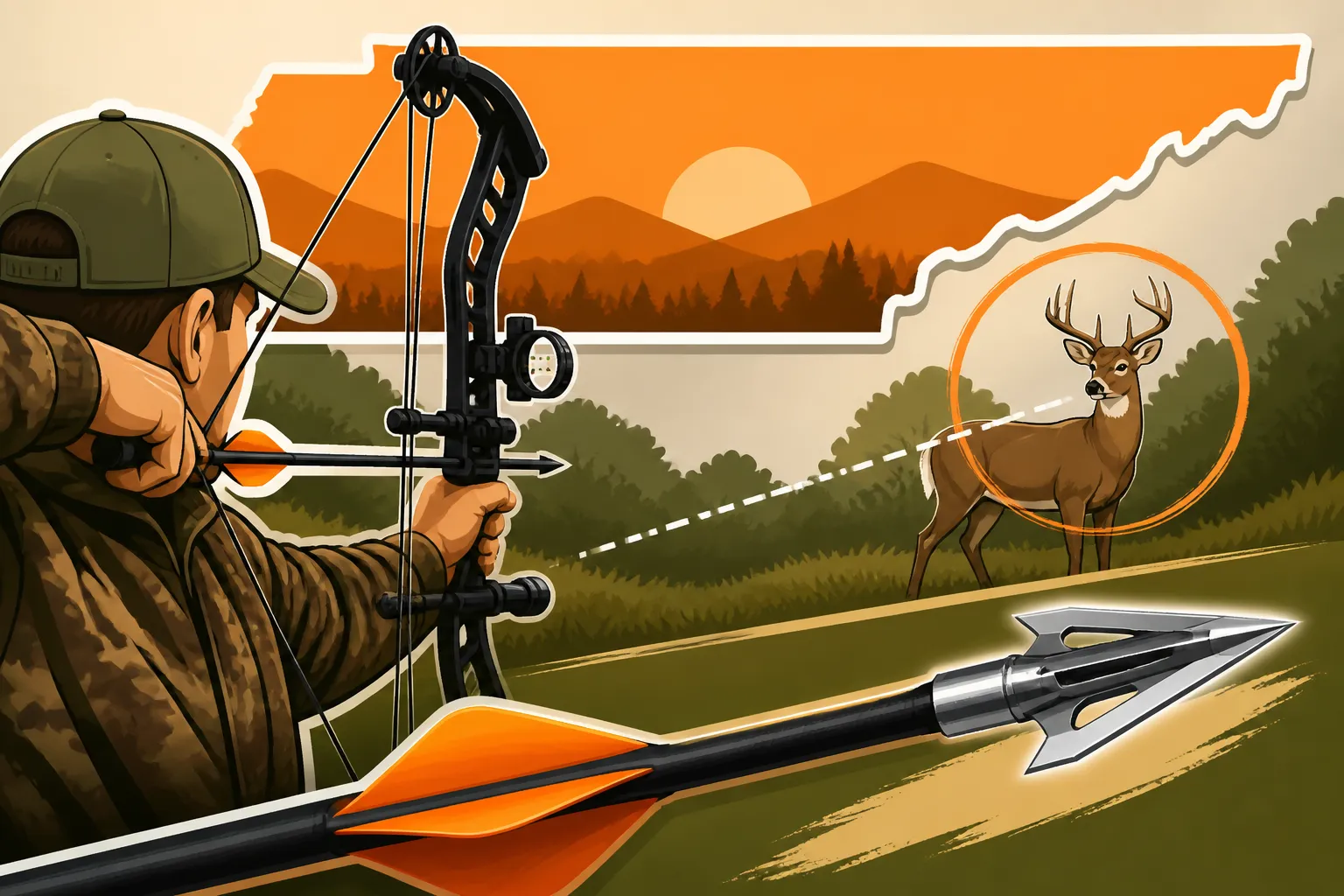
Arrow Weight for Short Shots
One of the most common frustrations bowhunters face, especially here in Tennessee, is the constant internal debate over arrow setup. We spend so much time thinking about long-range precision, ethical limits, and the perfect pin gap at 40 or 50 yards that we sometimes overlook the nuances of those up-close and personal encounters. This guide is all about diving deep into arrow weight specifically for short shots – those 25-yard-and-under opportunities that often happen in our thick cover and dense woods.
The Physics of Arrow Weight and Short Shots
When you're slinging an arrow from your bow, whether it's a traditional stick and string or a high-tech compound, you're dealing with physics. It’s not just about how fast that arrow leaves the string, but how much punch it carries when it hits its mark, especially when the shot is tight and the range is short.
Kinetic Energy and Momentum Explained for Bowhunters
Let's break down the science in a way that makes sense for us hunters. You've heard the terms "kinetic energy" (KE) and "momentum," but what do they really mean for your arrow in the woods? Kinetic energy is essentially the energy an arrow possesses due to its motion. It's often associated with speed. A faster arrow generally has more kinetic energy. Momentum, on the other hand, is a product of an object's mass and its velocity. Think of it as the arrow's ability to keep going once it hits something – its "punch-through" power. For bowhunting, especially for larger game like our Tennessee whitetails, or even a black bear if you're lucky enough to draw a tag, momentum is king for penetration.
Imagine you've got two arrows: one light and fast, the other heavy and a little slower. At the moment of impact, the lighter, faster arrow might have a higher kinetic energy reading. But the heavier arrow, even if it's traveling at a slightly reduced speed, often has greater momentum. This is crucial because it's momentum that helps your broadhead push through hide, muscle, and bone. In the context of a short shot, where trajectory isn't as critical as raw penetration, optimizing for momentum can give you a significant advantage, ensuring that broadhead busts through a rib or shoulder blade cleanly.
This balance between KE and momentum becomes even more critical when you consider the varied game we pursue here. While a lighter, faster arrow might be perfectly adequate for a Tennessee turkey, a mature whitetail buck, with his dense bone structure and thicker hide, demands an arrow with serious stopping power. Even more so if you're ever chasing one of the big boys in the Hunting Tennessee's Restored Elk Herd program. You want confidence that your arrow can get the job done, regardless of the angle or what obstacle it encounters.
Speed Versus Weight: The Trade-off
The age-old debate in archery often boils down to speed versus weight. Manufacturers are always pushing faster bows, and it's easy to get caught up in the allure of high FPS numbers. But speed isn't everything, especially when your shots are consistently under, say, 25 yards. A lighter arrow will undoubtedly fly faster, leading to a flatter trajectory over longer distances, which can be an advantage when misjudging range by a few yards. However, this comes at a cost.
The trade-off is often in that critical penetration we just discussed. A lighter arrow sheds energy more rapidly, and its momentum suffers. When it hits something tough, like the off-side shoulder of a big buck, it can lose too much energy, reducing your chances of a complete pass-through. A heavier arrow, while a bit slower, retains its energy better, drives deeper, and is often less affected by minor wind gusts, which can be a factor even in dense woods if a swirling thermal catches your fletching. For a hunter primarily taking short shots in the timber, prioritizing a heavier arrow setup can lead to more consistent pass-throughs and better blood trails.
Think about it this way: at 15 or 20 yards, the difference in arrow drop between a 350-grain arrow and a 500-grain arrow is negligible – often just an inch or two at most. That's a difference easily accounted for by good form and a steady pin. But the difference in penetration could mean the difference between recovering your animal quickly or having a long, difficult tracking job. Finding that "sweet spot" where your bow shoots quietly, accurately, and delivers maximum terminal performance is the goal, and for short shots, that often leans towards a slightly heavier arrow. For more on optimizing your setup, check out Bow and Crossbow Setups for Tennessee.
Why Short Shots Are Different in Tennessee
Tennessee's diverse landscape, from the steep ridges of the Cumberland Plateau to the dense bottomlands of West Tennessee, often dictates that most bowhunting opportunities occur at close range. We aren't often out west, glassing huge sagebrush flats for long-range shots. Our hunting is intimate, close-quarters, and often adrenaline-fueled.
Tight Cover and Close Encounters
If you've spent any time hunting deer in our state, you know the scenario: You're tucked into a thicket on the edge of a standing cornfield in West Tennessee, or nestled against a big oak on a hardwood ridge in East Tennessee. Maybe you're Hanging a Stand on a Cumberland Ridge. The deer often appear like ghosts, emerging from heavy cover, sometimes as close as 10 or 15 yards. These aren't textbook 30-yard broadside shots. They might be quartering away slightly, moving through brush, or offering a fleeting window of opportunity.
In these tight quarters, a heavy, hard-hitting arrow becomes your best friend. A lighter, super-fast arrow might impress on the chrono, but if it doesn't carry enough punch to penetrate heavy bone or muscle at an imperfect angle, its speed advantage vanishes. When a buck steps out at 18 yards, broadside, a heavy arrow ensures that if you hit a shoulder blade, you still have a strong chance of breaking through for a lethal hit. It's about maximizing your chances for that ethical, quick harvest when the deer is practically in your lap. Consider the thick stuff when you're doing your Treestand Setups in Cherokee National Forest.
These close encounters also mean less time for the deer to react to the sound of your bow. A slightly slower, heavier arrow setup can often be quieter, as the bow is more efficient and experiences less vibration. This reduction in noise means the deer might not "jump the string" as readily, giving your arrow more time to reach its target before the animal reacts to the shot. Every split second counts in these situations, and a setup that minimizes string jump can be a game-changer.
The Impact of Arrow Flight on Close-Range Accuracy
While long-range shooting highlights every minor flaw in your form or equipment, close-range accuracy might seem easier. After all, a target at 20 yards looks a lot bigger. However, precision is still paramount. At short distances, any inconsistency in your arrow's flight, no matter how minor, can still result in a few inches of deviation, which is enough to turn a perfect heart shot into a gut shot.
The stability of a heavier arrow, particularly one with a good front-of-center (FOC) balance, can actually enhance close-range accuracy. FOC refers to how much of the arrow's weight is distributed towards the front. A higher FOC (typically 12-15% for hunting) means the arrow flies more like a dart, with the weight pulling the front and the fletching guiding the rear. This design helps the arrow recover faster from the paradox of the shot, stabilizing its flight path quickly.
At short ranges, this rapid stabilization can be beneficial, especially if your form isn't absolutely perfect on a rushed shot, or if you're shooting through a small gap in the foliage. A stable, heavier arrow combined with a well-tuned bow, as we discuss in Bowhunting Tennessee's Long Archery Season, will maintain a more consistent point of impact. You might not notice significant vertical drop at 20 yards, but you will notice the difference in how consistently your arrows group, which is what truly matters when aiming for vital organs.
Finding Your Ideal Arrow Weight for Tennessee's Timber
So, you're convinced that a little extra arrow weight might be beneficial for your Tennessee hunting setup. Great! Now, how do you figure out what's right for you and your bow? It's not just about grabbing the heaviest arrow you can find; it's about balance and thoughtful construction.
Calculating Your Total Arrow Weight (TAW)
Your total arrow weight (TAW) isn't just the weight of the bare shaft. It's the sum of every component: the carbon or aluminum shaft itself, the fletching, the nock, the insert (if you use one), and most importantly, your broadhead. Many hunters start with a shaft that's designed for a certain spine (stiffness) based on their draw weight and draw length, but then they customize the components to reach their desired TAW.
For most deer hunting in Tennessee, a TAW in the range of 400 to 550 grains is a good starting point for maximizing momentum and penetration on those close shots, while still maintaining reasonable trajectory for shots out to 30-40 yards if needed. Some hunters, particularly those using traditional bows or wanting maximum penetration for larger game, might go even heavier, pushing 600 grains or more. Here’s a hypothetical breakdown of how those components can add up:
| Component | Typical Weight Range (Grains) | Notes |
|---|---|---|
| Carbon Shaft | 5-10 grains per inch | Varies greatly by spine and manufacturer. |
| Fletching (3) | 15-30 grains | Feathers are lighter; plastic vanes vary by size and material. |
| Nock | 10-15 grains | Standard nocks are fairly consistent. |
| Insert | 10-50 grains | Aluminum inserts are standard; brass or steel add weight. |
| Broadhead | 100-150 grains | Mechanicals often lighter, fixed blades can be heavier. For Broadheads for Timber Shots, heavier is often preferred. |
| Total Arrow Weight | ~400-600+ Grains | Target range for balanced performance in Tennessee. |
Adding weight can be done through heavier inserts, heavier broadheads, or even small weight tubes inside the shaft, though this last option requires careful tuning. Understanding each component's contribution allows you to fine-tune your setup.
Testing Different Weights and Broadhead Combinations
The numbers on paper are one thing, but how your bow actually shoots a particular arrow setup is the real test. You absolutely have to spend time at the range, shooting different arrow weights and broadhead combinations to see what your bow likes best. Don't assume a heavier arrow will automatically make your bow shoot poorly. Sometimes, a slightly heavier arrow can actually stabilize a bow that was previously a bit jumpy.
Start by assembling a few arrows with different total weights. For instance, you might have one batch at 425 grains and another at 475 grains, using the same broadhead type. Shoot groups at 20 and 30 yards. Pay attention to not just accuracy, but also the feel of the shot – is it smooth, quiet, and consistent? Experiment with different Crossbow Versus Vertical Bow in Tennessee setups, as they can react differently to weight. You might find that a certain weight range consistently groups tighter for you. This is also where resources like GoHunt can come in handy. Many hunters use their platforms to track gear specs, arrow builds, and even shot data from practice sessions, helping them make informed decisions based on their own performance.
Beyond group size, ensure your broadheads are flying true. Fixed-blade broadheads, especially, can sometimes plane or "kick" if your bow isn't perfectly tuned for your arrow setup. A heavier arrow can sometimes help stabilize a fixed blade. If you find your broadheads are consistently hitting differently than your field points, it's a clear sign you need to adjust your bow's tuning, potentially by tweaking your rest, cam timing, or even limb bolts. Practice with the exact broadhead you plan to hunt with. This is not a step to skip, as we often remind new hunters when discussing Tennessee Hunter Education Requirements.
Practical Considerations Beyond the Numbers
While arrow weight is a critical factor, it's just one piece of the puzzle. The most perfect arrow setup in the world won't make up for a poorly tuned bow or a rushed, unethical shot. Let's talk about the practical side of making sure your heavy arrow setup performs when it counts.
Tuning Your Bow for Optimal Performance
A heavier arrow can significantly impact your bow's tune. When you change arrow weight, especially by a substantial amount, your bow's dynamic spine (how the arrow flexes during the shot) changes. This means your arrow rest, nocking point, and even cam timing might need adjustments to ensure perfect arrow flight.
Paper tuning is a great starting point. Shoot an arrow through paper at close range (5-10 feet) and observe the tear. A perfect tear is a small hole where the fletching creates three small cuts around it. If you're consistently seeing horizontal or vertical tears, your bow isn't tuned, and that heavier arrow won't fly consistently or accurately. Adjusting your arrow rest (horizontally or vertically) is usually the first step. For those who hunt often in areas like Hunting West Tennessee Bottomland, where shots can be through very small windows, consistent flight is crucial.
Another useful technique is walk-back tuning. After getting a decent paper tune, shoot at a single spot on a target at 10 yards, then take a step or two back and shoot another arrow at the same spot. Continue this process, backing up to 20, 30, and even 40 yards. If your bow is perfectly tuned, your arrows should all group vertically on the target. If they start stringing out horizontally, more rest adjustments are needed. Tuning is an ongoing process, not a one-time event, and it's essential when messing with arrow weight. Tools like those found on GoHunt can help you visualize your shot groups and track your tuning progress over time.
Ethical Considerations for Shot Placement
Ultimately, no amount of arrow weight, kinetic energy, or momentum can ever compensate for a poor shot. The goal of bowhunting is a quick, humane, and ethical kill, and that always begins with precise shot placement. A heavy arrow simply increases your margin of error for penetration after you've put the broadhead where it needs to go.
Focus on knowing your anatomy. Whether it's a whitetail deer or a spring gobbler you're after, understand where the vitals are and aim for them with confidence. Practice shooting from various positions – standing, kneeling, sitting in a tree stand, or from a Using a Ground Blind on Tennessee Public Land – because you never know what angle or body position that deer will offer you in the heat of the moment. The ability to make a precise shot, even under pressure, is far more important than a few extra grains of arrow weight.
Pair your ideal arrow weight with a razor-sharp, high-quality broadhead, as discussed in detail in Broadheads for Timber Shots. A dull broadhead, regardless of how heavy your arrow is, will hinder penetration. The combination of a sharp, effective broadhead and an arrow with sufficient momentum for those close-range timber shots in Tennessee will give you the best chance for a successful and ethical harvest. And remember, once the shot is made, a clean Blood Trailing After Dark in Tennessee effort is critical, and a pass-through from a heavier arrow can often leave a better trail.
Disclaimer
This article is for general informational purposes only and does not constitute professional advice. Laws, prices and regulations vary by location and change over time. Consult a qualified professional for guidance on your specific situation.