Broadheads for Timber Shots
There's nothing quite as frustrating as watching your perfectly executed bow shot vanish into a thicket of twigs and saplings, resulting in a deflection and a lost opportunity. Hunting Tennessee's diverse landscapes, from the dense undergrowth of the Cumberland Plateau to the tight timber of river bottoms, often means encountering obstacles between you and that deer. This guide is all about helping you understand how to pick the right broadheads and tactics to maximize your chances when those unavoidable timber shots arise.
Understanding the Challenge of Timber Shots in Tennessee
Hunting in Tennessee, especially in our public land areas or even some of the more rugged private tracts, means you're almost always dealing with timber. We're not often hunting wide-open Western plains. Instead, we're navigating hardwood forests, pine thickets, and creek bottoms that can be incredibly dense. This environment poses unique challenges when it comes to shot selection and, crucially, broadhead performance.
The Reality of Hunting Dense Woods
Picture yourself perched in a Treestand Setups in Cherokee National Forest, thirty feet up, watching a buck ease through a stand of oaks. You’ve ranged him at 25 yards, a perfect broadside shot. But wait – there’s a small, unsuspecting sapling just behind his shoulder, or a stray branch hanging right in your flight path. This isn’t a rare occurrence; it's the daily reality for many Tennessee bowhunters. Our woods are alive, constantly growing, and what was a clear lane last week might be partially obstructed today. The leaves are gone in late season, but now you have more small, rigid branches that can easily deflect an arrow.
This isn't about blaming the hunter for not clearing every possible obstacle – sometimes, it's just not practical or even possible, especially on public land where habitat modification is restricted. Instead, it's about being prepared for those less-than-ideal situations where a broadhead might encounter some resistance before reaching its target. The sheer density of our timber means that even a perfectly aimed shot can brush a twig, leading to a slight deflection that can turn a vital hit into a glancing blow, or worse, a complete miss. We need gear that can withstand a little bit of abuse and still perform its primary function.
Common Broadhead Failures in Timber
So, what exactly happens when a broadhead hits timber, even a small twig? The outcome can vary wildly depending on the broadhead design, the speed of your arrow, and the angle of impact. One of the most common failures, especially with certain mechanical broadheads, is premature deployment. Imagine your arrow zipping through the air, clips a small branch, and the blades on your mechanical broadhead open before it hits the deer. Now you've essentially got a flying frisbee, and all that kinetic energy meant for penetration is instead dissipated by the drag of the open blades. This dramatically reduces penetration and your chances of a clean pass-through.
Another issue is deflection. Some broadhead designs, particularly those with very large cutting diameters or certain tip styles, are more prone to deflecting off a branch rather than cutting through it. Even a minor deflection can send your arrow a few critical inches off target, turning a heart shot into a gut shot, or a lung shot into a leg shot. We've all been there, scratching our heads wondering what went wrong, only to find a perfectly good arrow stuck deep in a tree limb a foot to the left of where we aimed. The frustration is real, and it’s why choosing a broadhead that excels in dense cover is so important for Bowhunting Tennessee's Long Archery Season.
Fixed Blade Broadheads: The Timber Workhorses
When it comes to navigating Tennessee's thick timber, fixed blade broadheads have long been the gold standard for many seasoned bowhunters, and for good reason. Their inherent design lends itself well to the unpredictable nature of hunting in heavy cover. There's a certain peace of mind that comes with knowing your broadhead is built for durability and reliable penetration, even if it encounters a bit of resistance on the way to the target.
Design and Durability
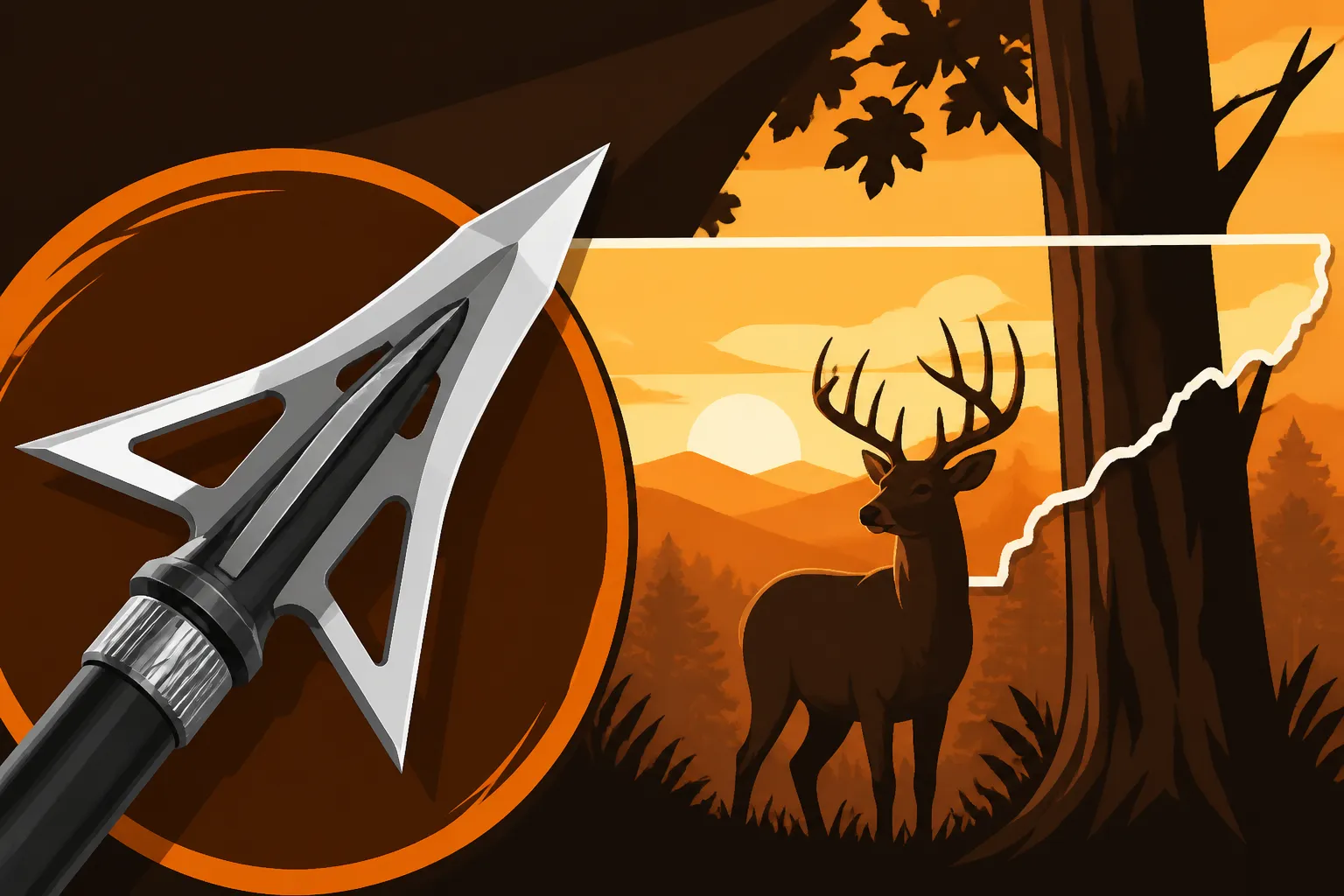
The core principle behind a fixed blade broadhead is simplicity and strength. These broadheads feature blades that are permanently affixed to the ferrule, meaning they don't move or deploy. This design eliminates any moving parts that could fail or deploy prematurely when striking a twig or branch. Think of them as miniature, ultra-sharp axes designed to cleave through whatever stands in their way. Their robust construction, often using hardened steel or aerospace-grade aluminum for the ferrule, means they can take a serious beating and still retain their integrity.
Many fixed blade designs incorporate a strong, chisel-like or cut-on-contact tip, which further enhances their ability to punch through tough material. This solid tip acts as a pilot hole, busting through bone or tough hide, allowing the razor-sharp blades to follow and create a devastating wound channel. While some might argue they're not as "aerodynamic" as some mechanicals, their predictable flight and unwavering construction make them incredibly reliable for the close-to-mid-range shots common in Tennessee's timbered environments. They're designed for consistency, not flash.
Pros and Cons for Tennessee Terrain
For hunters navigating the tight spots and sudden movements of Tennessee's deer, fixed blade broadheads offer a compelling set of advantages. The primary benefit, as mentioned, is their reliability in timber. You don't have to worry about a twig causing premature deployment, which means your arrow's energy is conserved for the deer, leading to better penetration. Their durability also means they are often reusable after a clean pass-through or even after hitting a sapling, assuming the blades aren't bent or chipped beyond repair. This can save you a few bucks in the long run. Plus, their predictable flight characteristics, especially with well-tuned bows, tend to be very forgiving.
However, it's not all sunshine and roses. One common complaint about fixed blades is their perceived effect on arrow flight, especially at higher speeds or with bows that aren't perfectly tuned. The fixed blades can catch more wind, potentially leading to planing or less consistent groups at longer distances. For hunters pushing the limits of their effective range, this can be a concern. Another point is the cutting diameter. Many traditional fixed blades have a smaller cutting diameter compared to some mechanicals, which means the wound channel might be slightly less dramatic. But don't let that fool you; a sharp fixed blade with good penetration makes a lethal hole. Ultimately, the trade-off is often well worth it for the peace of mind they provide in the woods.
Popular Fixed Blade Options
The market for fixed blade broadheads is vast, and many companies have refined their designs over decades. Brands like GrizzlyStik, Magnus, G5 Outdoors, and Wasp Archery have strong reputations in the fixed blade world. When considering options, you'll see different blade configurations – two-blade, three-blade, four-blade – and various tip designs.
For example, a two-blade "cut-on-contact" design, like the GrizzlyStik Silver Flame, is often praised for its ability to slice through hide and bone with minimal resistance, making it excellent for deep penetration. Three-blade designs, such as the G5 Montec or the Muzzy Trocar, offer a larger cutting surface while still maintaining a robust profile, creating a good balance of penetration and wound channel. Four-blade broadheads, like some of the NAP HellRazors, further increase cutting surface but can be a bit more finicky to get flying perfectly.
When you're trying to decide, it can be really helpful to look at resources that break down performance and durability. A site like GoHunt can be invaluable here, offering reviews and comparative data from other hunters who’ve put these broadheads through their paces in various conditions. They often have detailed discussions on how different designs hold up when encountering bone or, yes, even errant timber. Remember, the best fixed blade for you is one that flies true from your bow and gives you confidence in the field.
Mechanical Broadheads: When and Where They Fit
While fixed blades are the old standbys, mechanical broadheads have certainly gained a massive following over the past few decades. Their appeal is obvious: field-point-like flight and massive cutting diameters. But when it comes to punching through the unexpected timber we so often face here in Tennessee, they present a different set of considerations.
Deployable Blades and Flight Characteristics
The defining feature of a mechanical broadhead is its deployable blades. These blades remain tucked away during flight, resulting in a sleeker profile that mimics a field point. This design significantly reduces drag and wind planing, often leading to superior accuracy, especially at longer ranges, and making them much easier to tune with your setup. For many, the ability to get field-point accuracy out of a hunting broadhead is a huge draw. Once the broadhead impacts the target, the blades are designed to deploy, typically via a spring mechanism or through kinetic energy from the impact, creating a much larger cutting diameter than most fixed blades. This larger cutting diameter translates to a more expansive wound channel, which theoretically leads to quicker blood trails and faster recoveries.
However, this reliance on deployment is precisely where the challenges for timber shots begin. The mechanisms, while often incredibly reliable for deer, are still more complex than a solid piece of steel. They’re engineered for flesh, not wood. The very thing that gives them their accuracy—the sleek profile—is contingent on those blades staying closed until impact.
Risks of Mechanicals in Timber
The biggest risk with mechanical broadheads in dense timber, as we touched on earlier, is premature deployment. If your arrow clips a branch, even a small one, the force can be enough to trigger the blade mechanism. Once those blades are open, your arrow's flight path changes drastically. It becomes unstable, loses speed quickly due to increased drag, and its ability to penetrate cleanly is severely compromised. Imagine a dart suddenly sprouting wings mid-flight – it’s not going to fly straight or hit hard.
Beyond premature deployment, some mechanical designs might not be as robust as fixed blades when it comes to the ferrule or blade integrity. While many modern mechanicals are incredibly tough, repeated impact on hard objects like bone or timber can sometimes bend ferrules or shear off blades. This isn't just a hypothetical scenario; many of us have seen it happen. If a mechanical broadhead's blades deploy unevenly or are damaged by an obstruction before hitting the deer, the resulting wound channel can be less than ideal, and tracking can become a real headache. This is why for hunters who know they'll be in areas with high timber density or shooting through small gaps, the risks of mechanicals sometimes outweigh their advantages.
Hybrid Designs for a Balance
Recognizing the trade-offs, some manufacturers have developed hybrid broadheads. These designs attempt to blend the best features of both fixed and mechanical broadheads. Typically, a hybrid broadhead will have a small, fixed leading blade (or set of blades) combined with a larger, expandable set of mechanical blades.
The idea here is that the fixed blades provide the initial cut and act as a failsafe against premature deployment. If the arrow clips a small branch, the fixed blades are designed to cut through it, maintaining arrow stability and preventing the mechanical blades from opening prematurely. Once the broadhead hits the deer, the mechanical blades then deploy, providing that larger cutting diameter for enhanced wound channels.
Brands like Rage, NAP, and others offer various hybrid options. While they aim for the best of both worlds, it's still crucial to test them with your specific setup. Tuning is important with any broadhead, but especially with hybrids, to ensure that both the fixed and mechanical components perform as intended. For hunters who want better flight characteristics than a traditional fixed blade but are nervous about the full mechanical risks in thick cover, hybrids can be a really interesting middle ground. They offer a bit more confidence when hunting areas with scattered timber, such as some of our Hunting West Tennessee Bottomland Deer spots where cover can be sporadic but dense.
Key Considerations for Timber Broadheads
Choosing the right broadhead for hunting Tennessee's timber isn't just about picking between "fixed" or "mechanical." There are several specific design elements and characteristics you should scrutinize to ensure your broadhead performs optimally when those less-than-perfect shots arise.
Blade Angle and Tip Design
When you're trying to cut through or bust through small timber, the design of your broadhead's tip and the angle of its blades play a huge role. Think about it: a chisel tip broadhead, or one with a stout, reinforced point, is designed to punch through tough material. If it encounters a small sapling, it's more likely to break or push through it rather than glance off. Cut-on-contact (COC) broadheads, which feature blades that extend all the way to a sharp point, are also excellent for this. They start cutting immediately, offering less resistance than a blunt or rounded tip, and helping to maintain arrow flight.
In contrast, some mechanical broadheads have a tip that is designed more for aerodynamic flight than for impact resistance, and their blades are often tucked back. If these hit timber, they might be more prone to deflection or, as discussed, premature deployment. For timber hunting, you want a broadhead that presents a small, strong, and sharp initial point of contact. The blades themselves should also have a relatively steep, aggressive angle. This allows them to slice more efficiently through small woody obstacles without getting "hung up" or deflecting as easily as broadheads with very wide or flat blade angles. For a deeper dive into different designs, GoHunt often features articles and discussions comparing various broadhead characteristics, which can be super helpful.
Weight and FOC (Front of Center)
Arrow weight and its front-of-center (FOC) balance point are crucial, but often overlooked, factors that greatly influence a broadhead's performance, especially in timber. A heavier arrow carries more kinetic energy and momentum. This means it has more "umph" to push through resistance, whether that's a deer's shoulder blade or a pesky branch. Lighter arrows, while faster, tend to shed energy more quickly upon impact with anything that isn't air. So, for timber hunting, a slightly heavier arrow setup can be a real advantage, providing that extra punch when needed.
Front of Center (FOC) refers to the percentage of an arrow's total weight that is located in the front half of the arrow. An arrow with higher FOC (typically 12% or more) tends to fly more stably, particularly with broadheads. Why? Because the weight forward pulls the arrow, making it less susceptible to crosswinds and, crucially for our discussion, less prone to deflection if it clips an object. Imagine throwing a dart versus throwing a feather; the dart, with its weight concentrated at the front, flies truer. This added stability can make a significant difference if your arrow brushes a branch, helping it to stay on course better than a tail-heavy arrow. When thinking about your setup, consider adjusting your arrow weight or using heavier broadheads to achieve a higher FOC, particularly if you're looking for that timber-busting performance.
Sharpening and Maintenance
This might seem basic, but it's absolutely critical for any broadhead, especially those intended for timber shots. A dull broadhead is a poor performer, regardless of its design. For fixed blades, keeping them razor-sharp is paramount. A truly sharp blade will slice through hide, flesh, and even small twigs with minimal resistance, whereas a dull blade will tear and push, increasing the chances of deflection or poor penetration. Invest in a good broadhead sharpener – there are many excellent options designed specifically for different blade angles – and get into the habit of touching up your broadheads before every hunt, and certainly after any practice shots into a target.
Maintenance extends beyond just sharpening. For mechanical broadheads, regular inspection of the blade retention system, O-rings, and pivot points is key. Ensure everything is clean, lubricated (if recommended by the manufacturer), and free of debris that could hinder deployment. If you notice any bent blades or damaged ferrules after a practice shot or a missed opportunity, replace them. Don't try to reuse a damaged broadhead and expect it to perform. Even a small bend can compromise flight and penetration. Remember, your broadhead is the business end of your arrow; it deserves meticulous care to ensure it performs when it matters most, whether that's cutting through a whitetail's vitals or slicing through an unexpected branch.
Shot Placement and Practice: Beyond the Broadhead
While the right broadhead is a critical tool in your hunting arsenal, it's important to remember that it's just one piece of the puzzle. Even the most robust, timber-forgiving broadhead can't compensate for poor shot placement or a lack of preparation. For consistent success in Tennessee's woods, understanding where to aim and how to practice effectively are just as vital as your gear choice.
The Importance of a Clean Lane
This might sound obvious, but it bears repeating: the best shot is always the one with the clearest path to your target. Before you even draw your bow, take a moment to assess the shot lane. Are there any small branches, hanging vines, or even tall weeds that could interfere with your arrow's flight? It's amazing how many times a hunter gets target fixation on the deer and forgets to look at the immediate foreground and background for obstructions.
If you're hunting from a stand, take the time to clear shooting lanes before the season. This is particularly important on private land where you have more leeway. Even on public land, judiciously trimming a few small twigs with hand pruners from your shooting lanes (if permitted and within regulations) can make a world of difference. When Scouting Tennessee Public Land Before Season, visualize potential shot opportunities and note areas that might need clearing. If you can’t clear a lane, then position yourself for a cleaner shot, or simply pass on the shot if it's too risky. A missed or wounded animal due to a deflection is far worse than no shot at all. Sometimes, shifting your body just a few inches can open up a critical window. For those tricky scenarios, checking out resources like GoHunt's forums can provide great tips on how other hunters manage shooting lanes in tough terrain, perhaps even sharing strategies for Entry Routes Through Standing Beans that might block your view.
Practice, Practice, Practice
You can have the best broadhead on the market, but if you haven't practiced with it, you're not fully prepared. It's not enough to just shoot field points all summer. You absolutely must practice with your actual hunting broadheads. This allows you to confirm that your broadheads are flying true from your bow, identify any tuning issues, and gain confidence in their performance. Some broadheads, particularly fixed blades, may fly slightly differently than field points, and only consistent practice will reveal this.
Practice doesn't just mean shooting at a blank target. Set up realistic scenarios. Place a small branch or a piece of thin PVC pipe a few feet in front of your target (never directly aim at it, just use it to visualize a real-world obstruction). Practice shooting from your treestand or ground blind. Take shots at various angles and distances you might encounter in the field. This also builds muscle memory and helps you maintain your form under pressure.
Another invaluable practice technique is to shoot at odd angles, or from a kneeling or crouching position, mimicking situations you might find yourself in when trying to thread an arrow through a small gap. The more realistic your practice, the better prepared you'll be when that mature buck steps out and you have only a tight window for a shot through the timber. Confidence comes from competence, and competence comes from deliberate practice.
Comparing Broadhead Types for Timber
Let's distill the core differences between the main broadhead types when the risk of hitting timber is a real concern, as it so often is in Tennessee's hunting grounds. Understanding these distinctions can help you make an informed choice for your next hunt.
A Quick Look at Strengths and Weaknesses
| Feature/Broadhead Type | Fixed Blade | Mechanical | Hybrid |
|---|---|---|---|
| Timber Resilience | Excellent | Poor | Good |
| Durability | Very High | Moderate | High |
| Flight Accuracy | Good (tuned) | Excellent | Very Good |
| Wound Channel Size | Moderate | Large | Large |
| Penetration | Excellent | Good | Very Good |
| Complexity | Low | High | Medium |
| Cost | Moderate | Moderate-High | Moderate-High |
Fixed Blade Broadheads: These are the champions of timber resilience. Their solid construction means no moving parts to fail or deploy prematurely when clipping a twig. They are designed to cut or bust through minor obstructions, maintaining arrow flight and integrity better than any other type. While they might require more bow tuning for perfect flight, their reliability and deep penetration in adverse conditions are unmatched. If you hunt extremely dense cover or frequently face tight shot windows where obstructions are likely, fixed blades are your most dependable choice. They are especially popular when Hunting the Tennessee Rut in Early November when bucks are moving in heavy cover.
Mechanical Broadheads: Mechanicals excel in flight accuracy, often mimicking field points, which is a huge plus for many hunters. They also create larger wound channels upon deployment. However, this deployment mechanism is their Achilles' heel in timber. Premature deployment from hitting a branch can severely compromise arrow flight, penetration, and the entire shot outcome. While improvements in design have made them tougher, they generally remain a riskier choice for situations where timber interference is probable. They are best suited for truly open lanes where you can guarantee no obstructions.
Hybrid Broadheads: These offer a compromise, incorporating small fixed blades along with expandable mechanical blades. The fixed blades are there to mitigate the risk of premature deployment if a minor obstruction is hit, allowing the arrow to continue on a truer path before the mechanical blades deploy on impact with the animal. Hybrids attempt to give you the better flight of a mechanical with a degree of the timber-friendliness of a fixed blade. They can be a good option for hunters who want a larger cutting diameter but still need a bit of insurance against light timber. However, they are still more complex than a pure fixed blade and require careful testing to ensure both components perform reliably.
Ultimately, the best broadhead for you will be one that inspires confidence and flies true from your specific setup, especially after you've practiced extensively with it. Don't be afraid to experiment, and always prioritize ethical shot placement over trying to force a shot through heavy cover.
Disclaimer
This article is for general informational purposes only and does not constitute professional advice. Laws, prices and regulations vary by location and change over time. Consult a qualified professional for guidance on your specific situation.