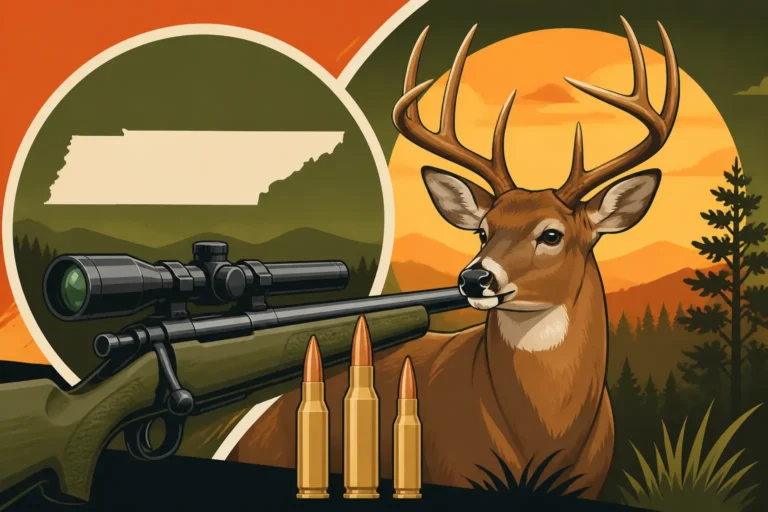
Choosing a Rifle Caliber for Tennessee Deer
Choosing the right rifle caliber for deer hunting in Tennessee can honestly feel like a bit of a puzzle. Our state's landscape is so incredibly diverse, from the dense, steep slopes of the Appalachian Mountains in East Tennessee to the vast, open agricultural fields of the Mississippi River bottoms in West Tennessee. What performs flawlessly in one scenario might leave you questioning your choice in another. This guide aims to demystify the process, helping you understand the pros and cons of various popular calibers so you can confidently pick the best rifle for your specific Tennessee deer hunting adventures.
Understanding Tennessee's Deer Hunting Landscape
Tennessee offers an incredible variety of hunting experiences, and the terrain you're in dramatically influences what kind of shots you'll likely encounter. Ignoring these differences when choosing your rifle caliber is a common mistake that can lead to frustration in the field.
Varied Terrain and Shot Distances
When you picture deer hunting in Tennessee, what comes to mind? Is it the towering hardwoods and rocky bluffs of the Cumberland Plateau, where shots might be measured in dozens of yards, or is it a sprawling soybean field in Obion County where a 300-yard shot isn't out of the question? Understanding these geographical nuances is crucial.
In East Tennessee, particularly within the vast Cherokee National Forest Hunting lands or other mountainous areas, you'll often find yourself in incredibly thick timber. The terrain is rugged, full of steep hollows and dense undergrowth. Here, shot opportunities usually come quickly and at relatively close ranges—think 25 to 75 yards, maybe 100 on a logging road or a powerline cut. A fast-handling rifle chambered in a cartridge designed for moderate distances and perhaps a bit of "brush-busting" capability could be ideal. You're not looking for extreme long-range precision here; you're looking for quick target acquisition and reliable knockdown power in close quarters.
Shift to Middle Tennessee, and the landscape often becomes a mix of rolling hills, smaller woodlots, and agricultural fields. This mixed habitat presents a wider array of shot distances. You might get a close-range encounter in a creek bottom or a longer shot across a small pasture or food plot. This is where a versatile cartridge shines, one that can handle both the shorter timber shots and stretch out to 150-200 yards with confidence. It's a balance of power and trajectory that really counts here.
Then there's West Tennessee, home to fertile river bottoms and expansive farm country. Hunting West Tennessee Bottomland Deer often means hunting along the edges of vast corn or soybean fields, or in relatively open hardwood timber where deer move between cover and food sources. Shots here can frequently extend beyond 200 yards, sometimes pushing 300 or even further depending on your setup and the specific field. For these conditions, a flatter-shooting cartridge with excellent downrange energy retention becomes a significant advantage. You're trying to minimize bullet drop and drift over longer distances, ensuring a precise hit on a wary buck.
Deer Size and Regional Differences
While Tennessee deer are generally all white-tailed deer, their average size can vary somewhat across the state, and this plays a role in how much punch your chosen caliber needs to deliver. No matter where you hunt, ethical hunting demands a quick, humane kill, and that means choosing a caliber that can deliver sufficient energy to reliably anchor a deer.
Overall, Tennessee deer are healthy and robust, but hunters in West Tennessee often report encountering larger-bodied deer, especially in the fertile river bottom areas and counties with rich agricultural land. These bucks might be a bit heavier, with a denser bone structure. For these larger animals, a cartridge that delivers ample kinetic energy and good bullet penetration is definitely a plus. You want a bullet that can punch through bone and muscle to reach the vitals effectively, even on a quartering-away shot.
Conversely, deer in the more rugged, mountainous regions of East Tennessee, while still a good challenge, sometimes tend to be a bit smaller on average, due to less abundant high-quality forage and harder living conditions. While this doesn't mean you should skimp on power, it does suggest that cartridges that might be considered "marginal" for very large deer in other states can still be perfectly adequate for many Tennessee whitetails, as long as shot placement is precise.
Ultimately, regardless of regional differences, the primary goal is a clean kill. Choosing a caliber that you can shoot accurately and that delivers enough energy to penetrate deeply is far more important than chasing the absolute biggest numbers on a ballistics chart. A well-placed shot with a moderately powered cartridge is always better than a poorly placed shot with a magnum.
Common Rifle Calibers and Their Performance
Let's dive into some of the most popular and effective rifle calibers for deer hunting in Tennessee. Each has its own strengths and ideal applications.
Classic Whitetail Cartridges
These are the tried-and-true workhorses that have filled freezers for generations, and for good reason. They are reliable, effective, and often very accessible.
The .30-30 Winchester is an absolute legend in deer hunting history. When you think of a classic lever-action rifle, you’re often thinking of a .30-30. It's perfectly suited for hunting in dense cover where shots are generally under 150 yards. Its effective range is somewhat limited by its slower velocity and bullet design, which isn't as aerodynamic as modern spitzer bullets. However, within its effective range, the .30-30 delivers plenty of energy to cleanly take a Tennessee deer. It's known for quick follow-up shots in lever-action rifles and its ability to handle thick brush, making it a favorite for still-hunting through deep timber or for Deer Drives With Three or Four Hunters on public land where engagements are often up close and personal. Ammunition is usually readily available and reasonably priced, and the recoil is mild, making it a comfortable rifle to shoot and practice with. If your hunts primarily involve thick woods and short to moderate shots, don't overlook this classic. You can learn more about its specific use in various conditions by reading .30-30 in Thick Bottomland Cover.
Next up is the .308 Winchester, a true jack-of-all-trades. If you ask a group of hunters for a single do-it-all deer cartridge, the .308 will be high on almost everyone's list. It offers an excellent balance of power, trajectory, and manageable recoil. It's powerful enough for even the largest Tennessee whitetail, and its relatively flat trajectory makes it effective out to 300 yards or more with a skilled shooter. Ammunition is incredibly abundant, with a huge variety of bullet weights and types available, and it's generally affordable. The .308 Winchester is a compact and efficient cartridge, which allows for shorter, lighter rifle actions, making for a more nimble hunting rifle. It's a fantastic choice for the hunter who might find themselves in varied terrain, from dense woodlots to open fields, and wants one rifle that can handle it all.
The .270 Winchester has been a favorite of deer hunters for decades, prized for its flat trajectory and excellent downrange energy. Developed by Winchester back in the 1920s, it's known for pushing lighter, aerodynamic bullets at high velocities, making it an outstanding choice for longer shots across open country or clear-cuts. While it might have a bit more recoil than a .30-30 or some 6.5mm cartridges, it’s still very manageable for most shooters. If you're hunting in West Tennessee farm country, or open ridge tops of the Cumberland Plateau Ridgelines, where longer shots are common, the .270 Winchester is a superb choice. It delivers plenty of punch for any Tennessee deer and boasts a fantastic reputation for clean kills.
Modern Flat-Shooters
The hunting world, like all things, evolves, and new cartridges are continually developed or gain popularity. These modern options often prioritize flatter trajectories, reduced recoil, and improved accuracy.
The 6.5 Creedmoor has exploded in popularity over the last decade, and for very good reasons. It's designed for exceptional accuracy and a very flat trajectory, especially at longer ranges, all while producing surprisingly mild recoil. This combination makes it incredibly easy to shoot accurately, even for new or recoil-sensitive hunters. Its aerodynamic 6.5mm bullets retain energy well downrange, making it highly effective on deer out to considerable distances. While it might not hit with the same sheer kinetic energy as a .30-06 at the muzzle, its efficiency and precision ensure excellent terminal performance with proper bullet choice and shot placement. For hunters looking to make those 200-300 yard shots with confidence and comfort, especially across the fields of Middle and West Tennessee or even off a Hanging a Stand on a Cumberland Ridge looking into a valley, the 6.5 Creedmoor is a stellar option. 6.5 Creedmoor for Cumberland Ridges offers even more specific insights into this cartridge's application in Tennessee's varied landscapes.
Another excellent, though perhaps less ubiquitous, modern flat-shooter is the .25-06 Remington. This cartridge is a necked-down .30-06 case, designed to launch lighter, faster 6.5mm (.257 diameter) bullets at blistering velocities. The result is an incredibly flat trajectory and very mild recoil, making it a pleasure to shoot. While it doesn't carry the same heavy-hitting energy as a .30 caliber, it's more than sufficient for deer, especially with premium bullets designed for controlled expansion. The .25-06 is a fantastic choice for open country hunting where long shots are common and recoil is a concern. It’s often a favorite for hunters who prioritize a flat trajectory and less punishment on the shoulder during long range sessions. However, ammunition availability might not be as widespread as for the .308 or 6.5 Creedmoor, so planning ahead is wise.
Straight-Wall Cartridge Options
While Tennessee generally permits most common centerfire rifle calibers for deer hunting, the concept of straight-wall cartridges is worth briefly discussing, especially for hunters coming from states with specific restrictions or those looking for a different kind of hunting experience. In some states, certain zones or seasons restrict hunters to straight-wall cartridges due to population density or terrain, aiming to limit projectile range. While Tennessee doesn't broadly impose this for general rifle season, understanding these cartridges adds to your overall knowledge.
Historically, cartridges like the .45-70 Government have been around for a long time. It’s a powerful, hard-hitting round known for its ability to deliver tremendous energy at closer ranges, often used in lever-action rifles. It’s definitely effective on deer and can be a good choice in thick timber if you prefer a large, heavy bullet.
More recently, cartridges like the .350 Legend and .450 Bushmaster have gained popularity, largely driven by those straight-wall-only regulations in other states. The .350 Legend, in particular, offers light recoil, decent velocity, and is very effective on deer out to 200 yards or so, making it quite capable in many Tennessee deer hunting scenarios. It provides a modern, low-recoil option with plenty of punch for whitetails.
While Tennessee's " Tennessee Legal Firearms for Deer Hunting" regulations permit a wide array of centerfire rifles without generally mandating straight-wall cartridges, a hunter might still choose one of these for personal preference, a desire for reduced range, or simply because they own a rifle chambered in it from hunting in other states. Always remember to check the specific regulations for any Wildlife Management Area (WMA) you plan to hunt, as some public lands might have unique rules regarding firearms.
Factors to Consider Beyond Ballistics
Choosing a caliber isn't just about bullet drop and energy; there are practical considerations that can greatly impact your hunting experience and success.
Recoil Sensitivity and Shooter Comfort
This is one of the most overlooked, yet critical, factors in rifle selection. A rifle's recoil is the backward "kick" you feel when you fire it. While some hunters pride themselves on being able to handle heavy recoil, the truth is, excessive recoil can significantly impact your accuracy and willingness to practice.
If a rifle kicks you hard every time you pull the trigger, two things are likely to happen:
- You'll develop a flinch. This is a subconscious reaction where you anticipate the recoil and subtly flinch or close your eyes just before the shot, throwing off your aim.
- You won't want to practice. If shooting your rifle is an unpleasant experience, you'll naturally avoid the range. And a hunter who doesn't practice isn't an accurate hunter.
Calibers like the .30-30, 6.5 Creedmoor, or .25-06 generally have lighter recoil, making them comfortable for extended range sessions and less likely to induce a flinch. Even new shooters or those with smaller frames can often master these rounds quickly. Calibers like the .308 Winchester and .270 Winchester offer a moderate level of recoil that most adult shooters can handle comfortably with proper technique and a good recoil pad. Heavier-hitting rounds like the .30-06 Springfield or magnum calibers (which are generally overkill for Tennessee deer) can have significantly more recoil, requiring more practice and a higher tolerance from the shooter.
Remember, the goal isn't to shoot the biggest gun; it's to shoot the most accurate gun. A comfortable rifle leads to more practice, which leads to better accuracy, which ultimately leads to more ethical and successful hunts.
Ammunition Availability and Cost
In the current hunting climate, ammunition availability is a real consideration. There's nothing worse than getting ready for opening day and realizing you can't find your preferred hunting load, or worse, any ammunition at all for your rifle.
Calibers like the .308 Winchester, .270 Winchester, .30-06 Springfield, and increasingly, the 6.5 Creedmoor, tend to have very high ammunition availability. You can usually find a variety of loads at sporting goods stores, local gun shops, and even many hardware stores in rural Tennessee. This widespread availability also often translates to more competitive pricing, allowing you to buy more rounds for practice without breaking the bank.
For less common calibers, like the .25-06 Remington or some of the newer straight-wall options, ammunition might be a bit harder to find and potentially more expensive. If you choose one of these, it's a wise strategy to stock up on several boxes of your preferred hunting ammunition and a few boxes of cheaper practice ammo when you find it. This ensures you have enough on hand for hunting season and for ample practice sessions throughout the year. You wouldn't want to be scrambling to find a specific load right before Tennessee Gun Season Opening Day.
Consider the long-term cost as well. While the initial rifle purchase is a one-time expense, ammunition is ongoing. More affordable and available ammunition means more time at the range, which, as we've established, makes you a better shot.
Legal Considerations and Minimums
When it comes to legalities, Tennessee is fairly straightforward regarding rifle calibers for deer. The Tennessee Wildlife Resources Agency (TWRA) specifies that centerfire rifles are legal for deer hunting during the gun seasons. Unlike some states, Tennessee does not impose a minimum caliber size for centerfire rifles, nor does it typically restrict them to straight-wall cartridges across the board.
However, "generally speaking" isn't good enough when it comes to hunting regulations. It is absolutely crucial to consult the most current TWRA hunting guide every single year. Regulations can and do change, and specific rules might apply to certain public lands or Wildlife Management Areas (WMAs). For example, some WMAs might have special regulations regarding weapons or ammunition types due to their proximity to populated areas or for specific management goals.
Here's what you should always do:
- Check the current TWRA Hunting and Trapping Guide: This is your bible for all regulations. It's available online through the TWRA website and usually at license vendors.
- Verify WMA-specific rules: If you plan to hunt on public land, always look up the regulations for that specific WMA. You can often do this through the TWRA website or by using resources like Scouting With the Tennessee TWRA App, which can sometimes have WMA-specific overlays.
- Understand blaze orange requirements: While not caliber-specific, remember that How Much Blaze Orange Tennessee Requires for rifle hunters is a critical safety regulation.
For the vast majority of Tennessee deer hunters using common centerfire rifle calibers (.243, .270, .30-06, .308, 6.5 Creedmoor, etc.), you'll be well within legal parameters. The key is to stay informed and never assume that last year's rules are this year's rules.
Matching Caliber to Hunting Style and Location
The best rifle caliber isn't just about ballistic charts; it's about what makes sense for your specific hunting situations here in Tennessee.
Thick Cover and Close Shots
If your deer hunting typically involves navigating dense forests, thick creek bottoms, or the rugged, brushy terrain of East Tennessee, your priorities for a rifle caliber will differ from someone hunting wide-open fields. In these environments, shots are often at close range, quick, and sometimes through sparse brush.
Here, you want a rifle that handles well in tight quarters, points quickly, and delivers substantial energy to stop a deer in its tracks before it can disappear into the thicket. Recoil is less of a concern for follow-up shots since the range is short, but quick target acquisition is paramount.
Excellent choices for these conditions include the classic .30-30 Winchester in a lever-action rifle, which is incredibly fast handling and known for its effectiveness at close range. Other solid options could be the .308 Winchester, particularly with heavier bullets, which can perform admirably in timber and still offers the versatility for a longer shot if one presents itself on a logging road. For those preferring a modern straight-wall option, a .350 Legend in a handy carbine can also be quite effective, delivering good energy with less recoil in a compact package. The key is to prioritize manageable length, fast aiming, and a bullet designed for good expansion at moderate velocities. Understanding Practical Range in Cherokee Forest Timber can help you visualize these scenarios.
Open Fields and Longer Shots
When your hunting grounds consist of expansive agricultural fields, powerline cuts, or open ridge tops in areas like West Tennessee's river bottoms or parts of the Cumberland Plateau, you need a caliber that excels at longer distances. These scenarios often demand a flat trajectory to minimize guesswork on bullet drop and sufficient energy retention to ensure a clean kill at ranges beyond 200 yards.
For these conditions, cartridges that launch aerodynamic bullets at higher velocities are your best friends. The .270 Winchester is a legendary choice, renowned for its flat shooting capabilities. The 6.5 Creedmoor has rapidly gained favor here too, offering superb accuracy and a very flat trajectory with mild recoil, making those longer shots much more approachable. The .30-06 Springfield (which we'll cover in versatility) is also a strong contender, capable of handling impressive distances with heavier bullet options. Even the .308 Winchester, while perhaps not as flat-shooting as a 6.5 Creedmoor, is certainly capable of ethical kills out to 300 yards with practice.
When hunting open country, having reliable tools to estimate distance is also critical. Utilizing a rangefinder and perhaps a mapping application like GoHunt to mark potential shot distances and landmarks in advance can make a huge difference. Accuracy at these ranges is a skill, and it starts with a caliber that performs consistently.
All-Around Versatility for Diverse Hunts
Many Tennessee deer hunters aren't confined to just one type of terrain. Perhaps you hunt the thick woods of public land for a few weeks, then switch to a friend's private farm with a mix of fields and timber. For these hunters, an "all-around" caliber that performs well in a variety of situations is invaluable.
The undisputed champions of versatility are the .308 Winchester and the .30-06 Springfield. Both offer a fantastic balance of power, trajectory, and bullet weight options that make them suitable for anything from dense timber to open fields.
The .308 Winchester is compact, efficient, and widely available. It's powerful enough for deer at close range, yet flat-shooting enough for 250-300 yard shots with a good shooter. Its mild recoil and wide array of factory ammunition make it a favorite for many.
The .30-06 Springfield is a classic American cartridge with a slightly larger case capacity than the .308, allowing it to push heavier bullets at higher velocities. This translates to a bit more power and effective range, making it a viable option for even larger game animals beyond deer, like elk (should you be lucky enough to draw a Tennessee Elk Quota Hunt Rules tag for North Cumberland). While it has a bit more recoil than the .308, it’s still manageable for most. For an all-around caliber that truly leaves no doubt about its effectiveness on any Tennessee whitetail, the .30-06 is a superb choice.
Choosing a versatile caliber means you might not have the absolute best tool for extreme long-range or the quickest-handling rifle for the densest brush, but you'll have a highly capable rifle for 90% of the scenarios you'll encounter across Tennessee.
The Importance of Shot Placement and Practice
No matter which rifle caliber you choose for hunting Tennessee deer, there are two factors that will always overshadow ballistic charts and bullet energy: precise shot placement and consistent practice.
Ethical Hunting with Any Caliber
We talk a lot about the "best" caliber, but the truth is, even a "perfect" caliber won't guarantee a clean kill if the shot isn't placed correctly. Ethical hunting means striving for the quickest, most humane kill possible. This responsibility falls squarely on the hunter, not the cartridge.
A well-placed shot with a less powerful but adequate cartridge (like a .243 Winchester, for example) through the vitals—heart and lungs—will result in a far quicker and more humane kill than a poorly placed shot with a heavy-hitting magnum. Understanding deer anatomy and aiming for the vital zone behind the shoulder is paramount. This requires patience, a steady hand, and confidence in your abilities.
Never take a shot that you are not 100% confident in making. If the deer is quartering away too sharply, or obscured by brush, or the distance is at the edge of your comfort zone, wait for a better opportunity. A lost deer is a tragic outcome, and our commitment as hunters is to avoid that at all costs. Blood Trailing After Dark in Tennessee is a skill you hope you never need to use, but good shot placement dramatically reduces the chances of needing it.
Range Practice and Familiarity
This brings us to the second, equally critical point: practice, practice, practice. Choosing a rifle caliber is only the first step. Becoming proficient with that rifle and understanding its capabilities, as well as your own limitations, is what truly matters.
You should aim to visit the shooting range regularly, not just a week before hunting season opens. Consistent practice allows you to:
- Zero your rifle: Ensure your scope is perfectly aligned with your barrel. You might want to zero at 100 yards, but also understand your bullet's drop at 200 and 300 yards. This is crucial for Zeroing a Rifle for Mixed Distances you might encounter.
- Become familiar with recoil: Regular shooting helps you manage recoil instinctively, preventing flinching and improving follow-through.
- Understand your rifle's nuances: Every rifle is slightly different. You'll learn its trigger pull, how it feels on your shoulder, and how it performs in different conditions.
- Practice from hunting positions: Don't just shoot from a bench rest. Practice shooting from kneeling, sitting, and even standing positions, simulating real-world hunting scenarios. If you plan to use a Using a Ground Blind on Tennessee Public Land, practice shooting from inside it. If you're Hanging a Stand on a Cumberland Ridge, simulate those elevated shots.
- Know your effective range: Through practice, you'll establish your personal maximum ethical shooting distance with your rifle and your chosen ammunition. This might be different from the theoretical maximum of the cartridge.
A rifle is a tool, and like any tool, its effectiveness depends on the skill of the person wielding it. Invest the time and effort into becoming a proficient shooter with your chosen caliber. The confidence you gain on the range will directly translate into calmer, more accurate shooting when that buck of a lifetime steps out into a clearing.
Comparing Popular Deer Rifle Calibers for Tennessee
Here's a quick overview of some popular rifle calibers and their general suitability for various Tennessee deer hunting scenarios. Remember, personal preference, rifle platform, and individual shooting ability play a huge role!
| Caliber | Ideal Tennessee Terrain | Key Characteristics | Recoil Level | Ammo Availability | Typical Deer Energy (ft-lbs @ 100yds) |
|---|---|---|---|---|---|
| .30-30 Winchester | Thick timber, short ranges | Classic lever-action, good brush bucker | Moderate | High | 1200-1500 |
| .308 Winchester | All-around, versatile | Excellent balance of power and range | Moderate | Very High | 1800-2200 |
| .270 Winchester | Open fields, longer shots | Flat trajectory, good for open country | Moderate | High | 1900-2300 |
| 6.5 Creedmoor | Open fields, accurate, longer | Low recoil, high accuracy, modern favorite | Low-Moderate | High | 1600-1900 |
| .30-06 Springfield | All-around, heavier game | Powerful, very versatile, long history | Moderate-High | Very High | 2200-2600 |
| .350 Legend | Specific zones/personal choice | Straight-wall, close to medium range | Moderate | Moderate | 1200-1500 |
| .243 Winchester | Youth/recoil sensitive, light deer | Low recoil, fast, good starter caliber | Low | High | 1100-1400 |
Note: Energy figures are approximations and vary significantly with bullet weight, type, and specific load. Always check manufacturer data for precise ballistic information.
Disclaimer
This article is for general informational purposes only and does not constitute professional advice. Laws, prices and regulations vary by location and change over time. Consult a qualified professional for guidance on your specific situation.