Deer Density by Tennessee Region
It’s a common frustration for hunters, isn't it? You've got this beautiful state, teeming with whitetails, but how do you even begin to figure out where the deer are actually concentrated? You can spend hours driving around, scouting a new area, only to wonder if you're even in a good neighborhood. This guide is all about cutting through that guesswork, giving you a detailed, realistic look at deer density across Tennessee's varied regions, helping you understand where to focus your precious hunting time.
Understanding Deer Density in Tennessee
When we talk about deer density, we're really digging into the nitty-gritty of how many deer are living in a specific area. It's not just a number on a spreadsheet; it's a critical piece of the puzzle for any serious hunter trying to fill a tag or just understand the ecosystem they're hunting in. Higher density generally means more deer sightings, more opportunities, and often a different set of challenges, like increased hunting pressure. Lower density areas, on the other hand, might mean you see fewer deer, but those deer could be older, wiser, and more challenging in a rewarding way. It’s all about matching your expectations and strategies to the reality on the ground.
What Deer Density Really Means for Hunters
For us hunters, deer density isn't an academic concept; it's the difference between a frustrating sit and an action-packed morning. A high deer density, common in many of Tennessee's agricultural zones or fertile river bottoms, often translates to more visual encounters, more tracks, and a higher chance of success, especially for antlerless deer. You might find a dozen deer in a single field or encounter multiple groups moving through timber. This can make scouting easier and provides more margin for error in your approach.
Conversely, hunting in a low-density area, like the rugged mountains of East Tennessee, requires a completely different mindset. You might not see a deer for days, but the one you do encounter could be a mature buck that has evaded hunters for years. Here, success isn't measured in sheer numbers, but in the quality of the hunt and the challenge it presents. Understanding these nuances helps you set realistic expectations and tailor your tactics to the specific environment. Knowing this information can even inform your strategy for how Tennessee's Deer Season Structure Explained works best for your chosen area.
How TWRA Measures and Monitors Deer Populations
The Tennessee Wildlife Resources Agency (TWRA) doesn't just guess at these numbers; they employ a variety of scientific methods to estimate and monitor our state's deer populations. This is a crucial, ongoing effort that informs everything from season dates to bag limits. They use a combination of harvest data — what we hunters report after we take a deer — along with roadside surveys, spotlight counts, and even aerial surveys in specific areas.
These methods help create a comprehensive picture of the Tennessee Deer Population Estimate, allowing TWRA biologists to track trends, identify areas of growth or decline, and manage the herd sustainably. They look at things like fawn recruitment (how many fawns survive to adulthood), buck-to-doe ratios, and overall herd health. This data is invaluable for predicting where deer populations are thriving and where they might be struggling, giving hunters a solid foundation for their scouting and hunting plans.
Factors Influencing Regional Deer Numbers
Deer density isn't static; it's a dynamic number influenced by a complex interplay of environmental factors, human activity, and disease. Habitat quality is paramount: areas with abundant food, water, and cover will naturally support more deer. Think about rich agricultural fields bordering dense timber, or expansive river bottoms with diverse vegetation. These areas provide everything a deer needs to thrive.
Hunting pressure also plays a significant role. Heavily hunted public lands might see deer shift their patterns, becoming more nocturnal or seeking out thicker cover, even if the overall density is still high. On the flip side, some private lands with little pressure can hold incredible numbers. Additionally, events like disease outbreaks, such as Chronic Wasting Disease in Tennessee Deer, or severe weather, like prolonged droughts or harsh winters, can dramatically impact local populations. Understanding these factors helps explain why deer numbers can vary so much, even within a relatively small geographic area.
West Tennessee: The Land of Plenty (and Pressure)
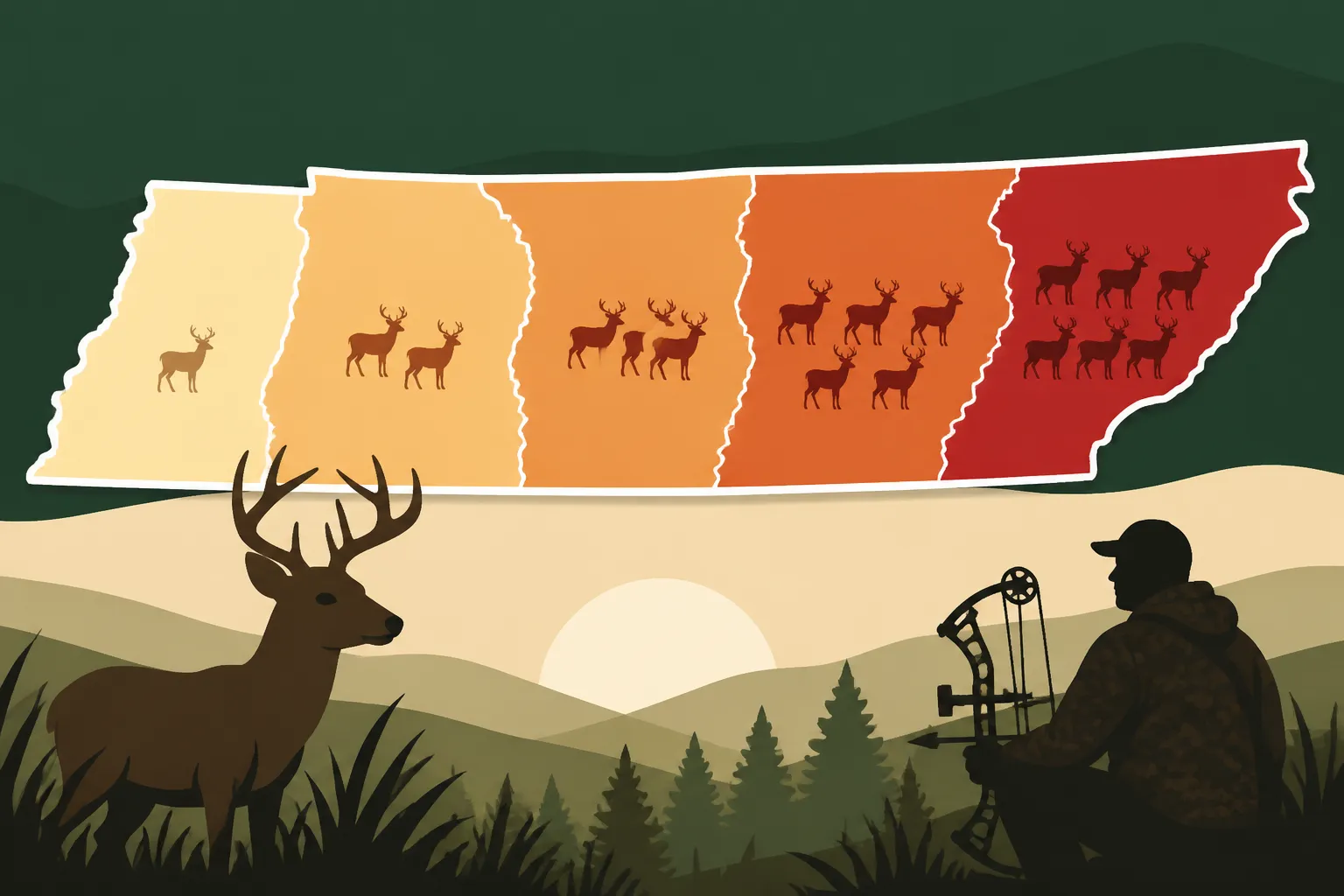
If you're looking for sheer numbers, West Tennessee often delivers. This region, characterized by its fertile river bottoms and vast agricultural fields, is often cited as having some of the highest deer densities in the state. It's the kind of place where you might see deer pouring out of a standing bean field at last light, or find an abundance of tracks along a creek bank. But with high density often comes high hunting pressure, especially on public lands or easily accessible private tracts.
Bottomland Hardwoods and Agricultural Hotbeds
West Tennessee is a mosaic of rich habitats that are simply perfect for whitetails. The major river systems like the Mississippi, Tennessee, and Hatchie provide expansive bottomland hardwoods, creating incredible natural food sources like acorns and soft mast. These areas are interspersed with vast agricultural fields – corn, soybeans, and winter wheat – which act as super-food plots, drawing deer in from miles around. This combination of natural browse and high-energy crops allows deer populations to flourish. It’s no wonder many hunters believe Why West Tennessee Grows Big Bucks is because of these conditions.
Deer here often have smaller home ranges due to the abundance of resources, making them somewhat more predictable if you can find their preferred bedding and feeding areas. If you're looking to consistently fill antlerless tags, areas around counties like Obion, Lauderdale, and Dyer often boast impressive numbers. You can learn a lot from scouting the Hunting West Tennessee River Bottoms during the off-season.
Impact of Chronic Wasting Disease CWD on Density
While West Tennessee generally maintains robust deer populations, the spread of Chronic Wasting Disease (CWD) has become a significant management concern, directly impacting deer density in certain zones. The Tennessee's Chronic Wasting Disease Management Zone now encompasses a growing number of counties in the western part of the state, particularly those close to the initial outbreaks. In these CWD-positive areas, TWRA has implemented specific regulations, including increased antlerless harvest opportunities and carcass movement restrictions, all aimed at slowing the spread and reducing herd density to minimize transmission.
Biologists monitor CWD prevalence closely, and while the disease can reduce localized deer numbers, the overall impact on regional density is actively managed. Hunters in these zones often face adjusted bag limits and mandatory testing requirements, but understanding that these measures are in place to preserve the long-term health of the herd is crucial. Always check the latest TWRA regulations if you plan to hunt in a CWD-affected county.
Navigating High Density Areas and Hunting Pressure
Hunting in high-density deer areas often means you're not alone. Public lands in West Tennessee, especially during the opening weeks of bow and gun season, can see significant hunting pressure. It’s not uncommon to pull up to a WMA parking lot and see a dozen trucks already there. This pressure can make deer more nocturnal, push them into the thickest cover, or make them highly sensitive to human presence.
To succeed, you need to be willing to work harder than the average hunter. This might mean hiking deeper into public land, identifying overlooked pockets of cover, or studying aerial maps on tools like GoHunt to find entry and exit routes that avoid main trails. Consider hunting during weekdays or later in the season when pressure wanes. Often, the deer are still there; they've just become savvier. Adapting your approach from standard setups to something more subtle, like still-hunting, can be the key to success. You might even find success on Hunting West Tennessee Bottomland Deer by focusing on overlooked thickets.
Middle Tennessee: A Mix of Suburban and Rural Opportunities
Middle Tennessee presents a fascinating blend of hunting opportunities, ranging from highly populated suburban areas with surprisingly robust deer numbers to sprawling farms and timber tracts that offer traditional hunting experiences. The deer density here can vary wildly from one county to the next, and even from one hollow to the next, making scouting an even more critical component of success. It’s not as universally "dense" as West Tennessee, nor as ruggedly sparse as parts of the East, but it has its own unique charm and challenges.
The Rolling Hills and Expanding Development
The landscape of Middle Tennessee is characterized by its iconic rolling hills, hardwood forests, and increasingly, suburban sprawl. As Nashville and its surrounding communities continue to grow, the lines between urban and rural become blurred. This expansion leads to interesting deer dynamics; deer learn to live alongside humans, often thriving in green spaces, parks, and large private properties where hunting pressure is low or non-existent.
In counties like Williamson, Wilson, or Rutherford, you might find deer densities that rival traditional hunting grounds, despite the proximity to bustling towns. These deer are often well-fed, robust, and can grow impressive antlers, thanks to lush forage and reduced stress. However, accessing these deer often requires securing permission on private land, which can be a challenge in itself.
Food Sources and Habitat Fragmentation
The diverse landscape of Middle Tennessee offers a smorgasbord of food sources for deer. From acorns in the expansive hardwood forests to agricultural crops like corn and soybeans in the more rural areas, deer have plenty to eat. But a defining characteristic of this region is habitat fragmentation. As development pushes outwards, large contiguous blocks of habitat are broken up by roads, subdivisions, and commercial zones.
This fragmentation forces deer to adapt, often creating distinct travel corridors between remaining patches of woods and food sources. Understanding these corridors is paramount. A small woodlot bordering a golf course or a creek bottom running through multiple private properties can become a superhighway for deer movement. Scouting, often with the help of mapping apps like GoHunt, becomes essential to identify these subtle patterns. Even a small, overlooked parcel of timber can hold a significant number of deer if it's positioned correctly between bedding and feeding areas.
Hunting Near Population Centers
Hunting near population centers in Middle Tennessee comes with a unique set of considerations. While deer numbers can be high, legal access, safety zones, and public perception are all critical factors. Many suburban areas have strict archery-only seasons or specialized permits to help manage deer populations that might otherwise become a nuisance to homeowners. This means more hunters are exploring options like Tennessee Suburban Archery-Only Zones.
If you're hunting private land, maintaining a good relationship with landowners and respecting their property is paramount. Always be aware of safety zones around dwellings and public areas. For public land hunters, WMAs within reasonable driving distance of cities, like Cheatham WMA or Percy Priest WMA, can offer good hunting, but expect competition, especially during peak season. These areas often benefit from early-morning or late-afternoon scouting to understand deer movement patterns and identify less-pressured pockets.
East Tennessee: Mountainous Challenges and Hidden Gems
East Tennessee, with its majestic Appalachian Mountains and rugged terrain, offers a completely different deer hunting experience than the rest of the state. Here, deer densities are generally lower than in the fertile western and central regions. This isn't necessarily a bad thing; it just means the hunting is different, often more physically demanding, but incredibly rewarding for those who embrace the challenge.
Appalachian Foothills and the Cherokee National Forest
The vast expanse of the Appalachian Foothills and the Cherokee National Forest Hunting dominates much of East Tennessee. This landscape is characterized by steep ridges, deep hollows, and dense, mature timber. Unlike the agricultural lands to the west, food sources here are primarily natural mast crops like acorns, hickory nuts, and various forms of browse. Deer populations are adapted to this environment, often ranging over larger areas in search of food and cover.
While deer density might not be as high as in other regions, don't mistake that for a lack of deer. The deer are simply more spread out and often harder to locate. This region is known for producing older, wiser bucks that have survived multiple hunting seasons by mastering the art of evasion in their mountainous home. This makes for a truly challenging and fulfilling hunt. For a serious challenge, consider Hunting Near the Great Smoky Mountains.
Lower Densities, Mature Bucks, and Difficult Terrain
Hunting in East Tennessee often means covering a lot of ground. Lower deer densities necessitate extensive scouting and patience. You'll likely spend more time walking and less time sitting, unless you've pinpointed a specific travel corridor or feeding area. The terrain itself is a formidable challenge: steep climbs, rocky outcrops, and dense rhododendron thickets will test your endurance and grit.
However, the reward can be substantial. These lower-density environments often foster the development of older, more mature bucks. A five-year-old buck in the Cherokee National Forest is a truly magnificent animal, having outsmarted predators and hunters for years. The satisfaction of harvesting a deer from such challenging terrain is unparalleled. It's a different kind of hunt, focusing on quality over quantity, and often involves a unique approach compared to White-Tailed Deer Across Tennessee in other areas.
Adapting Tactics to Mountainous Deer Behavior
To consistently succeed in East Tennessee, you need to adapt your tactics to the unique behavior of mountain deer. Understanding thermals and wind currents is paramount, as swirling winds in hollows can quickly betray your presence. Deer often use benches and saddles along ridges as travel corridors, especially during the rut. Scouting these features and identifying fresh sign is critical. Tools like GoHunt can be invaluable for mapping out elevation changes, benches, and potential bedding areas.
Food sources can also be a puzzle. After a poor acorn year, deer might shift dramatically to different browse or soft mast areas. Look for clear-cuts or logging operations, as new growth provides vital forage. Being physically prepared for strenuous hikes and mentally prepared for long hours without sightings is key. Focus on stealth, patience, and a deep understanding of the terrain. This might involve different strategies for Reading a Ridge for East Tennessee Deer.
The Cumberland Plateau: A Unique Landscape for Whitetails
Nestled between the rolling hills of Middle Tennessee and the rugged mountains of East Tennessee, the Cumberland Plateau offers a distinct deer hunting experience. This elevated, relatively flat-topped region is characterized by its mixed forests, deep gorges, and often remote public lands. Deer density here can be moderate, offering a blend of opportunities that appeal to various hunting styles.
Rugged Terrain and Mixed Forests
The Cumberland Plateau, particularly in counties like Morgan, Scott, and Fentress, presents a landscape that is both beautiful and challenging. You'll find a mix of oak-hickory forests, pine plantations, and dense undergrowth. While the plateaus themselves can be relatively flat, they are frequently dissected by steep-sided canyons, making for grueling hikes. Water sources often consist of small creeks and seep springs, which can be critical for deer, especially during dry spells.
The habitat diversity provides ample food and cover, contributing to a healthy deer population. Hunters often appreciate the solitude found on the Plateau, a stark contrast to the crowds sometimes encountered in other regions. It's a place where you can truly immerse yourself in the wilderness, learning to read the subtle signs of deer movement in this unique environment. If you're considering Hunting the Cumberland Plateau, be prepared for some serious leg work.
Finding Pockets of Higher Density
While the overall deer density on the Cumberland Plateau might be considered moderate, skilled hunters know how to find pockets of higher concentration. These often occur in areas with a confluence of favorable conditions: reliable food sources, excellent bedding cover, and less hunting pressure. Look for areas with a strong mast crop in a given year, or recent timber cuts that are providing fresh browse. Creek bottoms and the edges of agricultural fields (where they exist) can also be magnets for deer.
Ridgelines with benches and saddles frequently serve as deer highways, especially during the rut. Identifying these subtle terrain features using topo maps and satellite imagery (again, GoHunt is a fantastic resource here) can be a game-changer. Don't be afraid to walk a little further than most; often, the deer are just beyond the typical hunter's comfort zone. Even in areas with seemingly low Cumberland Plateau Deer Density, these concentrated pockets can offer excellent hunting.
Strategies for the Plateau Hunter
Hunting the Cumberland Plateau requires a blend of tactics. Still-hunting along ridgelines, pausing frequently to glass and listen, can be incredibly effective. Setting up a treestand or ground blind near a consistent food source or pinch point, especially during the colder months, can also pay dividends. Since deer here often cover more ground, patterning them can be more challenging, but understanding their seasonal shifts is key.
During the early archery season, focusing on water sources and soft mast can be productive. As acorns drop, deer will spread out, so tracking the hot mast trees becomes critical. Later in the season, during rifle and muzzleloader seasons, cold fronts can push deer into thermal cover on south-facing slopes. Always pay attention to wind and thermals, which can be tricky in the broken terrain of the Plateau. Considering Reading Aerial Photos for Cumberland Plateau Deer can give you a major advantage in pre-season scouting.
Harnessing Data for Your Tennessee Deer Hunt
Understanding deer density is just the first step. The real art of hunting is taking that information and translating it into a successful strategy in the field. Thankfully, the Tennessee Wildlife Resources Agency provides a wealth of data that, when combined with modern mapping tools and a keen eye, can significantly improve your odds. It's about being informed, adaptable, and constantly learning from the landscape.
Using TWRA Resources and Mapping Tools
The TWRA website is a goldmine of information for hunters. Beyond just season dates and regulations, you can find annual harvest reports broken down by county, which can give you a strong indication of where deer are being harvested most frequently. They also offer maps of public lands, including Wildlife Management Areas (WMAs), with detailed boundary information. This data, while not directly "density" numbers, paints a clear picture of hunter success and potential deer concentrations.
Furthermore, combining TWRA data with powerful mapping tools like GoHunt, OnX Hunt, or BaseMap is a game-changer. These apps allow you to overlay property lines, topo maps, satellite imagery, and even TWRA data layers, helping you identify potential bedding areas, travel corridors, and food sources before you ever set foot in the woods. You can mark waypoints, track your movements, and even analyze wind direction for specific stand locations. Mastering Scouting With the Tennessee TWRA App can save you countless hours of blind searching.
Interpreting Harvest Reports and Trends
Don't just glance at the harvest reports; dig into them. While a county's total harvest number might seem impressive, look at the "harvest per square mile" or "harvest per hunter" statistics to get a truer sense of density and opportunity. Pay attention to trends over several years. Is the harvest stable, increasing, or declining? Are antlered buck harvests high, or is it mostly antlerless deer? These details can inform your strategy.
For instance, a county with a consistently high antlerless harvest often indicates a healthy, dense deer population. Conversely, a sharp decline might signal environmental issues like EHD, or increased hunting pressure. Understanding these nuances helps you make educated decisions about where to spend your time and what kind of hunt to expect. This also relates to how Tennessee Deer Harvest Records are compiled and presented annually.
The Role of EHD and Other Environmental Factors
Epizootic Hemorrhagic Disease (EHD) is a frustrating reality for deer managers and hunters alike. This viral disease, transmitted by biting midges, can cause significant localized deer die-offs, especially during late summer and early fall, particularly after periods of drought followed by rain. While not always widespread, EHD can dramatically reduce deer density in affected areas, turning a once-productive hunting spot into a ghost town.
Beyond EHD, other environmental factors play a constant role. Hard mast failures (poor acorn crops) can force deer to shift their patterns, concentrating them in areas with alternative food sources or leading to wider dispersal. Severe weather events, like ice storms that damage timber or prolonged flooding, can also impact deer movement and survival. Staying informed about these issues through local TWRA updates or hunter reports can give you a critical edge in understanding the current state of deer density in your chosen hunting grounds.
Disclaimer
The information provided in this guide is for general informational purposes only and is subject to change. Hunting regulations, deer densities, and environmental conditions can vary and are often updated by the Tennessee Wildlife Resources Agency (TWRA). Always consult the most current TWRA hunting guide and local regulations before planning any hunting activity. Safe hunting practices and adherence to all laws are the responsibility of the individual hunter.