Treestand Setups in Cherokee National Forest
Hunting in the Cherokee National Forest can be an incredibly rewarding experience, but let's be honest, it's also incredibly challenging. The steep, rugged terrain, dense timber, and vastness of it all can make even the most seasoned hunter feel overwhelmed, especially when it comes to figuring out where and how to set up a treestand effectively. You trek for miles, find what looks like perfect sign, only to realize the only "stand-worthy" trees are on an impossible slope, or the wind swirls like crazy in that hollow. This guide is here to walk you through the nuances of successful treestand setups in the Cherokee, helping you understand the landscape, choose the right gear, and strategize your approach for safer, more productive hunts.
Understanding the Unique Terrain of Cherokee National Forest
The Cherokee National Forest is a beast of a different stripe compared to the rolling hills of West Tennessee or the flatter farmlands of the Cumberland Plateau. Its character is defined by towering mountains, deep valleys, and unforgiving grades, all of which play a crucial role in how deer move and, consequently, how you should set up your treestand. Ignoring these geographical realities is a surefire way to have a miserable and unproductive hunt.
Steep Slopes and Remote Hollows
The first thing that hits you when you start hunting the Cherokee is the sheer verticality. You're not just walking; you're climbing. And those climbs often lead to remote hollows that rarely see human pressure. Deer, being creatures of efficiency, will use benches, saddles, and more subtle terrain features to navigate these steep areas, often moving horizontally across a mountain face rather than straight up and down. This means you need to train your eye to spot these subtle breaks in the terrain. A bench, even if it's only a few feet wide, can be a major deer highway. A saddle, connecting two ridge lines, acts as a natural funnel, especially during the rut.
The frustration here is real: you might find a perfect game trail, but the trees around it are either too small, too limby, or on such a severe lean that setting up a stand safely feels impossible. This is where patience and persistence pay off, along with a keen eye for finding that one "just right" tree in an otherwise chaotic forest. Remember, moving slowly and deliberately, especially when looking for rub lines or scrape activity, will reveal more than simply crashing through the woods.
Timber Types and Their Influence on Stand Placement
The Cherokee National Forest boasts a diverse mix of timber, and understanding what you're looking at can give you a significant advantage. Higher elevations often feature more oak species like white oak and chestnut oak, providing crucial mast crops that deer absolutely key in on. Lower down, especially in creek bottoms and areas with more moisture, you might find a mix of poplar, maple, and even some hemlocks. Pine thickets are also prevalent, offering dense thermal cover and bedding areas.
Your stand placement should always consider the prevailing timber type and its current value to deer. If it's an excellent acorn year, you want to be on an oak-laden ridge or bench where deer are actively feeding. If the acorns are scarce, deer might be pushed towards browse or other less desirable food sources, or even down to agricultural fields on the fringe of the forest. Understanding Hunting After a Poor Acorn Year is critical in these situations. Furthermore, thick pine stands, while offering great cover for deer, are incredibly difficult to hunt from a stand due to limited visibility and the difficulty of finding suitable trees. You'll often find yourself setting up on the edge of such cover, intercepting deer as they move in and out.
Water Sources and Travel Corridors
In the mountainous terrain of the Cherokee, water sources are often less visible than in flatter regions, but they are no less vital. Small springs, seeps, and trickling creeks in hollows can be magnets for deer, especially during dry spells or late season when other water might be frozen. Deer will often follow these water features, using the contours of the land for cover. These natural "drainage" systems often form excellent travel corridors.
Imagine a small, rocky creek bed winding its way down a hollow. Deer will frequently walk these beds, or parallel to them just up on the bank, especially if it offers softer footing or good cover. Intersecting one of these drainages with a ridgetop saddle or a subtle bench can create a perfect ambush point. These natural funnels concentrate deer movement, making your stand location much more effective. Always look for evidence of repeated use, like worn trails, fresh tracks in the mud near a spring, or even old rubs lining a creek bank. These telltale signs confirm that deer are regularly using that corridor.
Choosing the Right Treestand and Gear for the Cherokee
The Cherokee National Forest is not the place for heavy, bulky gear. Every pound you carry up those steep inclines feels like five, and noise can echo through the quiet timber, spooking game long before you even get settled. Choosing the right treestand and supplementary gear is paramount for both effectiveness and your sanity.
Types of Treestands for Mountain Hunting
Given the diverse and often challenging tree growth in the Cherokee, a versatile approach to treestands is usually best.
Climber Stands: Limited, But Effective When Possible
Climber stands are beloved for their portability and ease of setup if you can find the right tree. The Cherokee National Forest, with its abundance of irregular timber, gnarled oaks, and limby hardwoods, often makes finding a truly "climber-friendly" tree a frustrating exercise. You need a straight trunk, free of limbs for at least 20-25 feet, and ideally one with relatively smooth bark. If you manage to locate such a tree along a deer travel route, a lightweight climber can be an excellent option for a quick, mobile setup. However, don't count on them for every spot you scout. They are also notoriously noisy to ascend if you're not careful, which can blow your hunt before daylight.
Hang-on Stands: The Workhorse of Mountain Hunters
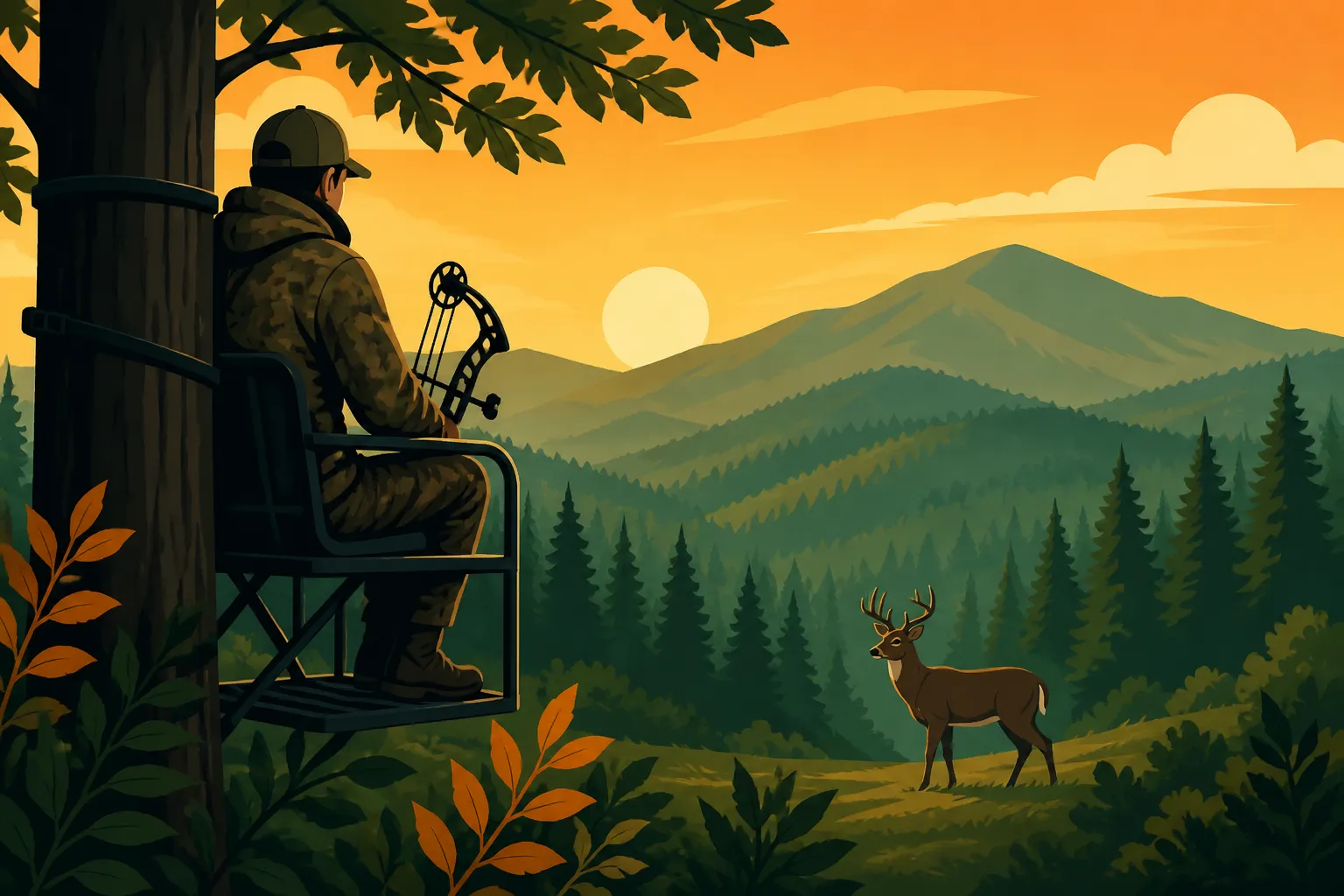
For the vast majority of situations in the Cherokee, a hang-on stand coupled with climbing sticks is the most adaptable and often the safest choice. These stands allow you to pick almost any healthy tree, regardless of its limb structure or slight lean, giving you far more flexibility in your exact stand placement. You can wrap around a tree to hide your silhouette, or get into gnarlier, thicker timber where a climber would be impossible. The downside is the added weight of climbing sticks and the slightly longer, more involved setup process. However, the ability to leave a stand in place for the duration of a short hunt, or to set one up silently and securely, makes them invaluable. For more detailed insights on public land setups, consider this guide on Treestand Rules on Tennessee Public Land.
Saddle Hunting: The Ultimate in Mobility
Saddle hunting has exploded in popularity for good reason, especially in rugged terrain like the Cherokee National Forest. It offers unmatched mobility, allowing you to scale almost any tree, pivot 360 degrees for shots, and hunt from angles that traditional stands simply can't achieve. The minimalist nature of a saddle setup – often just the saddle, a set of lightweight sticks, and a platform – makes long treks deep into remote hollows far more manageable. The learning curve can be steep, and comfort is highly personal, but for hunters prioritizing agility and the ability to get into truly tough spots, a saddle is a game-changer. It allows you to quickly adjust to changing deer patterns and set up on trees that would be impossible with other stand types.
Essential Gear for Safe and Effective Setup
Beyond the stand itself, a few pieces of critical gear are non-negotiable for anyone hanging a stand in the Cherokee.
Safety Harness: Your Lifeline
This isn't a suggestion; it's a requirement. A full-body safety harness must be worn from the moment your feet leave the ground until they return. The Cherokee's steep, unforgiving terrain makes any fall exponentially more dangerous. Investing in a comfortable, high-quality harness and a lifeline (like a HSS Ultra-Lite or a Muddy Safeguard) that stays with the tree as you climb is the smartest decision you'll make. No deer is worth a broken neck or worse.
Climbing Sticks and Haul Rope
If you're using a hang-on stand, quality climbing sticks are crucial. Look for lightweight, modular sticks that pack down easily. For example, brands like Lone Wolf or Hawk offer excellent options. A good haul rope is also indispensable for raising your bow or rifle safely once you're in the stand. Never climb with your weapon; always haul it up after you're secured.
Lightweight Pack and Tools
A lightweight day pack, perhaps from brands like GoHunt for organization and comfort, is essential for carrying your gear. You'll need a small folding saw or pruning shears to clear shooting lanes, a headlamp for walking in and out in the dark, and plenty of water. Every item should be considered for its weight and utility. When you're Packs for a Cherokee Forest Day Hunt, remember that lighter is always better.
The Importance of Lightweight and Quiet Gear
In the Cherokee National Forest, ounces equal pounds, and pounds equal pain. A stand setup that feels manageable on flat ground can become an unbearable burden when you're slogging up a 45-degree slope for a mile. This is why prioritizing lightweight gear is so important. Look for aluminum stands, carbon fiber climbing sticks, and minimalist packs. The less weight you carry, the deeper and more comfortably you can penetrate into untouched areas.
Equally important is quiet gear. The mountains are often incredibly still, and any metallic clank, squeaking strap, or rustling fabric will carry a long way. Before you ever head into the woods, practice setting up your stand and sticks in your yard to identify and eliminate any sources of noise. Wrap metal-on-metal components with electrical tape, use rubber washers, and ensure your pack straps don't rub noisily against your clothing. A deer hearing you clanking around at 5 AM is a deer that's going to be far away before shooting light.
Strategic Stand Placement: Reading the Mountain Landscape
Placing a treestand effectively in the Cherokee National Forest isn't just about finding a big tree near a deer track; it's about understanding the complex interplay of terrain, wind, food, and cover. It's like putting together a puzzle, and every piece matters.
Identifying Key Deer Movement Patterns
Deer in the mountains are opportunists and energy conservers. They will use the path of least resistance whenever possible, which often means following subtle contours of the land.
Saddles and Ridge Points
Saddles, which are dips in a ridgeline connecting two higher points, are absolute goldmines. Deer will almost always cross these saddles when moving between drainages or ridge systems, especially during the rut. Setting up a stand in a tree overlooking a well-used saddle can be incredibly effective. Ridge points – where a finger ridge extends off a main ridge – also act as natural funnels. Deer will skirt around these points, creating obvious travel corridors. Look for fresh rubs and scrapes on both sides of a saddle or point to confirm active use. Reading a Ridge for East Tennessee Deer can provide more detail on these critical features.
Benches and Creek Bottoms
Benches are flat or gently sloped sections on an otherwise steep mountainside. They are deer highways, allowing them to traverse steep terrain horizontally without expending too much energy. These can be tough to spot from a distance, requiring boots-on-the-ground scouting to locate. Creek bottoms, as discussed earlier, also serve as major travel routes, especially when they offer thick cover or easy access to water. Pay attention to how deer move from bedding areas on higher slopes down to feed in creek bottoms or vice versa. The intersection of a bench with a creek crossing, or a bench that funnels into a tight hollow, can be a killer stand location.
Playing the Wind and Thermals in Hilly Terrain
This is arguably the most critical aspect of mountain hunting. Wind and thermals behave very differently in rugged terrain than on flat ground, and misreading them will blow your hunt every single time.
Understanding Thermals
Thermals are air currents driven by temperature changes. In the mountains, they are incredibly predictable. In the morning, as the sun warms the earth, air begins to rise. This means thermals will typically pull your scent uphill. In the evening, as the sun sets and the air cools, the thermals reverse, pulling your scent downhill into the hollows.
The frustration comes when thermals "switch" around mid-morning or late afternoon, or when you encounter a strong crosswind that overrides them. You might be set up perfectly for a morning hunt, only for the thermals to shift an hour after daylight, broadcasting your scent. Always carry a small bottle of wind checker powder and constantly monitor the air currents. Setting up on a Wind and Thermals on a Ridge System is an art, and it requires constant vigilance.
Dealing with Swirling Winds
Beyond predictable thermals, mountains create their own unpredictable wind patterns. Valleys and hollows can act like funnels or eddies, causing winds to swirl in unpredictable directions. A steady wind on a ridgetop can become a chaotic mess down in a deep hollow. Your goal is to identify areas where the wind is most consistent, or to pick a stand site that offers multiple wind direction options. Sometimes, the best strategy is to set up a few different stands for different wind scenarios, especially on a longer hunt. This allows you to adapt to the conditions on the day.
Entry and Exit Routes Without Spooking Game
Getting to and from your stand without alerting every deer in the county is paramount, especially on heavily pressured public land like portions of the Cherokee. This requires meticulous planning.
Concealed and Quiet Pathways
Prioritize routes that offer maximum concealment and quiet footing. Dry creek beds can be excellent, as the sound of crunching leaves is often masked by the rocks. Utilizing ridgelines as opposed to walking through thick hollows can keep you above potential bedding areas, and often the wind is more consistent. Avoid walking through known bedding areas or primary food sources, especially during legal hunting hours. Your goal is to be a ghost entering and exiting the woods.
Using Topography to Your Advantage
Study your maps (and your GoHunt app!) beforehand to identify topographical features that can shield your approach. A small knoll, a dense thicket, or even a subtle dip in the terrain can provide enough cover to slip in undetected. For more information on finding those hidden gems, read about Finding Ground Others Walk Past on public land. Remember, deer are incredibly sensitive to movement and foreign smells. A well-planned entry route might mean taking a slightly longer path, but it dramatically increases your chances of a successful, unpressured hunt.
Pre-Season Scouting and In-Season Adaptations
Hunting the Cherokee National Forest isn't something you just show up for on opening day. It demands diligent pre-season scouting and the flexibility to adapt your tactics as the season progresses.
Leveraging Technology for Remote Scouting
In vast public lands like the Cherokee, technology is your best friend for narrowing down hundreds of thousands of acres to a few promising spots.
Satellite Imagery and Topographical Maps
Before you ever put boots on the ground, spend hours poring over satellite imagery and topographical maps. Use tools like GoHunt mapping features, Google Earth, or the TWRA's Go Outdoors app. Look for ridgeline saddles, benches, creek confluence points, and any areas that show distinct changes in elevation or timber type. These are often indicators of natural funnels or bedding areas. Topographical maps are especially critical for identifying those subtle benches that might be invisible on satellite views but are heavily used by deer. Mark potential stand locations, bedding areas, and water sources as waypoints on your GPS or phone app. This detailed remote scouting saves you countless hours of aimless wandering in the woods.
Utilizing GPS Devices and Phone Apps
Once you've identified promising areas remotely, load those waypoints into your handheld GPS or phone app. This becomes invaluable when you're on the ground, confirming features and navigating the dense forest. Many modern hunting apps also allow you to track your movement, mark fresh sign, and even check property boundaries, which is crucial on public land. For a deep dive into using these tools, check out Scouting Tennessee Public Land Before Season. Always carry a backup power source for your phone, as cell service can be spotty in the remote reaches of the Cherokee.
Boots-on-the-Ground Reconnaissance
As helpful as technology is, nothing replaces boots-on-the-ground scouting. This is where you confirm or deny your hypotheses from remote scouting and find the crucial, up-to-the-minute sign.
Confirming Trails and Sign
Walk every ridgeline, every hollow, and every bench you've identified. Look for fresh rubs (indicating buck activity), scrape lines (especially during the pre-rut and rut), and well-worn trails. Pay attention to how these trails intersect and where they lead. Is there a heavily used trail connecting a bedding area on a steep slope to a feeding area in a bottom? Is there a subtle trail leading to a hidden spring? These are the details that turn a "good" spot into a "great" one. Don't be afraid to put in the miles; the more ground you cover, the better your chances of finding that perfect ambush point.
Trail Camera Placement and Public Land Rules
Trail cameras can be powerful scouting tools, offering insights into deer movement timing and patterns. However, always be aware of the rules regarding trail camera placement on public land in Tennessee. Generally, they are allowed, but you should mark them clearly with your name and TWRA ID. Place cameras on active trails, near scrapes, or overlooking pinch points. The data you gather from trail cameras can help you fine-tune your stand placement and confirm whether a spot is worth hunting. Just remember to be discreet with their placement to avoid theft or disturbance from other hunters.
Adjusting to Changing Conditions and Pressure
The Cherokee National Forest is a dynamic environment, and deer behavior can shift rapidly due to various factors. What worked last week might not work this week.
Adapting to Food Source Changes
One of the most significant factors is food availability. An abundant acorn crop can draw deer to certain ridges, but once those acorns are gone, deer will move on to other food sources like browse, honeysuckle, or agricultural fields on the forest fringes. A dry spell might push deer closer to reliable water sources. Always be observing the current conditions and be prepared to move your stand or hunt a different area if the food source you were keying on has dried up or disappeared. This flexibility is crucial for consistent success.
Responding to Hunting Pressure
The Cherokee National Forest, being public land, can experience significant hunting pressure, especially during opening weekends of rifle and muzzleloader seasons. When Hunting Pressure on Tennessee Public Land increases, deer often become more nocturnal or retreat to the thickest, most inaccessible cover they can find. If your favorite spot suddenly becomes crowded, don't be afraid to pull your stand and hike deeper, or switch to a different area entirely. Deer that are pushed tend to move predictably along certain escape routes, and if you can identify these, you might find success by setting up on them. This adaptability is what separates successful public land hunters from those who consistently come home empty-handed.
Safety First: Protocols for Treestand Hunting in Rough Terrain
Hunting from a treestand, especially in the rugged, steep environment of the Cherokee National Forest, inherently carries risks. Prioritizing safety is not just a recommendation; it's a life-or-death imperative. You are often far from roads, deep in remote areas, and a fall could have catastrophic consequences.
Full-Body Harness and Lifelines: Non-Negotiable Safety
Let's reiterate this: a full-body harness and a lifeline are absolutely non-negotiable. Every single time you leave the ground, you should be connected to the tree. No exceptions. A fall from even 10-15 feet can result in severe injuries, paralysis, or worse. In the remote parts of the Cherokee, help might be hours away.
Proper Usage and Equipment Checks
Ensure your harness fits properly and is free of any wear, tears, or damage. Inspect all straps, buckles, and tethers before each use. When ascending or descending, use a lineman's rope or a similar system to stay connected at all times. Once in your stand, immediately attach your tether to the tree. The idea is to maintain "three points of contact" – either two hands and a foot, or two feet and a hand – as you climb, and always have that safety tether engaged. Never, ever, rely solely on your stand's attachment to the tree; the harness is your personal backup. It's easy to get complacent, but one moment of distraction or a slick step could change everything.
Communication and Emergency Preparedness
Being prepared for an emergency is even more critical in the isolated stretches of the Cherokee National Forest.
Share Your Hunt Plan
Always, always tell someone reliable exactly where you are going, what time you expect to return, and who to call if you don't check in. Be as specific as possible with your location, using landmarks or GPS coordinates if you can. A simple text message with a dropped pin can be a lifesaver. This simple act creates a safety net in case the unthinkable happens.
Essential Emergency Gear
Carry a fully charged cell phone (though service can be unreliable in the mountains), a small first-aid kit, a whistle, and a headlamp (even for daytime hunts, as unexpected delays can leave you walking out in the dark). Consider a personal locator beacon (PLB) or a satellite messenger like a Garmin InReach for truly remote hunts, as these can summon help even without cell service. Knowing how to administer basic first aid for cuts, sprains, or even a deep puncture wound could be crucial for yourself or a hunting partner. This is especially true if you are faced with Recovering a Deer From a Steep Hollow – an endeavor that often involves uneven ground and heavy lifting.
Tree Selection and Stand Maintenance
Your stand is only as safe as the tree it's on and its own condition. Careful selection and regular inspection are key.
Choosing a Healthy Tree
Before hanging any stand, thoroughly inspect the tree. Choose a healthy, live tree with a sturdy trunk that is free of rot, large dead limbs, or heavy moss/vines that could hide structural issues. Avoid leaning trees, diseased trees, or trees with shallow root systems that could be easily uprooted in a strong wind. Ideally, pick a tree with rough bark, which helps secure climbing sticks and stand straps more effectively.
Regular Stand Inspection and Maintenance
Before and after each season, thoroughly inspect your treestand, climbing sticks, and all straps and ropes. Look for frayed straps, rusty buckles, cracked plastic parts, or any signs of wear and tear. Rodents can chew through straps, and UV exposure can weaken them over time. Replace any questionable components immediately. Never use a stand that shows signs of damage. If leaving a stand out for an extended period, periodically re-check straps for tightness, as trees can grow and stretch them, or they can loosen with weather changes.
Here's a quick comparison of treestand types for the Cherokee National Forest:
| Treestand Type | Pros | Cons | Ideal Cherokee Scenario |
|---|---|---|---|
| Climber | Lightweight, quick setup (on right trees), portable for deep hunts. | Limited to straight, limbless trees; noisy to ascend; not ideal for very steep slopes or irregular timber. | Long walks to specific areas with abundant straight pines or mature hardwoods on relatively moderate slopes. |
| Hang-on | Highly versatile (any healthy tree); silent setup; good for hard-to-reach spots; can be left in place. | Requires climbing sticks (added weight); longer initial setup time; can be awkward on extremely steep inclines. | Most common choice. Adapts to varied terrain and timber, allowing precise placement near subtle deer sign like benches or saddles. |
| Saddle | Maximum mobility; lightweight; 360-degree shooting; adaptable to almost any tree; minimalist for deep treks. | Steep learning curve; comfort is personal; requires a separate platform/mini sticks; not for hunters seeking a full sit-down experience. | For the most mobile, deep-woods hunters targeting remote, rough terrain where traditional stands are impractical. |
Disclaimer
Hunting is an inherently dangerous activity. This guide provides information and suggestions for treestand setups in the Cherokee National Forest but cannot account for all variables or individual skill levels. Always consult and adhere to all Tennessee Wildlife Resources Agency (TWRA) regulations, practice extreme caution, and prioritize safety above all else. The author and publisher are not responsible for any accidents, injuries, or legal infractions incurred while hunting.