Zeroing at 100 Yards for Ridge Hunting
The crisp morning air on a Tennessee ridge often brings a sense of anticipation, but it also presents a unique challenge for rifle hunters: varied shot distances and tricky angles. You might be staring across a hollow at a buck at 175 yards, or a doe might appear suddenly at 40 yards, straight downhill. Trying to figure out where to aim when your gun is zeroed for a flat range can be a real head-scratcher, leading to missed opportunities or, worse, a poorly placed shot. This guide will walk you through why a 100-yard zero is your best friend in these situations and how to master it for confident, ethical hunting on Tennessee's dynamic terrain.
The Foundation of the 100-Yard Zero
When you're out in the woods, especially on the undulating landscape of the Cumberland Plateau or the rolling hills of Middle Tennessee, consistency is king. Trying to zero your rifle for an arbitrary "longer" distance can often lead to more confusion than clarity, especially if your local range doesn't offer those extended distances regularly.
Why 100 Yards is a Solid Starting Point
Think of a 100-yard zero as your home base. It's universally understood, easy to replicate at almost any shooting range, and provides a predictable baseline for your bullet's trajectory. When you know exactly where your bullet will impact at 100 yards, you've established a consistent reference point. This takes a lot of the guesswork out of the equation. For example, if you're practicing at the range, and your rounds are consistently hitting dead center at 100, you gain immense confidence that your rifle and scope are working together as they should.
Many hunters experience frustration trying to get a perfect 200-yard zero, only to find that minor inconsistencies in their shooting form or ammunition are magnified. Starting at 100 yards allows you to fine-tune your technique and ensure your rifle is truly dialed in before you even consider longer distances. It's a fundamental step that builds confidence and accuracy, which are paramount when that trophy buck steps out. Plus, many shots in the dense timber or thick cover of Tennessee are often well within 100 yards anyway, making this zero immediately practical.
Understanding Bullet Trajectory and Point Blank Range
A common misconception is that a 100-yard zero means your bullet only hits where you aim at precisely 100 yards. In reality, due to the parabolic arc of a bullet's flight path, your bullet rises slightly after leaving the muzzle, crosses your line of sight, and then begins to drop. With a 100-yard zero, your bullet will be slightly high at, say, 50 yards, dead on at 100, and then start dropping past that mark.
Understanding this trajectory is key. Let's consider common calibers often used for Tennessee Deer Season Structure Explained. For instance, a .308 Winchester zeroed at 100 yards might be about 1.5-2 inches high at 50 yards, dead on at 100, and then drop roughly 3-4 inches at 200 yards, and 10-12 inches at 300 yards. A flatter-shooting caliber like a 6.5 Creedmoor might have less drop at those extended distances.
This leads us to the concept of Point Blank Range (PBR). PBR is the maximum distance at which a bullet can be fired with a given sight setting without rising or falling beyond a certain vertical distance, typically the vital zone of the animal you're hunting (e.g., a 6-inch circle for a deer). By understanding your bullet's trajectory with a 100-yard zero, you can determine your effective PBR. This means that for a significant range of distances, you can simply put your crosshairs on the vitals and know you'll hit them, without adjusting your aiming point. For many typical Tennessee Deer Camp Traditions scenarios, especially in moderate cover, a 100-yard zero provides a very generous PBR.
| Caliber/Load (Example) | Zero Range | Max Rise (Approx.) | Drop at 200 yds (Approx.) | Drop at 300 yds (Approx.) |
|---|---|---|---|---|
| .308 Win (150gr) | 100 yards | +1.5" @ 75 yds | -3.5" | -11" |
| .270 Win (130gr) | 100 yards | +1.7" @ 85 yds | -2.5" | -8" |
| 6.5 Creedmoor (143gr) | 100 yards | +1.2" @ 80 yds | -2" | -6.5" |
| .30-06 Sprg (165gr) | 100 yards | +1.8" @ 80 yds | -3" | -9.5" |
Note: These figures are approximate and can vary significantly based on specific ammunition, barrel length, atmospheric conditions, and individual rifle performance. Always verify with your own rifle and load.
Adapting the 100-Yard Zero for Tennessee Ridges
Hunting Tennessee's varied terrain means you're rarely on a perfectly flat surface. The ridges, hollows, and steep climbs present challenges that flat-range shooting simply doesn't prepare you for without some extra knowledge. Your 100-yard zero is a fantastic starting point, but you'll need to know how to adapt it.
Account for Elevation and Angles
This is where many hunters get tripped up. When you shoot uphill or downhill, gravity affects the bullet's flight path differently than on level ground. The bullet is essentially traveling through less effective "gravity time" perpendicular to its path. What does this mean for you? It means that when shooting at a steep angle, whether up or down, your bullet will actually hit higher than if you were shooting the same linear distance on flat ground.
This phenomenon is often referred to as the "rifleman's rule" or simplified angle compensation. Ignoring it can lead to shooting over your target, especially at longer distances or steeper angles. The frustration is real: you range a deer at 200 yards across a deep ravine, aim perfectly, and watch your bullet sail harmlessly over its back. You likely just didn't account for the angle.
The good news is that modern rangefinders often have an angle compensation feature built-in. Instead of giving you the line-of-sight distance, they'll provide a "true ballistic range" or "horizontal equivalent distance" that you should use for your holdover calculations. This takes the guesswork out of it. If your rangefinder gives you 200 yards line-of-sight and a 170-yard horizontal equivalent, you should treat that shot as if it were 170 yards on flat ground for aiming purposes. This can drastically simplify your mental calculations and improve your accuracy on Hunting Cumberland Plateau Ridgelines.
Practical Holdover and Holdunder Techniques
Once you've got a solid 100-yard zero, adapting for different ranges and angles involves understanding holdovers and holdunders.
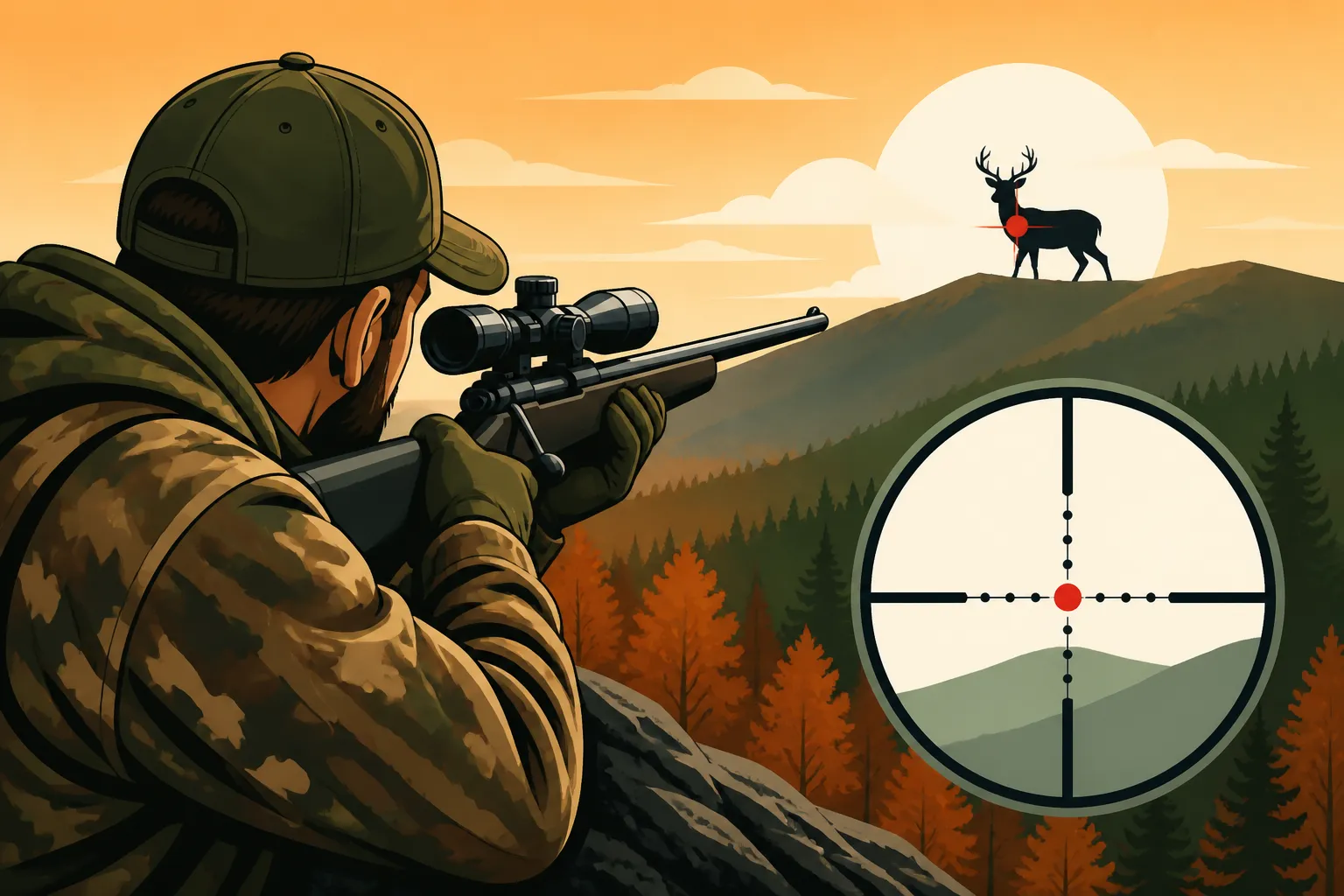
For shots beyond your 100-yard zero, you'll need to "hold over," meaning you aim slightly higher than the target to compensate for bullet drop. This is where your scope's reticle becomes incredibly useful. Many scopes have multiple aiming points, either BDC (Bullet Drop Compensating) reticles or hash marks that represent specific minute of angle (MOA) or milliradian (MRAD) subtensions. By knowing your bullet's drop at various distances (from a ballistic chart or app), you can learn which hash mark to use for a 200-yard shot, a 250-yard shot, and so on.
Let's say you're Reading a Ridge for East Tennessee Deer and spot a nice buck at 225 yards across a saddle. Your rangefinder gives you a horizontal equivalent of 200 yards. If your ballistic chart shows a 4-inch drop at 200 yards for your .308 with a 100-yard zero, you'd aim about 4 inches high on the buck's vitals. With a scope that has a reticle with subtensions, you could use the appropriate hash mark corresponding to that drop.
For shots under 100 yards, your bullet is likely still rising or at its peak. With a 100-yard zero, your bullet will typically hit slightly high (e.g., 1-2 inches high at 50 yards). For a quick, close shot, simply aiming dead center on the vitals will usually suffice, as this slight elevation is typically within the kill zone of a deer. However, if you're taking a shot at, say, 30 yards straight downhill, and your angle-compensating rangefinder gives you a horizontal equivalent of 25 yards, you're essentially shooting at a very close, "rising" part of your bullet's trajectory. You might need to make a slight "holdunder," aiming just a hair low to ensure a perfect hit. This might sound overly precise, but practicing these scenarios, even mentally, helps build confidence. You can often find sophisticated ballistic tools, some of which are part of broader hunting apps like GoHunt, that can help you calculate these precise holds for your specific rifle, ammunition, and even local atmospheric conditions.
Gear and Practice for Precision Ridge Hunting
Having the right equipment and committing to realistic practice are just as important as understanding ballistic principles. You can know all the theory in the world, but if your gear fails or you haven't practiced effectively, it won't matter when the moment of truth arrives.
Essential Gear for Confident Shots
- Rangefinder: This is non-negotiable for accurate ridge hunting. As mentioned, an angle-compensating rangefinder takes the guesswork out of uphill and downhill shots. It provides the horizontal equivalent distance, which is what truly matters for bullet trajectory. Without it, you're just guessing, and that's not a recipe for ethical hunting. Brands offer various models, so look for one that is rugged, waterproof, and has a clear display for those low-light Tennessee mornings.
- Optics: Your rifle scope is your window to precision. For Rifle Scopes for Low-Light Hollows, you need a scope with excellent light-gathering capabilities to pick out deer in dim timber or during the magical last minutes of legal shooting light. A reticle with holdover points (like a BDC or a simple duplex with subtensions) can be incredibly beneficial, allowing you to quickly select an aiming point for different ranges without fiddling with turret adjustments, which can be slow and noisy. Choose a scope that can withstand the bumps and knocks of hunting in rugged terrain.
- Ammunition: Consistency is paramount. Once you've chosen a bullet weight and brand that shoots well in your rifle, stick with it. Zeroing with one type of ammunition and hunting with another is a recipe for disaster, as different loads will have different trajectories. Invest in quality hunting ammunition that matches your rifle's preferences.
- Shooting Support: On uneven ground, finding a stable shooting position can be difficult. A good bipod attached to your rifle, shooting sticks, or even a well-packed hunting backpack can provide the steady rest you need for an accurate shot. Practicing with these supports from various field positions is crucial. Imagine trying to shoot freehand across a 150-yard hollow after a strenuous climb; a solid rest makes all the difference.
Drills and Real-World Practice
Just plinking at targets from a bench rest won't fully prepare you for the demands of ridge hunting. You need to simulate real-world scenarios.
- Unconventional Positions: Practice shooting from kneeling, sitting, or even prone positions, as well as simulating shots from a treestand. Often, you won't have the luxury of a perfect prone setup on a steep hillside. Being comfortable and accurate from less-than-ideal positions builds adaptability.
- Varying Distances and Angles: If you have access to a range that allows for varying distances and some elevation changes, use it! Set up targets at 50, 100, 150, and 200 yards (or further if safe and legal). Practice ranging targets and applying your holdovers/holdunders quickly and confidently. For angle practice, use a sloped hill or even a sturdy step ladder to practice aiming up and down at targets. This helps to solidify your understanding of how bullet impact changes with angle.
- Timed Drills: Hunting situations are often fast-paced. Practice getting your rifle up, ranging, finding your aiming point, and taking the shot within a short timeframe. This helps build muscle memory and reduces "buck fever" when the real moment arrives.
- Pre-Season Scouting: Use your off-season to scout Scouting Tennessee Public Land Before Season. Walk the ridges you plan to hunt. Use your rangefinder to measure distances across hollows, up and down slopes. Visualize shot opportunities and mentally calculate holds. Some hunters even use hunting apps, like those available through GoHunt, to analyze terrain, pinpoint potential shooting lanes, and mark key features that could influence a shot. This mental preparation is invaluable.
Maintaining Your Zero and Confidence
A 100-yard zero isn't a "set it and forget it" kind of deal. It requires regular attention to ensure accuracy and, perhaps most importantly, to maintain your mental confidence in your equipment and your abilities.
Regular Zero Checks
Before every hunting season, or if your rifle has taken a significant bump or been subjected to rough travel, it's absolutely critical to check your zero. Even minor shifts can mean the difference between a clean kill and a missed opportunity or a wounded animal. A trip to the range to fire a few shots at 100 yards will confirm everything is still aligned. If you've been hunting in wet or cold conditions, like those often seen during Hunting the Late-Season January Lull, ensure your bore is clean and free of moisture before storage, and double-check your zero again before your next outing.
While less critical for general Tennessee hunting, significant changes in temperature and altitude can subtly affect bullet trajectory. For most whitetail hunting, these changes are minimal enough not to cause major issues, but being aware that extreme shifts could occur is part of being a well-rounded hunter. Your primary concern should always be confirming mechanical accuracy.
Building Mental Confidence
Ultimately, successful and ethical hunting comes down to confidence. When you're Hunting Where the Antlerless Limit Drops to Two and that deer finally steps out, you want to focus on the shot, not on second-guessing your equipment or your aiming point.
- Know Your Limits: Understand your effective range with your rifle, ammunition, and personal skill level. Just because your rifle can shoot 300 yards doesn't mean you should take that shot in every field condition. If a shot feels too long, too angled, or too uncertain given the wind or terrain, it's always better to pass. There will be other opportunities.
- Review and Learn: After each hunt, whether successful or not, take a moment to review. What worked well? What could have been better? Did you misjudge a distance or angle? Did you rush a shot? Learning from every experience, even the frustrating ones, makes you a better hunter. This continuous learning process, combined with a solid 100-yard zero, will make you a far more effective and confident hunter on Tennessee's challenging ridges.
Disclaimer
This article is for general informational purposes only and does not constitute professional advice. Laws, prices and regulations vary by location and change over time. Consult a qualified professional for guidance on your specific situation.