Where Tennessee Sits in the Grouse Cycle
If you’ve spent any time chasing ruffed grouse in Tennessee, you know it’s a pursuit that often tests your patience and your boot leather more than your shotgun skills. Many of us remember stories, or even experienced ourselves, times when grouse seemed more abundant, drumming from every ridge. Today, it feels different, and understanding where Tennessee's ruffed grouse population stands in its natural cycle—and why it often feels like we're constantly on the downside—is key to managing expectations and finding those challenging birds.
Understanding the Ruffed Grouse Population Cycle
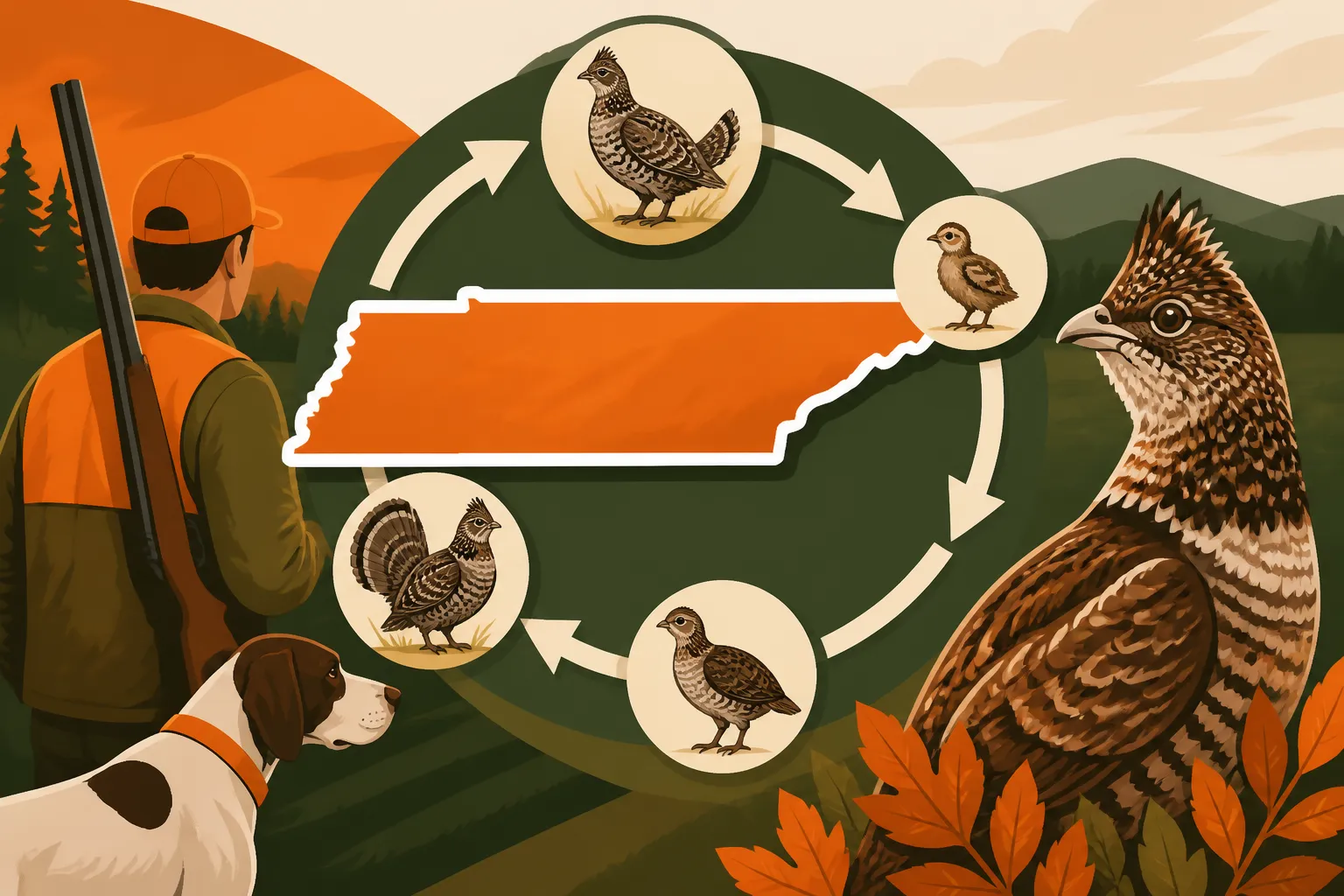
The concept of a "grouse cycle" is something hunters talk about frequently, and for good reason. It refers to the well-documented, natural fluctuation in ruffed grouse populations, typically over an 8 to 11-year period. These cycles are characterized by dramatic peaks in abundance followed by equally dramatic crashes, often leaving hunters scratching their heads about where all the birds went.
The Science Behind the Boom and Bust
At its core, the grouse cycle is a complex interplay of environmental factors. While the exact mechanisms are still debated and likely vary by region, several key elements contribute to these population swings. Food availability is a huge one; good mast years (acorns, beech nuts) can lead to healthier birds going into winter, increasing survival and reproductive success the following spring. Weather patterns play a role, too. Harsh winters can thin out populations, but more critically, cold, wet springs can devastate young broods, leading to a poor hatch. Predator populations, such as coyotes, bobcats, foxes, and various raptors, also cycle, and when predator numbers are high, they can exert significant pressure on grouse, especially when grouse numbers are already on the decline. Disease, while less understood in its cyclic impact, can also factor in. It's a natural, wild ecosystem at work, constantly finding equilibrium.
Regional Variations in Cycle Intensity
While the cycle is a real phenomenon, its intensity isn't uniform across the ruffed grouse's range. In the northern parts of the grouse's habitat, particularly in states like Minnesota, Wisconsin, and Michigan, the peaks and valleys of the cycle tend to be much more pronounced. Hunters in these regions can feel a clear difference between a "boom year" and a "bust year." However, as you move south, towards the fringe of the grouse's traditional range, such as here in Tennessee, the cycle often becomes less distinct. Our grouse populations are frequently more influenced by local habitat conditions and annual weather events than by the strong, sweeping cyclic patterns seen further north. This means that while a "cycle" might technically be happening, its effects are often masked or overshadowed by persistent habitat challenges, leading to what can feel like a perpetual low in population. It's not so much a dramatic up-and-down here, but more like a general struggle against baseline challenges, with only subtle shifts in overall numbers.
Tennessee's Unique Grouse Challenges and Habitat
Tennessee's position at the southern edge of the ruffed grouse range means our birds face a different set of challenges compared to their northern cousins. While the general cycle influences them, the health and availability of specific habitat types often dictate their localized success more profoundly. The good old days of plentiful grouse here were really tied to a different landscape, one that's largely disappeared.
Historical Decline and Habitat Loss
For generations, ruffed grouse thrived in Tennessee’s mountainous and hilly regions. The Cumberland Plateau and eastern counties, with their vast expanses of mixed hardwoods and early successional forest, once supported robust populations. However, widespread, large-scale clear-cutting practices of the past, followed by effective wildfire suppression, led to a shift in forest composition. Many areas that were once ideal, featuring diverse age classes of timber and dense understory, matured into vast tracts of older, unbroken canopy forest. While beautiful, mature timber lacks the critical early successional habitat that grouse absolutely require for nesting, brooding, and predator escape. Without that patchwork of young growth, dense thickets, and diverse food sources, grouse simply don't have the cover and sustenance they need to flourish. This historical change in our forests is arguably the biggest factor in the long-term decline of grouse in Tennessee, making any "up-cycle" feel far less impactful. Tennessee Ruffed Grouse Decline explains more about this history.
The Importance of Early Successional Habitat
So, what exactly is ideal grouse habitat in Tennessee? It's not just any woods. Grouse need young, regenerating forest, often described as 5- to 20-year-old clear-cuts or areas that have seen recent, significant disturbance, such as prescribed burns. These areas feature an incredibly dense understory—think thickets of briars, grapevines, mountain laurel, rhododendron, and young saplings. This "dog-hair thicket" provides essential overhead cover from raptors and ground cover from mammalian predators, while also producing a rich variety of soft mast and insects for food. Without these specific conditions, grouse simply cannot survive and reproduce effectively. The challenge is that these types of regenerating forests are often transient; they grow up quickly and, without ongoing disturbance (logging, burning), mature into less suitable habitat. This means that How Old a Cut Should Be for Grouse is a constant consideration for anyone looking to find these birds.
Where Tennessee Sits in the Current Cycle: A Realistic Assessment
Let's be frank: if you're looking for the kind of grouse numbers you'd find in prime northern states during a population peak, Tennessee isn't that place right now. We are, by most accounts, experiencing a prolonged low in grouse populations, which may or may not be directly tied to the traditional cyclic pattern. Instead, it's more about specific, localized pockets of suitable habitat.
A Prolonged Low, Not a Peak
For many years now, Tennessee's ruffed grouse populations have generally been low. While there might be minor fluctuations from one year to the next—a slightly better hatch here, a slightly tougher winter there—we aren't seeing the dramatic "boom" that characterizes a strong upward swing in the traditional cycle. Instead, what we're likely experiencing is a baseline population that is heavily dependent on specific, actively managed habitats. Our grouse aren't riding a broad, continental wave of abundance; they're more like resilient survivors clinging to what good cover they can find. This means that finding grouse in Tennessee isn't about hoping for a general population surge across the landscape, but rather about pinpointing those specific islands of ideal, early successional cover that are being maintained, often through dedicated conservation efforts.
Conservation Efforts and Localized Hotspots
Despite the challenges, conservation groups and the Tennessee Wildlife Resources Agency (TWRA) are actively working to improve grouse habitat on public lands. Much of this work focuses on areas within the Cherokee National Forest Hunting and various Tennessee Wildlife Management Areas (WMAs) on the Hunting the Cumberland Plateau. These efforts include timber harvests designed to create young forest, strategic prescribed burns to open up the understory and promote new growth, and invasive species control. These projects, while localized, are absolutely crucial for grouse survival. They create small, vibrant pockets where grouse can still find the dense cover and food sources they need. For hunters, this translates into a strategic hunt: success often means identifying these actively managed zones rather than hoping to stumble upon birds in mature timber. While it might not restore grouse numbers to historic highs, it does offer hope and opportunity for those willing to put in the work.
| Factor | Northern Grouse Range (Typical Cycle) | Tennessee (Current Reality) |
|---|---|---|
| Population Trend | Pronounced 8-11 year boom-bust cycle | Prolonged low, minor annual fluctuations |
| Dominant Influence | Cyclic dynamics (food, predation, weather) | Habitat availability, local conditions |
| Habitat Quality | Widespread, diverse early successional | Fragmented, localized early successional |
| Hunter Expectations | High potential for "banner" years | Challenging, rewarding, low-density pursuit |
| Conservation Focus | Managing for cyclic peaks | Creating & maintaining specific habitat |
What This Means for Hunters
For dedicated grouse hunters in Tennessee, this realistic assessment means adjusting your approach. You won't find grouse everywhere, and you certainly won't find them in the numbers your grandfather might have. Instead, success in Grouse Hunting Cumberland Plateau Cover (and other limited areas) comes from a deep understanding of habitat and a willingness to cover ground in some of the toughest terrain. It's not a casual stroll, but a commitment to the craft. It's a testament to the resilience of the bird and the passion of the hunter. We're not hunting a population surge; we're hunting the pockets of prime habitat that make up their last strongholds.
Tips for Hunting Tennessee Grouse in Low-Density Areas
Hunting grouse in Tennessee, especially given their current population status, demands a specific strategy. It's not a numbers game, but a hunt for those elusive pockets of prime habitat. Think of it as a treasure hunt, where the treasure is a covey of birds.
Scouting is Absolutely Paramount
You can't just walk into any woods in Tennessee and expect to kick up grouse. Scouting, both from your armchair and on the ground, is critical. Start with aerial maps. Look for tell-tale signs of early successional habitat: recent timber cuts, power line clearings, old logging roads that have grown in, or creek bottoms with incredibly dense cover. Areas with a mix of diverse vegetation—think mountain laurel, rhododendron, greenbrier thickets, and scattered oaks—are prime candidates. These are the places where grouse can find both food and sanctuary. A mapping tool like GoHunt can be incredibly valuable here, allowing you to identify potential clear-cuts, analyze elevation changes, and pinpoint public land boundaries from home. Look for those areas that might have seen recent disturbances like logging or controlled burns, as these are often the nurseries for new growth that grouse need. Before the season starts, get boots on the ground in these areas. Look for old cuttings, droppings, or dusting bowls. Remember, Scouting Tennessee Public Land Before Season is your best friend when chasing these elusive birds.
Strategic Tactics for Success
Once you've identified potential cover, your hunting strategy needs to be slow and methodical. This isn't a quick-paced walk in the park. Grouse in thick cover are masters of evasion, often holding tight until you're right on top of them before exploding into flight. Work the edges of dense thickets, old logging roads, and creek bottoms. These transition zones often provide both easy travel for you and critical cover for the birds. Hunting with a good bird dog, whether it's a pointing breed or a flushing dog, will dramatically increase your success rate. A dog can penetrate the thickest cover and either hold a bird for a point or flush it within shotgun range, which is nearly impossible for a solo hunter. Without a dog, you'll need to move even slower, stopping frequently to listen and scan ahead, letting the silence often encourage a nervous flush. Focus your efforts during the late morning and early afternoon, when birds are often out feeding and more active. Remember, good gear helps too; durable Boots for Tennessee Hollows and Creek Bottoms are essential for the rugged terrain you’ll be covering.
Setting Realistic Expectations and Embracing the Challenge
Let's be honest: grouse hunting in Tennessee is often a low-odds game. You might cover miles of tough terrain for only a few flushes, and a "one-bird day" is often considered a great success. If your primary goal is to fill your game vest, you might be better off pursuing other small game like squirrels or rabbits, which are generally more abundant. Squirrel Hunting Tennessee Bottomland Hardwoods or Rabbit Hunting Tennessee Fencerows can be very rewarding. However, if you embrace the challenge, the experience of hunting grouse in Tennessee is incredibly rewarding. It’s about being in wild, beautiful places, deciphering subtle signs, honing your hunting skills, and celebrating every flush, whether you connect or not. It’s the ultimate test of a serious upland hunter, and the reward is found as much in the pursuit itself as in the harvest. Using tools like GoHunt can help make that pursuit more efficient by guiding you to the most promising habitat, letting you focus your efforts where they're most likely to pay off.
Disclaimer
This article is for general informational purposes only and does not constitute professional advice. Laws, prices and regulations vary by location and change over time. Consult a qualified professional for guidance on your specific situation.