Ground Blinds on Tennessee Field Edges
Standing sentinel on a field edge during deer season in Tennessee can feel like a high-stakes game of hide-and-seek, where one wrong move means the game is over. The wide-open nature of these feeding areas, while drawing deer in like a magnet, also makes you incredibly vulnerable to their keen senses. This guide is all about mastering the art of hunting these productive spots from the concealment of a ground blind, offering a realistic, in-depth look at how to blend in, stay hidden, and turn those frustrating field edge encounters into successful hunts.
The Allure and Challenge of Field Edges in Tennessee
There's something inherently magnetic about a Tennessee field edge, isn't there? Whether it's a freshly cut soybean field, a patch of standing corn, or even a lush green food plot, these transitions between open feeding areas and dense cover are where the magic often happens. Deer, especially in agricultural regions, rely on these edges for survival, and knowing how to capitalize on that natural draw is key to consistent success.
Why Field Edges Are Deer Magnets and Hunter Hotspots
Deer are creatures of habit and efficiency. They need food, water, and cover, and a field edge often provides two or three of those necessities within a stone's throw. In the mornings and evenings, particularly during the rut, these edges become bustling highways for deer moving between bedding areas in the timber and their preferred forage. Young bucks will cruise them looking for does, while does will use them as safe travel routes with easy escape options into the woods. It's a prime location for interception.
The sheer availability of food often makes these edges irresistible. From the protein-rich soybeans of early archery season to the residual corn of late gun season, or the planted rye and clover of a dedicated food plot, deer are drawn to these areas throughout the hunting calendar. Hunters understand this, which is why field edges are often some of the most scouted and pressured spots on both public and private land. If you want to hunt where the deer are, you'll inevitably find yourself eyeing these linear goldmines.
The interplay of cover and open space is also critical. Deer feel secure knowing that heavy timber or a thick fencerow is just a few bounds away, offering immediate refuge if danger arises. This makes them comfortable enough to step out into the open to feed. For hunters, it means these narrow strips provide predictable travel corridors where deer are likely to be on their feet and visible, offering a crucial advantage if you can remain undetected.
The Inherent Difficulty of Hunting Open Areas
While field edges are undeniably productive, they come with significant challenges. The very openness that attracts deer also makes a hunter stick out like a sore thumb. Unlike hunting dense timber where trees can break up your outline and hide small movements, a field edge often exposes you to wary eyes. A mature doe can pick out the slightest unnatural shape or movement from hundreds of yards away, making traditional stand setups incredibly tricky.
Scent is another enormous hurdle. In open areas, wind currents can be unpredictable, swirling and carrying your scent across vast distances. What might seem like a perfect crosswind can suddenly shift, blowing your human odor right into the nose of an approaching buck. This lack of reliable thermal cover means your scent cone is a constant threat, and every puff of wind is a gamble.
Then there's the issue of the skyline. Perched in a treestand along a field edge, you can often be silhouetted against the open sky, especially during sunrise or sunset. Even with good camouflage, this can make you visible to deer approaching from the field. Ground blinds, while offering better concealment against the ground, still require careful placement to avoid this. The overall lack of natural breaks in the landscape means hunters must work twice as hard to disappear into their surroundings.
Choosing the Right Ground Blind for Tennessee's Landscape
Successfully hunting a field edge from the ground starts with selecting the right blind. It's not just about having a camouflaged box; it's about choosing a durable, functional piece of gear that can withstand Tennessee's weather and blend seamlessly into its diverse habitats.
Types of Blinds and What Works Best Here
When it comes to ground blinds, you've got a few main types. The most common are pop-up blinds, which use a spring-loaded or hub-style frame that makes them incredibly fast to set up and take down. These are fantastic for hunters who need portability and want to scout a spot, then quickly deploy a blind for a morning or evening hunt. Brands like Ameristep and Primos offer many options that are relatively lightweight and packable, making them ideal for carrying a good distance into public land. Their versatility makes them a top choice for hunters who adapt to changing deer patterns throughout the season.
Then there are panel blinds, which are essentially solid panels (often plastic or metal with camouflage fabric) that link together to form a structure. These are generally heavier and less portable than pop-ups but offer superior durability and can be left in place for extended periods. They might be better suited for private land where you have established food plots or consistent field edge travel routes and don't need to move the blind often. They often provide more interior space and more rigid shooting windows.
Finally, there are natural blinds, which, while not a manufactured product, are often the most effective. These are built from the ground up using brush, logs, and whatever natural materials are available. They take time and effort but can be absolutely deadly because they are the environment. For a field edge, you might enhance an existing brush pile or thicket with additional cuttings to create a shooting lane. This method is often overlooked but can be superior in high-pressure areas where deer are wary of anything new. For true concealment, nothing beats becoming part of the landscape.
Camouflage and Concealment for Southern Forests
The camouflage pattern on your ground blind matters more than you might think, especially when trying to melt into the distinct look of Tennessee's landscape. A pattern designed for vast western plains won't do you much good against a backdrop of hardwoods and mixed pine stands that characterize much of the state's hunting grounds. You want a pattern that mimics the dominant vegetation around your field edge.
Consider the time of year and the surrounding environment. During early archery season, when hardwoods are still covered in green leaves, a leafy green pattern like Mossy Oak Bottomland or a similar broken-up pattern with lots of dark shadows will work well. As fall progresses and leaves turn brown, then drop, you'll want patterns with more browns, grays, and stick-like elements to blend with dormant timber. If you're hunting along a fencerow with lots of briars and tall weeds, a pattern that incorporates those elements is key.
Ultimately, the goal isn't to become invisible, but to break up your outline so you don't look like a solid block sitting in the field. Darker patterns with realistic tree bark or leaf elements tend to perform better in the shadows and dappled light of a forest edge. Many modern blinds come with exterior brush loops, which are a godsend. These allow you to weave in natural vegetation from the immediate area – think corn stalks, kudzu vines, oak branches, or honeysuckle. This personalizes your blind's camouflage and makes it truly disappear, a critical step often overlooked by impatient hunters.
Strategic Placement and Setup on Tennessee Field Edges
Once you’ve chosen your blind, its effectiveness hinges almost entirely on its placement. A perfectly camouflaged blind in the wrong spot is as useless as no blind at all. This requires careful consideration of the deer's habits, wind direction, and the sun's path.
Reading the Wind and Sun for Optimal Advantage
Hunting deer in any capacity, but especially from a fixed position like a ground blind, is a constant battle against their nose. Deer rely heavily on their sense of smell, and in the open environment of a field edge, your scent can carry far and wide. Therefore, understanding and playing the wind is paramount. Before you even consider placing your blind, study the prevailing winds for your hunting area. Use a mapping app like GoHunt to mark potential blind locations relative to likely deer entry and exit points, then overlay wind direction data.
Ideally, you want the wind to blow your scent away from where you expect deer to approach. This often means placing your blind downwind of trails, pinch points, or preferred feeding areas along the field edge. However, wind in Tennessee can be fickle, especially in undulating terrain or on mornings when thermals are rising. Always be prepared for shifts. A good practice is to bring a small puffer bottle of unscented powder or a feather to test the wind often while in the blind, even if you think you have it figured out. Sometimes, the subtle movement of air can be enough to give you away.
The sun's position is another crucial, yet often neglected, factor. Imagine sitting in your blind, perfectly concealed, only to have the rising or setting sun glare directly into your face, silhouetting you for any approaching deer. Or worse, shining behind you, making your blind a dark blob against a bright background. When setting up, try to place your blind so that the sun will be at your back or to your side during peak hunting hours (first and last couple of hours of daylight). This positions the sun in the deer's eyes, making it harder for them to see into your dark blind, while giving you a clear, glare-free view. This simple consideration can make a huge difference in staying undetected.
Brushing In Your Blind for Ultimate Concealment
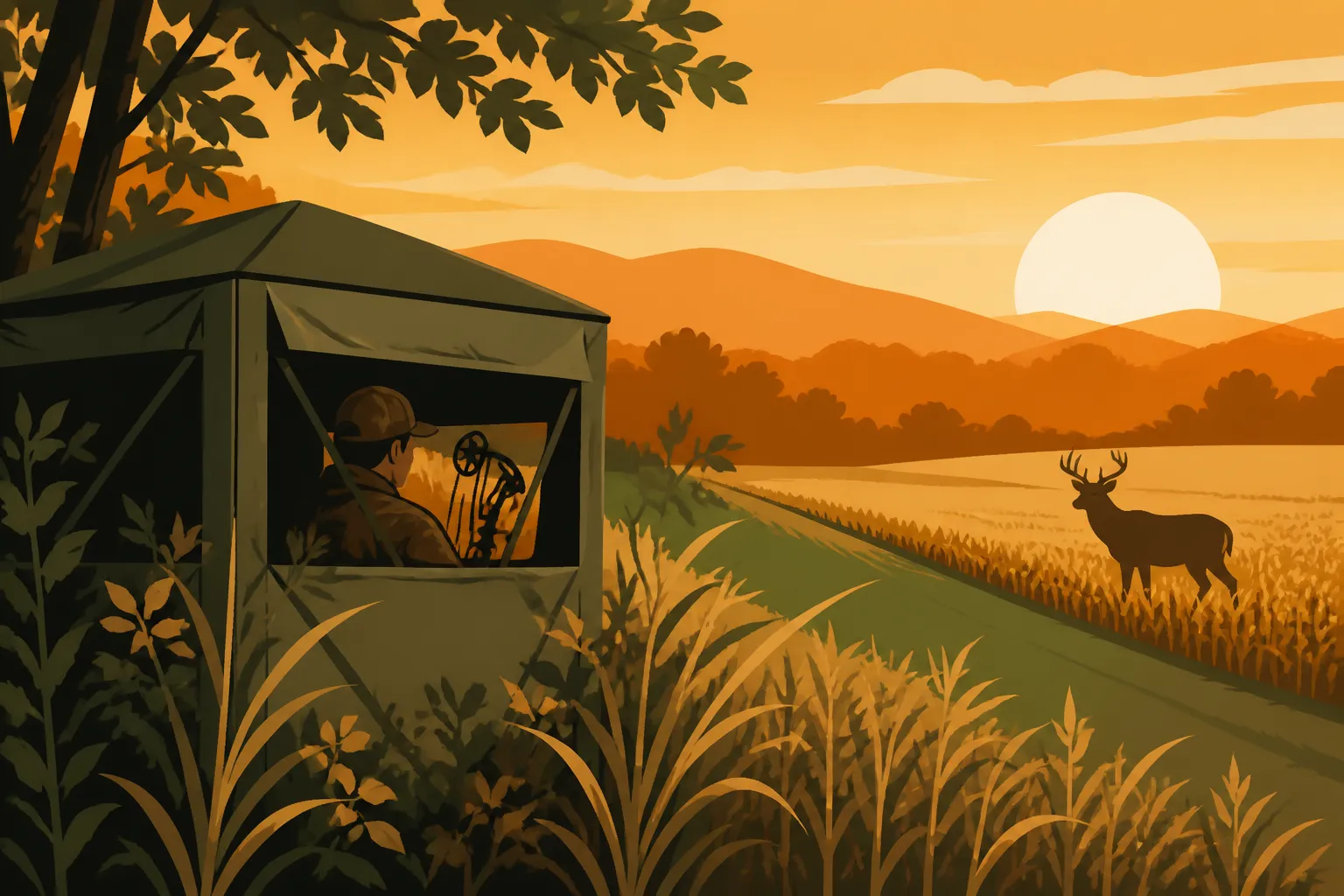
A brand-new, perfectly camouflaged pop-up blind can still scream "hunter!" to wary deer if it's not properly brushed in. Think of it this way: a deer sees its environment change, even subtly. A new, perfectly symmetrical blob of camo material will stand out. The goal is to make your blind look like a natural part of the landscape, like an overgrown brush pile or a thicket that's always been there. This is where Brushing In a Blind on a Field Edge really shines.
Start by placing your blind well in advance of your hunt, if possible. Deer are less likely to spook from something that has been there for days or weeks. Position it against a natural backdrop, like a clump of trees, a thick fencerow, or a large brush pile. Avoid placing it in the wide open unless you have an exceptional reason and ample time to create a formidable natural screen around it. Once positioned, gather local vegetation: fallen branches, tall grasses, corn stalks, kudzu vines – anything that naturally grows in the immediate vicinity.
Weave these materials into the brush loops on the exterior of your blind. Don't just pile them on; carefully integrate them to break up the blind's hard lines and artificial shape. Vary the textures and colors to match your surroundings. Pay extra attention to the top of the blind and any areas that might silhouette against the sky. The idea is to create an irregular, organic shape that mirrors what a deer expects to see. When you're done, step back 20-30 yards and look at your blind. Does it disappear? If not, keep adding and adjusting. This critical step takes time, but it's the difference between being busted and getting a shot. You can also read more about Using a Ground Blind on Tennessee Public Land for additional tips specific to high-pressure areas.
Maximizing Effectiveness: Tactics from Within the Blind
Even with the perfect blind in the perfect spot, your hunt is far from over once you're inside. What you do – or don't do – within the confines of your blind is just as important as the setup itself.
Managing Movement and Noise Inside the Blind
One of the biggest advantages of a ground blind is the forgiveness it offers for movement. Unlike a treestand where every twitch can be seen, a blind's solid walls and dark interior allow for a certain degree of freedom. However, this doesn't mean you can throw caution to the wind. Excessive movement, especially near the windows, can still catch the eye of a distant deer. The goal is to minimize movement to what's necessary and keep it slow and deliberate.
Before the hunt, arrange your gear inside the blind to be easily accessible without shuffling around or making noise. Hang your bow or position your rifle within easy reach. Have your rangefinder, calls, and other essentials organized in pockets or on a small shelf. When you need to move, do so slowly, perhaps waiting for a deer to put its head down to feed, or for a gust of wind to mask any slight sound. The dark mesh often found in shooting windows provides excellent concealment for slight movements like slowly raising binoculars or a rangefinder, but don't assume you're invisible.
Noise is another factor. The fabric walls of a pop-up blind can sometimes amplify internal sounds, making that rustle of your jacket or the clink of a call seem louder than it is. Dress in quiet layers, especially if it's cold. Padded seats and carpet squares on the floor can help deaden sound. If you're hunting with a partner, communicate through whispers or hand signals. The blind should be a silent fortress, allowing you to observe and react without giving away your presence.
Shot Angles, Window Management, and Shooting Lanes
Effective hunting from a ground blind requires careful consideration of your shooting angles and how you manage the blind's windows. Unlike a treestand, where you typically shoot down, from a ground blind, you're shooting across or slightly down, depending on the terrain. This changes how you perceive distances and how clear your shooting lanes need to be.
Before the season, or at least before your first hunt from the blind, get inside and practice drawing your bow or shouldering your rifle. Identify potential shooting lanes and trim any small branches or tall weeds that might deflect an arrow or bullet. Remember that an arrow needs more clearance than a bullet, so be meticulous if you're bowhunting. Mark distances to key landmarks like fence posts or distinctive trees with your rangefinder. You might even use a mapping tool like GoHunt to mark these ranges on your custom map, so you're not fumbling with your rangefinder when a deer appears.
Window management is also critical. While leaving all windows wide open might seem appealing for visibility, it significantly compromises your concealment. Ideally, only open the windows you absolutely need for shooting or observation. Utilize the mesh screens that often come with blinds; they do an incredible job of letting you see out while making it very difficult for deer to see in. Position yourself so that you are deep within the blind, several feet back from the shooting window, further enhancing your concealment. You might even want to consult a post like Setting Up on a West Tennessee Field Edge for ideas on how hunters in agricultural areas handle these open scenarios.
Overcoming Common Ground Blind Challenges
No hunting method is without its quirks, and ground blind hunting on field edges in Tennessee certainly presents its share of common frustrations. Knowing how to anticipate and mitigate these issues can make your experience far more successful and enjoyable.
Dealing with Scent and Thermal Dynamics
We've talked about scent already, but it's such a persistent challenge that it bears repeating. In open field edge environments, air currents are incredibly dynamic. While a steady wind direction might prevail for a few hours, thermals will rise in the morning as the sun heats the earth and fall in the evening as temperatures drop. This means your scent can be carried upward, then drop down into a valley, or swirl unpredictably. This is particularly true if your field edge is near a ridge or creek bottom. Even when you're sure you're good, deer have an uncanny ability to sniff you out.
Employ a multi-layered approach to scent control. This starts long before you enter the blind. Wash your hunting clothes in scent-eliminating detergent and store them in airtight containers. Shower with scent-free soap. Use scent-eliminating sprays on your clothes and gear. While no product will make you completely scent-free, these steps reduce your odor signature significantly. Once in the blind, be mindful of any strong smells you might carry – coffee, breakfast, even certain bug sprays. For more in-depth knowledge on how air currents affect your hunt, consider reading Wind and Thermals on a Ridge System, as the principles often apply to how thermals move along field edges as well.
Consider how your blind's design might help or hinder. Some blinds offer full enclosures with minimal gaps, which can help contain scent. However, you'll still need to open windows for shooting, at which point your scent becomes a factor. A strategy for extended sits might involve running a small, battery-operated ozone generator inside the blind (check local regulations for legality of use while hunting). Ultimately, diligent scouting for wind direction and constant vigilance are your best tools against a deer's nose.
Public Land Pressure and Blind Security
Hunting field edges on Tennessee public land can be a fantastic way to find deer, but it also means dealing with increased pressure from other hunters. It’s a common scenario: you scout a perfect field edge, set up your blind, and then arrive on opening morning to find another hunter already in the spot, or worse, your blind has been tampered with or stolen. This can be incredibly frustrating. For general insights into high-pressure areas, check out Hunting Pressure on Tennessee Public Land.
When placing a blind on public land, especially if you plan to leave it for an extended period, try to choose less obvious locations. While a field edge is a great spot, positioning your blind 10-20 yards back into the timber, just off the actual edge, can make it less visible to casual observers. Always check WMA-specific rules regarding leaving blinds overnight or for extended periods; some areas have strict regulations. Many hunters tag their blinds with their name and contact information, and perhaps a note politely asking others to respect their spot. This won't guarantee security, but it's a good practice.
Security is a genuine concern. Some hunters use small, discreet locks on zippers or anchor their blinds with tent stakes and tie-down cords that are less easily removed. While not foolproof, these measures can deter opportunistic theft. Most importantly, accept that public land means shared resources. Be courteous to other hunters, and if you encounter someone in "your" spot, move on and find another. The woods are big enough for everyone, and sometimes a slightly less obvious location will yield better results precisely because it sees less pressure.
Seasonal Considerations for Field Edge Blind Hunting
Tennessee's hunting seasons offer a long window of opportunity, and the effectiveness of a field edge ground blind can vary dramatically depending on the time of year and the changing habits of deer. Adapting your strategy is key.
Early Season Archery to Late Season Gun
The early archery season, typically starting in late September in Tennessee, often finds deer focused on lush, high-protein food sources. This means soybeans, clover plots, and any fresh green browse along field edges are prime locations. At this time, deer movements might be more predictable, with distinct evening patterns as they emerge from thick cover to feed. Your blind setup should prioritize concealment from deer that are still relatively comfortable in the open before intense hunting pressure sets in. Hunting the August Antlerless-Only Archery Hunt offers insights into very early season field edge hunting, though primarily for antlerless deer.
As the season progresses into late October and early November, the rut begins to influence deer behavior. While food sources remain important, bucks become more nomadic, cruising field edges during daylight hours searching for does. This is an exciting time to be in a blind, as a buck might appear at any moment, sometimes in broad daylight. You might consider using rattling antlers or grunt calls from your blind to attract curious bucks. The changing foliage means your blind's camouflage needs to adapt, with more browns and grays as leaves fall.
By the time gun season opens and extends into January, deer have experienced significant hunting pressure. Their patterns become tighter, and they may be more reluctant to venture into open fields until late evening or even after dark. The focus shifts to calorie-dense late-season food sources like standing corn, winter wheat, or acorns that have dropped from nearby oaks. Hunting the Late-Season January Lull provides valuable insights into how deer adapt to extreme cold and hunting pressure during this period. Your blind becomes a crucial sanctuary from the cold and an excellent way to remain still and patient during long sits, especially when hunting those critical Late-Season Food Sources for Tennessee Whitetails.
Using Technology and Scouting Tools with Your Blind
In today's hunting world, technology can be a powerful ally in making your field edge ground blind hunts more productive. From advanced mapping software to trail cameras, these tools can help you predict deer movement and fine-tune your blind setup.
Mapping applications like GoHunt are invaluable for scouting field edges, both remotely and in person. You can use aerial imagery to identify key terrain features, potential deer trails, pinch points, and natural cover along the edges. Marking exact GPS coordinates for your blind, known buck rubs, scrape lines, or bedding areas allows you to visualize deer movement patterns and ensure your blind is strategically placed downwind of these hotspots. This digital scouting can save you countless hours of walking and help you find those subtle advantages that lead to success. Learning to interpret these maps, similar to Reading Aerial Photos for Cumberland Plateau Deer, can give you an edge no matter the specific terrain.
Trail cameras are another essential piece of technology for field edge hunting. Placing cameras strategically along the field edge, on known deer trails, or overlooking a food source can provide real-time intelligence on deer activity, movement patterns, and even specific bucks. This data allows you to confirm peak activity times, preferred entry/exit routes, and even monitor wind effectiveness. Reviewing trail camera photos from your phone (if service allows) or on an SD card reader can inform your decision on exactly when and where to hunt from your blind. Scouting With the Tennessee TWRA App can also integrate with some of these tools, allowing you to access public land boundaries and regulations directly from your device. Combining these digital tools with careful ground blind placement dramatically increases your odds of success on those challenging Tennessee field edges.
Disclaimer
This article is for general informational purposes only and does not constitute professional advice. Laws, prices and regulations vary by location and change over time. Consult a qualified professional for guidance on your specific situation.