Practical Range in Cherokee Forest Timber
Hunting in the vast, beautiful, and often incredibly dense timber of the Cherokee National Forest presents a unique set of challenges that can leave even seasoned hunters scratching their heads. It’s not like hunting open fields or sparse hardwoods; here, the woods close in, visibility plunges, and distances become distorted, making that seemingly simple 75-yard shot suddenly feel like a Hail Mary. This guide is here to walk you through what "practical range" truly means when you're deep in the Cherokee timber, helping you understand the limitations and opportunities so you can hunt safer, smarter, and more effectively.
Understanding the Cherokee National Forest Environment
The Cherokee National Forest isn't your average woodlot. It's a rugged, expansive wilderness spanning hundreds of thousands of acres across East Tennessee, characterized by dramatic elevation changes, deep hollows, thick stands of mixed hardwoods and pines, and an understory that can be almost impenetrable in places.
The Dense Canopy and Undergrowth
Picture this: you're walking up a steep ridge, sunlight dappling through a thick canopy of oaks, hickories, and pines. Below that, mountain laurel and rhododendron form dense, chest-high thickets, often interwoven with tangled vines. This isn't just pretty scenery; it severely limits line of sight. What looks like a clear lane for a short distance can quickly become a maze of branches and leaves. Even in late fall and winter, when leaves are down, the sheer density of the smaller branches and the evergreen undergrowth creates a visual screen. This means that a shot you might confidently take at 200 yards in an open field is absolutely out of the question here, not because your rifle can't do it, but because you simply cannot see that far with any reliability. Knowing where the game will move through these thickets is paramount, often narrowing your shot windows to mere seconds.
Topography and Shot Angles
The terrain in the Cherokee National Forest is rarely flat. You'll encounter steep ridges, deep hollows, creek bottoms, and benches that contour the mountainsides. This constantly changing elevation dramatically impacts shot angles. A deer walking below you in a hollow, even at a relatively close horizontal distance, can present a much steeper downward angle than you're used to. Conversely, a deer on a parallel ridge might be at an upward angle. These angles subtly (and sometimes not so subtly) change your point of aim. What might be a perfect lung shot on flat ground could easily become a shoulder or brisket hit on a steep angle if you don't adjust. Gravity has more of an effect on your bullet or arrow when shooting at steep angles, and practice with these scenarios is crucial. Understanding how your projectile behaves on an uphill or downhill trajectory is just as important as knowing your horizontal yardage. This is especially true when still-hunting, as you're constantly adapting to new positions.
Common Game Movement Patterns
Deer, bear, and turkey navigate the Cherokee timber with an intimate knowledge of its contours and cover. Deer often follow natural funnels created by saddles, creek beds, or changes in vegetation density. They might use thick rhododendron patches for bedding and dense stands of timber as travel corridors between feeding areas. Bear, similarly, will utilize the thickest cover, often along remote ridges or in the deepest hollows, making them incredibly difficult to spot at distance. Turkeys, while more visible, still use the timber for roosting and often move along benches and ridges. You won't typically see animals running wide open across hundreds of yards here. Instead, you'll glimpse a flash of movement, a partial body, or hear footsteps before you see anything. This means your engagements are often fleeting, close, and require quick decision-making. Scouting to understand these patterns is vital; it's about predicting where the animals will appear within your limited visibility. Finding Sign in Big Cherokee Forest Timber can give you an edge in this regard, helping you identify these key movement areas.
Factors Limiting Your Practical Range
In the Cherokee National Forest, your "practical range" is less about your weapon's maximum capability and more about what the environment allows you to do ethically and effectively.
Visibility and Line of Sight
The most significant factor limiting your practical range in Cherokee timber is, without a doubt, visibility. Imagine trying to thread a needle through a thick bush at 100 yards. That's often what a shot through the timber can feel like. Even if you spot a deer through a small window, there's no guarantee your bullet or arrow won't deflect off an unseen branch. The dense foliage, intertwined vines, and thick underbrush mean clear shooting lanes are rare and often fleeting. Your line of sight might be just 30-50 yards in the thickest areas, pushing out to 70-100 yards on a relatively open ridge or down a mature timber logging road. Anything beyond that becomes a gamble, not just on your marksmanship, but on the trajectory of your projectile through a web of potential obstructions. This is why careful observation and patience become even more critical when Hunting the Cumberland Plateau Ridgelines or similar terrain.
Ethical Shot Placement and Animal Reaction
Every hunter aims for a clean, humane kill. In thick timber, achieving this requires a rock-solid understanding of ethical shot placement and anticipating animal reaction. If you take a shot that is too long for the conditions, or if you can't clearly see the animal's vitals, you risk wounding the animal, leading to a difficult, if not impossible, recovery. Deer often "crouch" or "jump the string" at the sound of a shot, especially with archery equipment, and in thick cover, even a slight movement can turn a lethal hit into a marginal one. With a rifle, deflections off small twigs or branches can dramatically alter bullet trajectory. Given the rugged, unforgiving terrain of the Cherokee, a wounded animal that bolts into a rhododendron thicket can quickly become lost. Your practical range, therefore, must be defined by the distance at which you can consistently guarantee a precise shot, even with the added variables of timber.
Hunter Skill and Confidence
Your personal skill and confidence play a monumental role in determining your practical range. Are you confident in your ability to make a precise shot at a partially obscured animal at 60 yards with a bow, or 150 yards with a rifle, uphill, through a narrow lane, when your heart is pounding? If the answer isn't a resounding yes, then that distance is outside your practical range for that specific scenario. Consistent practice, not just at a flat range, but from various positions, at different angles, and through simulated obstacles, builds this confidence. Knowing your weapon intimately – how it performs, its limitations, and your own – is far more important than any arbitrary number found in a ballistic chart. Many hunters overestimate their abilities in the field, leading to poor decisions. Honesty with yourself about your comfort zone is paramount.
Equipment Limitations
While most modern hunting equipment is incredibly capable, the Cherokee timber imposes its own set of limitations.
- Rifles: While a .30-06 or .308 can reach out to several hundred yards, in the timber, your practical rifle range might be capped at 150-200 yards simply due to visibility. For closer shots, especially those under 100 yards, a fast, flat-shooting bullet isn't always necessary. A heavier, slower bullet like those often used in a .30-30 might actually be ideal for cutting through light brush without as much deflection, though no bullet is truly "brush-proof." Best Rifle Caliber for Tennessee Deer explores these choices further.
- Archery: Bowhunters face the most restrictive practical ranges. An ethical archery shot typically maxes out at 40-50 yards for most skilled archers in open conditions. In thick timber, however, this often shrinks to 20-30 yards, sometimes even less. The potential for branch deflection, the need for a clear flight path for the arrow, and the limited energy of an arrow at longer distances make close-range precision vital. Crossbow Versus Vertical Bow in Tennessee discusses specific considerations for these tools.
- Optics: High-power rifle scopes, while great for long-range precision, can be a hindrance in thick timber. A 3-9x or 2-10x scope set on its lowest magnification is often more practical, offering a wider field of view for quick target acquisition. For binoculars, a compact 8×42 is often preferred over bulkier, higher-magnification options, as it offers a good balance of light gathering and field of view without being cumbersome. Rifle Scopes for Low-Light Hollows details how to choose the right glass for these conditions.
Maximizing Your Effective Range in Timber
Even with the inherent challenges of the Cherokee National Forest, there are definitely strategies and gear choices that can help you make the most of your time afield and expand your effective range within ethical limits.
Strategic Stand Placement and Scouting
This is where your homework truly pays off. Instead of just walking in and hanging a stand, spend considerable time scouting before the season. Look for natural funnels, pinch points, and cover transitions where game is forced to move through a predictable, narrow lane. These are your prime locations for setting up. Think about creek crossings, saddles between ridges, or the edges of dense bedding thickets. When you identify these spots, strategically trim shooting lanes before the season, ensuring they lead to vitals-sized openings at reasonable distances. Don't go overboard and clear everything, just enough to give you a clean shot. For rifle hunters, this might mean a 100-yard lane; for bowhunters, a 30-yard lane. Placing your stand high enough to shoot over some of the undergrowth can also help. Remember, when you're in a fixed position like a Treestand Setups in Cherokee National Forest, you're relying on the animal to come to you within your pre-defined effective range.
Optic Choices for Dark Timber
For rifle hunters, a variable power scope with a lower minimum magnification (e.g., 1.5-5x, 2-7x, or 3-9x) is typically ideal. You want a wide field of view for quick target acquisition when an animal bursts into a small opening, and enough magnification to make a precise shot. Larger objective lenses (e.g., 40mm or 50mm) can help gather light in the notoriously dim timber, especially during those magical first and last minutes of legal shooting light. An illuminated reticle can also be a game-changer in low-light conditions or against a dark animal in deep shadows. For bowhunters, a multi-pin sight is standard, but ensure your pins are bright and easily visible in low light. Some archery sights offer fiber optics or small battery-powered lights to illuminate pins, which can be invaluable in deep woods. Bow Sights for Timber Shots provides more insight into these critical choices. Don't forget a quality rangefinder, ideally one that can compensate for angle, as those steep hills are everywhere.
Shot Practice and Situational Drills
The shooting range is great for groups and zeroing, but it doesn't replicate hunting conditions. To truly maximize your effective range in timber, you need to practice in scenarios that mimic the actual hunting environment.
- Practice from your stand: If possible, set up your treestand or ground blind at home and practice shooting from it. Shoot at odd angles, both uphill and downhill, to understand how it affects your point of impact.
- Shoot through small openings: Set up targets behind light brush or small branches. Practice finding the clearest lane and making a quick, precise shot. You'll quickly learn what constitutes an acceptable "lane" and what's too risky.
- Time yourself: Practice drawing your bow or raising your rifle and acquiring a target quickly. Game often doesn't stand still for long in the timber.
- Simulate pressure: Have a friend call out yardages unexpectedly, or even make some noise to get your heart rate up before a shot. This helps prepare you for the adrenaline dump of a real hunting encounter.
Using Technology for Enhanced Awareness
Modern technology can be a huge asset in the Cherokee, not just for navigation but for strategic planning. Apps like GoHunt provide detailed satellite imagery, topographic maps, and public/private land boundaries. Before you ever step foot in the woods, you can use these tools to identify potential funnels, bedding areas, and travel corridors, helping you plan your approach and stand locations more effectively. During the hunt, GoHunt allows you to mark sign, plot your route, and understand the terrain in real-time, even when cell service is spotty. This enhanced situational awareness can help you make better decisions on the fly, whether it's confirming a boundary or deciding where to push through a thicket. Combining this digital scouting with boots-on-the-ground reconnaissance is the most powerful approach. Scouting Tennessee Public Land Before Season is a great way to use these tools to your advantage.
Different Weapon Types and Their Practical Ranges
Each weapon type demands a different approach when considering practical range in the dense Cherokee timber.
Rifle Hunting in the Thick Woods
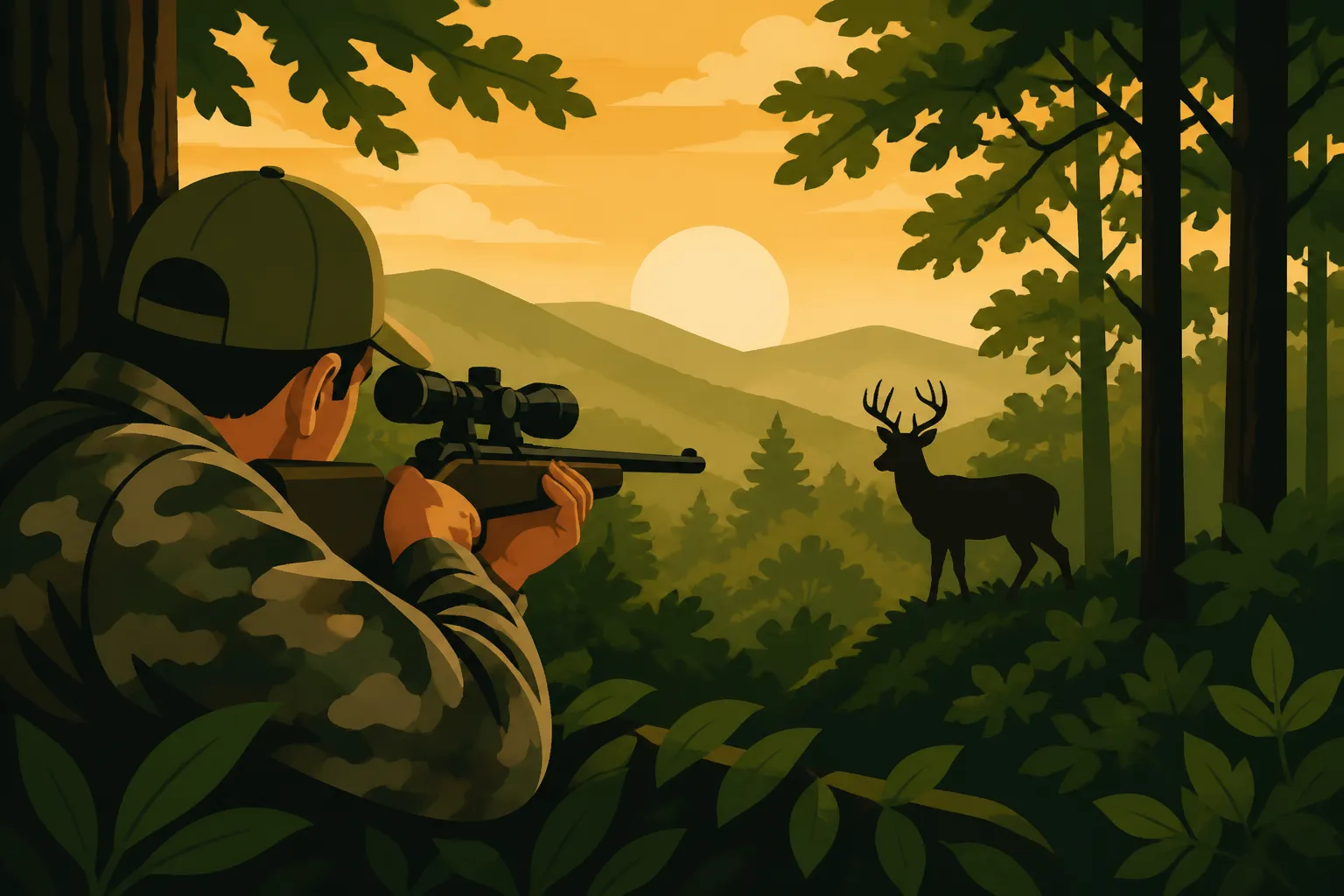
For rifle hunters, the biggest challenge isn't the bullet's capability, but your ability to see and hit your target reliably. While your .30-06 might be lethal at 400 yards, your practical range in Cherokee timber will likely be closer to 75-150 yards for the majority of shots, perhaps extending to 200 yards in very specific, clear lanes on a ridge or logging road. The key is to choose a caliber that offers good energy retention for quick, clean kills, and a bullet that performs well at these closer, often high-impact velocities. Many hunters prefer a medium-to-heavy for caliber bullet (e.g., 150-180 grain in a .30 caliber, 130-150 grain in a .270) that can punch through bone if needed. Avoid ultra-light, frangible bullets that might break up on light brush or simply not penetrate heavy muscle and bone at close range. Always ensure your rifle is properly zeroed for typical timber distances.
Archery and Crossbow Considerations
Archery hunting in the Cherokee National Forest is an exercise in patience and precision at extremely close quarters. Your practical range for a compound bow or traditional bow is rarely beyond 30-40 yards, and often much closer, 20-25 yards, is the sweet spot. Crossbows can push this a bit further, perhaps to 50-60 yards, but the same rules of clear shooting lanes and ethical shot placement apply. The critical factor is an arrow's flight path; even the smallest twig can deflect an arrow. This means bowhunters must be incredibly selective about their shot opportunities. Focus on broadheads that penetrate well – either fixed blade or heavy-duty mechanicals designed for large game. Your stand placement, camouflaged as you are, is even more critical for bowhunting. Hunting Where the Antlerless Limit Drops to Two often means targeting mature deer in thick cover, where archery shines.
Muzzleloader Challenges
Muzzleloader season in Tennessee often falls during prime deer movement, and these traditional firearms can be very effective in the timber. However, they come with their own set of practical range considerations. Most modern inline muzzleloaders are capable of 100-150 yard accuracy with practice, and some can push to 200 yards. However, the smoke generated from a shot can obscure your view, making it difficult to see the animal's reaction or where it ran – a significant disadvantage in thick cover. Follow-up shots are also much slower, meaning you need to be absolutely confident in your first shot. Ballistic characteristics often favor heavier, slower projectiles like saboted bullets or conicals, which can retain energy well at closer ranges. Keeping your powder dry in the often damp conditions of the Cherokee is also a critical practical consideration. Muzzleloader Deer Hunting in Tennessee offers more specific advice for this season.
Here’s a quick overview of typical practical ranges for different weapon types in average Cherokee timber conditions:
| Weapon Type | Typical Practical Range (Yards) | Key Considerations |
|---|---|---|
| Rifle | 75-150 (max 200 in clear lanes) | Visibility, bullet deflection, quick target acquisition |
| Compound Bow | 20-40 | Clear arrow flight, precise shot placement, animal movement |
| Crossbow | 30-60 | Clear arrow flight, precise shot placement, quick setup |
| Muzzleloader | 75-150 | Smoke obstruction, slow follow-up, keeping powder dry |
Conclusion
Hunting in the Cherokee National Forest is an incredibly rewarding experience, but it demands respect for its rugged nature. Your "practical range" here isn't a fixed number; it's a dynamic assessment based on visibility, terrain, your equipment, and, most importantly, your personal skill and ethical considerations. Take the time to scout meticulously, practice in realistic conditions, and choose your shot opportunities wisely. Remember, a close, clean shot is always better than a long, risky one, especially when you're hunting in challenging timber. By understanding and respecting the limitations and embracing the strategies outlined here, you'll increase your chances of a successful and ethical hunt in one of Tennessee's most iconic wildernesses.
Disclaimer
This article is for general informational purposes only and does not constitute professional advice. Laws, prices and regulations vary by location and change over time. Consult a qualified professional for guidance on your specific situation.