Rangefinders in Thick Cumberland Cover
There's nothing quite like the rugged beauty of Tennessee's Cumberland Plateau, but if you've spent any time hunting its dense timber and steep hollows, you know the frustration that comes with trying to get an accurate range on a deer. The trees are just too thick, the underbrush too high, and that laser beam seems to scatter before it ever reaches your target. This comprehensive guide will walk you through the specific challenges of using rangefinders in such unforgiving terrain and equip you with the knowledge to select and effectively use a rangefinder that can handle the nuances of thick Cumberland cover, ensuring you make ethical, confident shots.
The Unique Challenges of Ranging in Tennessee's Thick Cover
Hunting the Cumberland Plateau offers incredible opportunities, but it also presents a unique set of obstacles, particularly when it comes to accurately judging distance. The very features that make it so wild and appealing – the dense forest, the undulating terrain, the sheer amount of vegetation – conspire against modern ranging devices.
The Cumberland Plateau's Dense Landscape
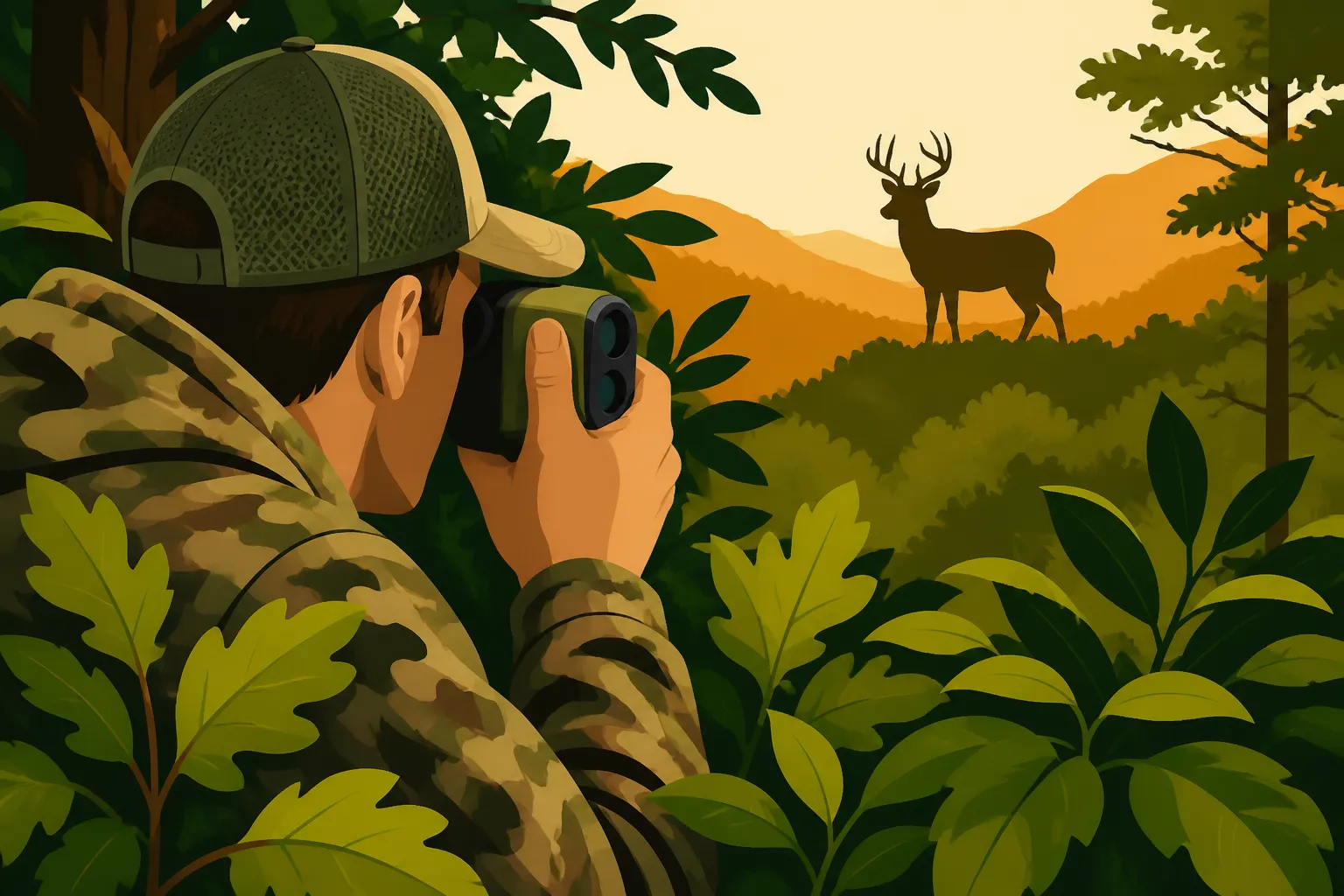
Picture yourself on a Cumberland Plateau ridge, looking down into a creek bottom or across a steep ravine. You might spot a buck moving through the pines or a turkey skirting the edge of a thick laurel patch. The distances can be deceiving. What looks like 50 yards might actually be 70, or vice-versa, especially when you factor in the elevation changes. The sheer density of trees, vines, and undergrowth means that often, your target isn't standing in a clear, unobstructed lane. Instead, they're moving between trunks, peeking through gaps, or partially obscured by a briar thicket. This visual clutter is the primary antagonist for any laser rangefinder. You're not just ranging an animal; you're ranging a needle in a haystack of leaves and branches.
Consider a typical fall day on the Plateau: the leaves are mostly down, but the understory of young saplings, mountain laurel, and rhododendron is still thick. A deer might be standing only 60 yards away, but there are three small cedars between you and it, along with a tapestry of dormant briars. Your eye might tell you the shot is clear, but the laser beam, which travels in a perfectly straight line, hits the nearest obstruction first. This isn't like hunting open fields where a rangefinder shines. Here, the challenge is less about reaching extreme distances and more about penetrating the immediate visual noise to hit the intended target. It takes a specific approach to gear and technique to overcome this natural barrier.
Why Standard Rangefinders Struggle Here
Many general-purpose rangefinders, designed with more open terrain in mind, simply aren't up to the task of the Cumberland. Their laser divergence might be too wide, picking up multiple objects in the beam's path. Or, their target acquisition system might be optimized for large, reflective objects at long distances, rather than smaller, less reflective game animals partially hidden by foliage. The common issue is that the laser, instead of bouncing off your deer, hits a branch a mere 10 yards out, or a sapling 30 yards away, giving you a misleadingly short reading.
This struggle is compounded by the variations in light. Deep in a hollow under a thick canopy, the light can be dim even at midday, which can affect a rangefinder's performance. Conversely, bright, direct sunlight reflecting off wet leaves after a morning shower can create optical noise that confuses some devices. A standard rangefinder might give you a reading, but is it the right reading? That's the critical question. Without specialized features or techniques, you're left guessing, and guessing is the last thing you want to do when a big buck steps out from behind a thicket. This is why understanding the capabilities and limitations of your particular unit is paramount when Hunting the Cumberland Plateau.
The Frustration of False Readings
Nothing is more disheartening than getting a range on what you think is your target, only to discover later that the shot was off because your rangefinder picked up a twig or a leaf. You aim for 40 yards, only to realize the deer was actually 60, or perhaps it was 25 and you aimed high. This isn't just a missed opportunity; it’s an ethical concern. A poorly ranged shot increases the chance of wounding an animal, and that's a scenario no hunter wants to face.
The Cumberland Plateau's terrain amplifies this frustration. You might spend hours still-hunting along a ridge, carefully picking your way through the undergrowth, and then finally get a fleeting glimpse of a deer. In those precious seconds, you need absolute confidence in your range. If your rangefinder consistently delivers false short readings because of intervening brush, or struggles to give any reading at all, it undermines your confidence and your ability to execute a clean shot. It's not just about owning a rangefinder; it's about owning one that can reliably cut through the clutter and deliver an accurate reading under pressure, especially in the variable conditions you encounter when Hunting the Rut in Early November.
What Makes a Rangefinder "Cumberland Ready"?
When you're navigating the dense forests of the Cumberland Plateau, your rangefinder needs to be more than just a gadget that spits out numbers. It needs specific capabilities to overcome the unique challenges of the environment. Think of it as specialized equipment, purpose-built for the task.
Understanding Laser Technology and Target Priority
At the heart of any rangefinder is its laser technology, and for thick cover, not all lasers are created equal. You want a rangefinder that employs a narrow laser divergence. This means the beam stays tight and focused, minimizing the chances of it hitting incidental branches or leaves between you and your target. Some manufacturers design their units with superior beam divergence specifically for these conditions.
Equally important is a feature often called "target priority" or "first/last target mode." In thick cover, this is an absolute game-changer.
- First Target Priority (or close target priority) is ideal for archery hunting in extremely dense brush where you absolutely need to hit the closest object. However, for gun hunting where you're often trying to range past the foreground clutter to a deer, it can be detrimental.
- Last Target Priority (or distant target priority) is what you'll typically want for the Cumberland. This mode instructs the rangefinder to ignore closer obstructions like leaves, small branches, or tall grass, and instead provide the distance to the farthest object it detects within the laser's path. This is invaluable when a deer is standing just behind a thin screen of brush, allowing you to get a reading on the animal itself rather than the foliage in front of it. Look for rangefinders that explicitly state they have a "last target" or "deer mode" that prioritizes the furthest target. This feature makes a tangible difference when Reading a Ridge for East Tennessee Deer.
Optical Clarity and Magnification for Dense Woods
While a rangefinder's primary job is to measure distance, its optical quality can't be overlooked, especially in the dim, shadowed hollows and thick timber of the Cumberland. You're often trying to spot and range a deer in low light, against a busy backdrop of browns and greens. A clear, bright image helps you precisely aim your rangefinder's reticle at the animal, rather than an adjacent tree trunk. Look for high-quality glass with excellent light transmission. Fully multi-coated lenses are a good indicator of superior optical performance.
Magnification also plays a role, but it's a balancing act. Too much magnification (e.g., 10x or 12x) can make it difficult to hold steady and find your target quickly in close quarters or when scanning. For hunting in dense woods, a magnification of 6x or 7x is often a sweet spot. It provides enough power to clearly see your target and the reticle, but still offers a wide enough field of view and sufficient stability for fast target acquisition. Paired with good binoculars, a lower-magnification rangefinder can be highly effective. Remember, your rangefinder isn't your primary glassing tool; it's a precision instrument for a specific task. Good optical clarity on your rangefinder complements your primary Optics for Cumberland Plateau Ridges.
Angle Compensation: A Necessity, Not a Luxury
The Cumberland Plateau is renowned for its steep terrain, with ridges, hollows, and ravines creating significant elevation changes. When you're shooting uphill or downhill, gravity affects the projectile differently than it would on flat ground. A laser rangefinder measures the direct "line of sight" distance, but for archery and even rifle hunting at closer ranges on steep angles, you need the "horizontal equivalent distance" – essentially, the distance the bullet or arrow perceives gravity to act over.
This is where angle compensation, often called "true ballistic range" or "horizontal distance" mode, becomes critical. A rangefinder with this feature automatically calculates and displays the adjusted distance you should use for aiming. Without it, shooting downhill at a deer 40 yards away (line of sight) might require you to aim for a 30-yard shot, but manually estimating that adjustment is fraught with error. Modern rangefinders with angle compensation take the guesswork out of it, providing you with the exact number to use with your ballistic tables or pin settings. On the steep slopes of the Cumberland, this isn't just a nice-to-have; it's an ethical imperative for making accurate, humane shots. Always verify your rangefinder's angle compensation feature and understand how it displays the adjusted distance before heading out.
Choosing the Right Features for Your Hunt
Beyond the core technology, several practical features can significantly enhance your rangefinder's utility and performance in Tennessee's rugged terrain. These aren't just bells and whistles; they're tools that address specific challenges you'll face while hunting.
Scan Mode for Moving or Partially Obscured Targets
Imagine a scenario: you're perched in your Hanging a Stand on a Cumberland Ridge, and a small group of deer is slowly picking their way through a thick oak flat, occasionally disappearing behind trees. A single-shot rangefinder would be next to useless here. This is precisely where a good "scan mode" shines.
Scan mode allows you to continuously depress the range button, sweeping the rangefinder across an area. As you move the reticle, the distance updates in real-time, often multiple times per second. This is incredibly useful for several reasons:
- Ranging through gaps: You can scan across a cluttered area, and as the laser finds small windows through the foliage, it will give you readings to targets beyond.
- Moving targets: If a deer is slowly walking, you can track it with the rangefinder, getting updated distances as it moves.
- Confirming ranges: By scanning past your target and back, you can often confirm if a reading is truly on the animal or if it's hitting a foreground obstruction. If the distance jumps significantly when you scan slightly past the deer, you know the original reading was likely on brush.
Some advanced rangefinders even offer features like "tree mode" or "bow mode" within their scan function, which combines scan capabilities with specialized target priority algorithms to further aid in dense cover. A fast, responsive scan mode can save precious seconds and provide crucial information in dynamic hunting situations.
Durability and Ergonomics for Rugged Terrain
The Cumberland Plateau isn't known for its manicured trails. You'll be climbing, descending, pushing through thick brush, and occasionally slipping on wet leaves. Your gear needs to be able to take a beating. A rangefinder for this environment should be built like a tank, but still be lightweight enough not to be a burden.
- Waterproofing: This is non-negotiable in Tennessee, where morning dew, sudden rain showers, or even accidental drops in a creek are always a possibility. Look for units that are fully waterproof and fogproof, often indicated by nitrogen purging.
- Rubber Armor: A thick rubberized exterior provides shock absorption against drops and bumps, and also offers a secure, non-slip grip, even with wet or gloved hands.
- Compact Size: While not strictly a durability feature, a compact and lightweight rangefinder is less likely to get snagged on branches or be a nuisance when strapped to your bino harness. It should fit comfortably in your hand for quick deployment.
- Button Placement: Can you easily operate the buttons with one hand, possibly with gloves on? Tactile buttons that are easy to locate and press without looking are a huge advantage when seconds count.
Contextual Brand Mention: Many hunters find that a combination of durable gear like a rugged rangefinder and reliable mapping applications such as GoHunt's mapping features can make navigating and hunting the challenging Cumberland terrain much more efficient and safer. Being able to mark your stand, potential bedding areas, or even the location of a downed deer, all while having confidence in your ranging capability, creates a complete system.
Battery Life and Temperature Resilience
There's nothing worse than hiking deep into the woods, settling into your stand, and discovering your rangefinder battery is dead. This is particularly true if you're out for multiple days or Hunting the Late-Season January Lull when temperatures drop. Long battery life is crucial. Most modern rangefinders use readily available CR2 batteries, which are relatively inexpensive, but how efficiently the unit uses that power varies.
Check the manufacturer's stated battery life, and always carry a spare, especially on extended trips. It’s also wise to replace batteries at the start of each season. Temperature resilience is another factor. Extreme cold can drain batteries faster and affect the performance of some electronics. While Tennessee winters aren't as harsh as some northern states, cold snaps can certainly occur. Ensure your chosen model is rated for a wide operating temperature range. Some units also feature an auto-shutoff function to conserve power, which is a small but valuable detail for preventing accidental battery drain.
| Feature | Importance for Thick Cumberland Cover | Why It Matters |
|---|---|---|
| Last Target Priority | Essential | Ignores foreground brush, ranges the actual animal. |
| Narrow Laser Divergence | High | Minimizes hitting incidental branches, more precise beam. |
| Angle Compensation | Essential | Provides true horizontal distance for steep shots. |
| Scan Mode | High | Ranges moving targets, finds gaps in brush, confirms distances. |
| Optical Clarity (6-7x) | High | Bright, clear image for target acquisition in low light and dense woods. |
| Waterproof/Fogproof | Essential | Protects against rain, dew, and accidental submersion. |
| Rubberized Armor | High | Shock absorption, secure grip in wet conditions. |
| Long Battery Life | High | Ensures power for extended hunts, especially in cold weather. |
| Ergonomics/Button Feel | Moderate | Easy one-handed operation, quick target acquisition. |
Mastering Rangefinder Techniques in Dense Foliage
Having the right rangefinder is only half the battle. Knowing how to use it effectively in challenging environments like the Cumberland Plateau is what truly makes a difference. It's about developing a strategic approach and honing your skills through practice.
The Art of Ranging Through Gaps
In thick cover, you rarely get a perfectly clear shot at your target. Instead, you'll be looking for small windows – gaps between tree trunks, openings in the undergrowth, or clear lanes where branches momentarily part. This requires a specific technique with your rangefinder.
First, use your optics (binoculars or the rangefinder itself if it has good clarity) to carefully pick out the clearest path to your target. Don't just point and shoot the laser. Visualize the laser beam's path.
Second, if your target is partially obscured, try to range the clearest part of the animal, often the chest or shoulder, where there's less chance of hitting an antler or a tail. If you have "last target priority" engaged, aim for what appears to be the most distant part of the animal from you, letting the rangefinder do its job of ignoring foreground clutter.
Third, utilize scan mode. Instead of one quick press, engage scan mode and slowly sweep the rangefinder across the area where the deer is, even slightly past it. The rangefinder will continuously update distances. Watch for the most consistent or furthest reading as it "sees" through the small openings. It's a bit like painting with light, feeling for the solid object behind the screen. This takes practice, but once mastered, it dramatically increases your chances of getting an accurate reading even when the deer is only visible through a postage-stamp-sized window in the brush. This technique is especially useful for Hunting Where the Antlerless Limit Drops to Two where you might be looking for a specific opening for a clean shot.
Ranging Reference Points and Confirming Distances
Even with the best rangefinder, getting a direct reading on an animal in dense cover isn't always possible. This is where ranging reference points comes in handy. Before a deer appears, take the time to range several key objects around your stand or chosen hunting area.
- Trees: Pick out prominent trees at varying distances – 20, 30, 40, 50, and 60 yards. Memorize these distances.
- Stumps or Rocks: Natural landmarks make excellent reference points.
- Trails or Field Edges: If you're near a Setting Up on a West Tennessee Field Edge or a logging road, range those specific points.
When a deer steps out, and you can't get a direct read, you can quickly glance at a nearby ranged reference point and estimate the distance to the deer. For instance, if you ranged a large oak at 45 yards, and the deer steps out 5 yards closer to you, you know it's approximately 40 yards.
Another crucial technique is to confirm your readings. If you get a reading on a deer, take a moment to range something directly behind or next to it. If you get wildly different numbers, it's a sign that your initial reading might have been inaccurate. Scan mode is also excellent for confirmation; sweep around the target to see if the distance remains consistent. Never take a single, questionable reading at face value, especially if it feels "off" to your eye. Trust your instincts, but verify with your technology.
Integrating Your Rangefinder with Scouting Tools
A rangefinder isn't just for the moment of truth; it's a powerful scouting tool. When you're out before the season, identifying key spots and preparing your setup, use your rangefinder to understand the terrain and potential shot opportunities.
- Determine maximum effective range: From your chosen stand location, use your rangefinder to find the furthest points you could comfortably take an ethical shot given the cover. This helps you identify blind spots and strategize your setup.
- Mark travel corridors: If you're seeing deer sign along a particular creek bottom or ridge line, range key intersections or pinch points. Knowing these distances beforehand eliminates guesswork when a deer finally uses that route.
- Pre-range shooting lanes: Even if you can't trim shooting lanes on public land, you can identify natural lanes and pre-range distances within them. This builds confidence.
Using a mapping app like GoHunt can significantly enhance this process. You can mark your stand location, pin ranged reference points directly onto your map, and even draw estimated shooting lanes. This creates a visual blueprint of your hunting area, complete with critical distances, long before opening day. This synergy between physical scouting, digital mapping, and precise ranging ensures you're as prepared as possible when the season arrives, aligning perfectly with good practices for Scouting Tennessee Public Land Before Season.
Beyond the Range: Complementary Gear and Habits
Your rangefinder is a critical piece of the puzzle, but it’s part of a larger system. To truly excel in the dense Cumberland Plateau, you need to consider how your rangefinder integrates with other gear and how your personal habits impact its effectiveness.
The Synergy of Optics and Mapping
Think of your hunting kit as an ecosystem where each piece supports the others. Your rangefinder works best when paired with quality binoculars or a spotting scope. Use your binoculars to scan for game, identify specific animals, and then switch to your rangefinder for precise distance measurement. Trying to do both with a rangefinding binocular can work, but sometimes having dedicated tools provides better performance in each category. Binocular Choice for Tennessee Whitetails is just as important as your rangefinder choice.
As mentioned, a robust mapping application is invaluable. GoHunt, for instance, allows you to not only view detailed satellite imagery and topographical maps but also to drop custom waypoints. You can literally mark your stand location, and then drop pins at 20, 30, 40, and 50 yards in various directions after you've ranged them. This gives you an immediate visual reference on your phone or GPS device, supplementing your memory and reducing the need to pull out the rangefinder repeatedly. You can also mark obstacles you ranged to avoid, or game trails you need to remember. This kind of integration turns your rangefinder from a standalone tool into an active participant in your overall hunting strategy.
Practice, Practice, Practice
There’s no substitute for hands-on experience. Buying the best rangefinder won’t magically make you an expert in thick cover. You need to practice with it in conditions that mimic the Cumberland Plateau.
- Backyard Drills: Set up targets at unknown distances in your backyard, with obstacles in between. Practice quickly acquiring ranges through gaps.
- Off-Season Scouting: When you're Shed Hunting on Tennessee Public Land or scouting for sign, carry your rangefinder. Practice ranging trees, stumps, and imaginary deer. Pay attention to how the rangefinder reacts to different types of cover.
- Varying Conditions: Practice in different lighting conditions – bright sun, overcast days, and early morning/late evening. Observe how your rangefinder performs.
- Under Pressure: Practice getting a quick, accurate range when you're slightly winded or stressed, simulating the adrenaline of a real hunting encounter. The more muscle memory you build, the more automatic and reliable your ranging will become when it truly matters.
Understanding the subtle nuances of your rangefinder, such as its exact reticle size, how quickly it acquires a reading, and how it handles false targets, can only be gained through consistent use.
Keeping Your Rangefinder Protected and Functional
Like any precision instrument, a rangefinder requires care and maintenance to ensure it performs when you need it most.
- Protection: Always keep your rangefinder in a protective case or a bino harness pocket when not actively in use. This protects the lenses from scratches and the housing from impact. A quality harness also keeps it readily accessible but secure against your chest.
- Cleaning: Dust, dirt, and fingerprints on the lenses can degrade optical performance. Use a microfiber cloth specifically designed for optics and a lens cleaning solution if necessary. Never use your shirt or abrasive materials.
- Battery Management: As mentioned, carry spare batteries and change them seasonally. Check the battery compartment for any corrosion, especially if the unit got wet.
- Storage: When storing your rangefinder for the off-season, remove the battery to prevent potential leakage and corrosion. Store it in a cool, dry place.
By adopting these habits, you'll ensure your rangefinder remains a reliable partner in the woods, ready to provide those critical distance measurements, even in the most challenging cover that Tennessee's Cumberland Plateau has to offer.
Disclaimer
This article is for general informational purposes only and does not constitute professional advice. Laws, prices and regulations vary by location and change over time. Consult a qualified professional for guidance on your specific situation.