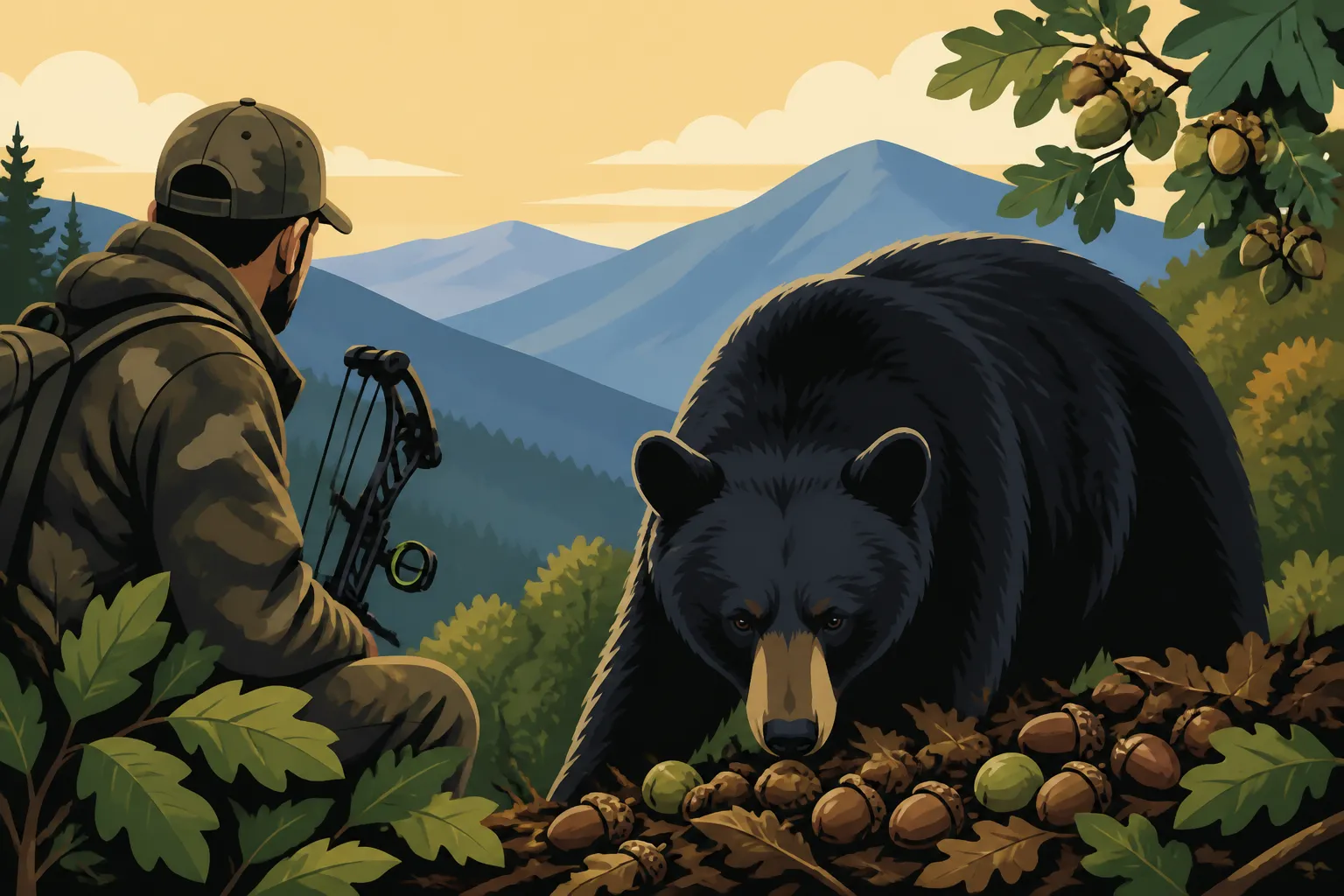
Hunting Bears Over Natural Mast in the Mountains
Hunting bears in Tennessee's rugged mountains, especially when they're scattered and primarily focused on natural food sources, can feel like searching for a needle in a vast, wild haystack. The challenge lies in understanding how these powerful animals utilize the ever-changing bounty of the forest floor and canopy. This guide is here to unravel the mysteries of mountain mast, helping you pinpoint those elusive bears and increase your odds of success.
Understanding Tennessee's Mountain Mast Cycles
When we talk about hunting bears in the mountains of Tennessee, understanding "mast" is like having the key to their kitchen. Mast refers to the nuts, seeds, buds, or fruits of trees and shrubs, and it's a critical food source for black bears, especially in the Appalachian regions like the Cherokee National Forest and the Cumberland Plateau. Bears are highly opportunistic feeders, and their movements and feeding patterns are directly influenced by what natural foods are available and abundant. A season with a bumper mast crop can mean bears are widely dispersed, gorging themselves on nature's buffet, while a poor mast year might concentrate them in the few areas where food can be found.
Hard Mast: Acorns, Hickories, and Beech Nuts
Hard mast is perhaps the most famous and sought-after food source for bears as they prepare for winter hibernation. This category includes acorns from various oak species, hickory nuts, and beech nuts. In the Tennessee mountains, you'll find a diverse array of oaks – red oaks, white oaks, black oaks, scarlet oaks, and more – each dropping its acorns at slightly different times, creating a prolonged feeding opportunity for bears. White oaks, for instance, typically drop their sweeter, lower-tannin acorns earlier in the fall, making them an immediate draw, while red oaks often hold their acorns longer, providing a crucial late-season food source well into the colder months.
Hickory nuts are another prized hard mast. Their tough shells might deter some animals, but a bear's powerful jaws are more than up to the task. You'll often find hickory trees on rich, fertile slopes and creek bottoms, and if you locate a stand of them producing, it's a good bet bears will be in the vicinity. Beech nuts, while smaller, are incredibly nutritious and can be found in dense groves in certain parts of the mountains. A good beech nut crop can draw bears from a wide area, as these trees tend to have synchronized, albeit less frequent, bumper years. The sheer caloric content of these hard mast crops is essential for bears to build up the fat reserves they need to survive the winter, making areas with abundant hard mast absolute magnets for bruins.
Soft Mast: Berries, Grapes, and Persimmons
Before the hard mast really starts falling in earnest, bears in the Tennessee mountains feast on a variety of soft mast. This includes wild berries like blackberries, blueberries, and raspberries in late summer, as well as wild grapes, serviceberries, and even persimmons as early fall approaches. While these foods are generally less calorically dense than hard mast, they provide critical nutrients and hydration during warmer months. The challenge with soft mast is its transient nature; it ripens quickly, is devoured rapidly, and often doesn't last long, making it a fleeting but potent draw.
Finding concentrations of soft mast requires diligent summer scouting. Wild grapes, for example, often grow in tangled thickets along old field edges, creek drainages, and logging roads, frequently forming canopies over other vegetation. Bears will spend hours in these areas, methodically stripping vines. Persimmons, particularly common on the fringes of the mountains where agriculture meets forest, are another favorite. These bright orange fruits become edible after the first frost, turning into a sweet, soft delicacy that bears can't resist. While soft mast might not hold bears for the entire hunting season, understanding its availability early on can give you a significant advantage in locating bears before they transition entirely to hard mast.
Scouting for Mast and Bear Sign
Successful mountain bear hunting isn't about luck; it's about meticulous scouting. Finding bears over natural mast means being where they are, when they are, and that takes a deep understanding of their movements and preferences for food. You can't just walk into the woods and expect to stumble upon them. You need to become a detective, piecing together clues from the landscape and the animals themselves. This proactive approach, both before the season and during, is what separates those who consistently find bears from those who go home empty-handed.
Pre-Season Reconnaissance and E-Scouting
The work for hunting bears over natural mast begins long before you ever step foot in the woods with your weapon. Pre-season reconnaissance is absolutely critical, and it often starts from the comfort of your own home with modern e-scouting tools. Using mapping apps like GoHunt, you can pore over satellite imagery to identify prime mast-producing timber stands. Look for distinct canopy textures that indicate oak or hickory stands, often distinguishable by their rounded crowns and denser foliage. Identify specific slopes and aspects – south-facing slopes, for instance, often warm faster and can have earlier-ripening soft mast, while north-facing slopes might retain moisture longer, affecting hard mast production.
Once you've identified potential areas on the map, it's time for boots on the ground. A crucial part of scouting Tennessee public land before season is to physically visit these spots in late summer and early fall. Look for actual mast production – are the oaks dropping acorns? Are the hickory nuts abundant? Are there wild grapes heavy on the vine? A good mast crop doesn't happen every year, and even within a single mountain range, certain areas will produce while others fail. Identifying these productive zones early allows you to focus your efforts come hunting season. Don't be afraid to walk extensively; the mountains demand effort, but they often reward diligence.
Reading Bear Sign Around Mast Zones
Once you've located a promising mast crop, your next task is to confirm that bears are actually using it. This means becoming proficient at reading bear sign. Bears, despite their size, can be incredibly stealthy, but they always leave calling cards. Fresh tracks in soft dirt or mud near creek crossings or logging roads are a dead giveaway. Pay close attention to the size and shape – a large, flat foot imprint with distinct claw marks indicates a substantial bear has passed through recently. The direction of travel can also give you clues about their daily routines, often leading between a feeding area and a dense bedding thicket.
Bear scat is another invaluable piece of evidence. The appearance of scat tells you not only that a bear is present but what it's been eating. Scat full of undigested acorn fragments or chewed hickory nut shells confirms they're actively feeding on hard mast. If you see scat packed with berry seeds or grape skins, you know they've been hitting the soft mast. Beyond scat and tracks, look for rubbed trees where bears have scratched their backs or scent-marked, or even broken branches and claw marks on trees where they've climbed to reach mast. Bears often create distinct travel corridors, or "bear trails," especially through dense rhododendron thickets or laurel slicks, connecting these mast zones to their bedding areas. Finding these subtle pathways can be key to understanding their daily movements and setting up an ambush.
Hunting Strategies for Mast-Driven Bears
With your scouting complete and a clear picture of where the bears are feeding, it's time to put a hunting strategy into action. Hunting bears over natural mast in Tennessee's mountains requires patience, stealth, and an understanding of bear behavior. These animals are incredibly smart and have an uncanny ability to detect danger. Your approach needs to be methodical, focusing on exploiting their reliance on these food sources while minimizing your presence. Whether you prefer to move slowly through the woods or sit patiently in a stand, adapting your tactics to the mast situation is paramount.
Still-Hunting and Stalking Mast Flats
For many mountain hunters, the art of still-hunting and stalking is the purest way to pursue bears. This involves moving through the woods at an incredibly slow pace, stopping frequently to scan, listen, and glass, taking perhaps only a few steps every minute. When bears are scattered across large mast flats – those relatively flat areas on ridge tops or benches where oaks and hickories are prolific – still-hunting allows you to cover ground effectively while remaining stealthy. The key is to be acutely aware of the wind direction; a bear's nose is their primary defense, and if your scent drifts to them, the hunt is over. Always hunt into the wind or with a crosswind that carries your scent away from potential feeding areas.
Focus on terrain features that naturally funnel bear movement. Benches, saddles, and small draws that lead into larger mast flats are prime areas for bears to travel. Move through these areas deliberately, pausing behind large trees or rock outcroppings to observe. Use binoculars to pick apart the dense cover, looking for a patch of black fur, an ear twitch, or the subtle movement of a bear feeding. The sounds of chewing acorns or rustling leaves can often give away a bear's position before you see it. Stalking effectively requires soft-soled boots, careful foot placement to avoid snapping twigs, and an abundance of patience. It’s a physically demanding but incredibly rewarding method of hunting when executed properly. If you're using this method in areas like the Cherokee National Forest, considering your Spot-and-Stalk Tactics for Cherokee Forest Bears is critical.
Stand Placement Near Active Mast
While still-hunting is effective, sometimes the most productive strategy is to let the bears come to you. Setting up a stand near active mast can be incredibly successful, especially if you've identified a concentrated feeding area or a distinct travel corridor. When choosing a stand location, prioritize fresh sign. Look for heavily used trails leading into the mast trees, fresh scat, and recent claw marks on climbing trees. Bears often move between bedding areas in dense cover and these feeding grounds, creating predictable routes.
Your stand placement needs to consider prevailing winds and, crucially in the mountains, thermals. Early in the morning, thermals typically rise, carrying your scent uphill. In the evening, they fall, carrying your scent downhill. Position your stand so that the thermals carry your scent away from the area you expect bears to approach from. This might mean setting up on a bench slightly above or below the main feeding area, rather than directly in it. Both ground blinds and treestands have their advantages. Ground blinds can be quickly brushed in on a field edge or along a thicket line, offering concealment, while treestands, especially in the larger timber found in the Cherokee National Forest, provide an elevated vantage point and help disperse your scent. Understanding Treestand Setups in Cherokee National Forest and how they intersect with prevailing Wind and Thermals on a Ridge System is paramount.
Understanding Bear Movement Patterns
Bears are creatures of habit, but their patterns can shift based on food availability, weather, and hunting pressure. Generally, bears are most active during the early morning and late evening hours, similar to deer, as they move from bedding to feeding. However, when a mast crop is abundant, they might feed throughout the day, especially on cooler or overcast days. In the peak of acorn drop, bears can be found on mast flats at midday, gorging themselves.
Weather plays a significant role in bear activity. A cold front after a warm spell can often kickstart feeding, as bears instinctively know winter is coming and it's time to pack on calories. Rainy or windy days can sometimes make bears more cautious, but they can also mask your approach, offering a unique opportunity for still-hunting. Conversely, extremely warm weather might make them more nocturnal, forcing you to adjust your hunting times or focus on shaded, cooler areas. Keeping a close eye on weather forecasts and understanding how bears react to these changes will help you be in the right place at the right time.
| Mast Type | Primary Season | Bear Behavior Focus | Typical Location | Hunting Strategy |
|---|---|---|---|---|
| White Oak | Early Fall | Intense feeding, often during daylight | Ridge tops, moderate slopes | Stand hunting, still-hunting into wind |
| Red Oak | Mid-to-Late Fall | Consistent feeding, crucial pre-hibernation fuel | Higher elevations, varied slopes | Still-hunting, focus on transition |
| Hickory Nuts | Mid-to-Late Fall | Consistent feeding, high caloric value | Richer soils, creek bottoms, benches | Scouting for heavy drops, stand hunting |
| Beech Nuts | Mid-to-Late Fall | Intense feeding during bumper crops, widely dispersed | Cool, moist slopes, specific groves | Search out productive groves, still-hunt |
| Wild Berries | Late Summer-Early Fall | Sporadic feeding, quick consumption | Clear-cuts, open areas, edges | Early season scouting, quick stalks |
| Wild Grapes | Early-Mid Fall | Concentrated feeding, often in thickets | Old fields, creek lines, logging roads | Ambush points, careful approach |
| Persimmons | Mid-to-Late Fall | Targeted feeding after first frost | Field edges, transition zones | Stand hunting near known trees |
Navigating Challenging Mountain Terrain
Hunting bears in the Tennessee mountains is not for the faint of heart. It demands a level of physical and mental fortitude that's different from hunting in flatter regions. The terrain itself presents challenges that can make or break a hunt, from steep ascents and descents to dense undergrowth and remote locations. A successful bear hunter in these environments isn't just a good shot; they're a skilled woodsman, a navigator, and a resilient athlete. Being prepared for what the mountains will throw at you is as important as knowing where the mast is.
Physical Demands and Preparation
The sheer physical demands of mountain bear hunting cannot be overstated. You'll be climbing steep ridges, descending into deep hollows, and navigating tangled thickets, often carrying heavy gear. This isn't a casual stroll in the park; it's a marathon that might involve miles of walking with significant elevation changes. Therefore, physical fitness is absolutely paramount. Start training well before the season by hiking with a loaded pack, simulating the inclines and distances you expect to cover. Focus on leg strength, endurance, and cardiovascular health. Many seasoned mountain hunters spend the off-season staying active, knowing that their physical condition directly translates to their ability to hunt effectively and, perhaps more importantly, to safely retrieve a downed animal.
Beyond physical conditioning, proper gear is essential. Sturdy, broken-in boots with excellent ankle support are a non-negotiable item, as they will protect your feet and prevent injuries on uneven ground. Layered clothing is critical for adapting to temperature swings that are common in the mountains, from chilly mornings to warm midday sun. Don't forget ample water and high-energy snacks; bonking on a steep climb miles from your vehicle is not a situation you want to be in. A good quality hunting pack, like those from Stone Glacier or Kifaru, is essential for carrying your essentials and, hopefully, hauling out meat. Consider what Packs for a Cherokee Forest Day Hunt you might need, ensuring it's durable and comfortable for long hauls.
Safety and Logistics in Remote Areas
Hunting in remote mountain areas, such as sections of the Cherokee National Forest or the North Cumberland Wildlife Management Area, comes with inherent risks that demand meticulous safety planning. Always, always tell someone your exact hunt plan: where you're going, your intended route, when you expect to return, and who to call if you don't check in. Cell service can be spotty or nonexistent in many mountainous regions of Tennessee, so relying solely on your phone for emergencies is a mistake.
Carry redundant navigation tools. A GPS unit or a reliable phone app like GoHunt with downloaded offline maps is essential, but also carry a physical map and compass and know how to use them. Being able to navigate effectively, especially if you get turned around in unfamiliar territory or need to track a wounded bear, is critical. Beyond navigation, consider personal safety items. While bear attacks are rare, carrying bear spray is a wise precaution, especially if you are hunting alone or in dense cover. Finally, think about the logistics of retrieving a bear. These are large, heavy animals, and dragging one out of a steep hollow is an immense undertaking. Have a plan for how you'll handle a bear after the shot, including potential partners, game bags, and perhaps even pack frames for quartering if you're deep in the backcountry. Reviewing advice on Handling a Bear After the Shot can provide valuable insights for this crucial step. It is also wise to carry a well-stocked First Aid Kits for Remote Cherokee Forest Ground with you.
Disclaimer
Hunting is an inherently dangerous activity. This guide provides general information and recommendations. Always prioritize safety, understand and follow all Tennessee Wildlife Resources Agency (TWRA) regulations, and consider local conditions. The information contained herein does not substitute for personal research, preparation, and professional guidance.