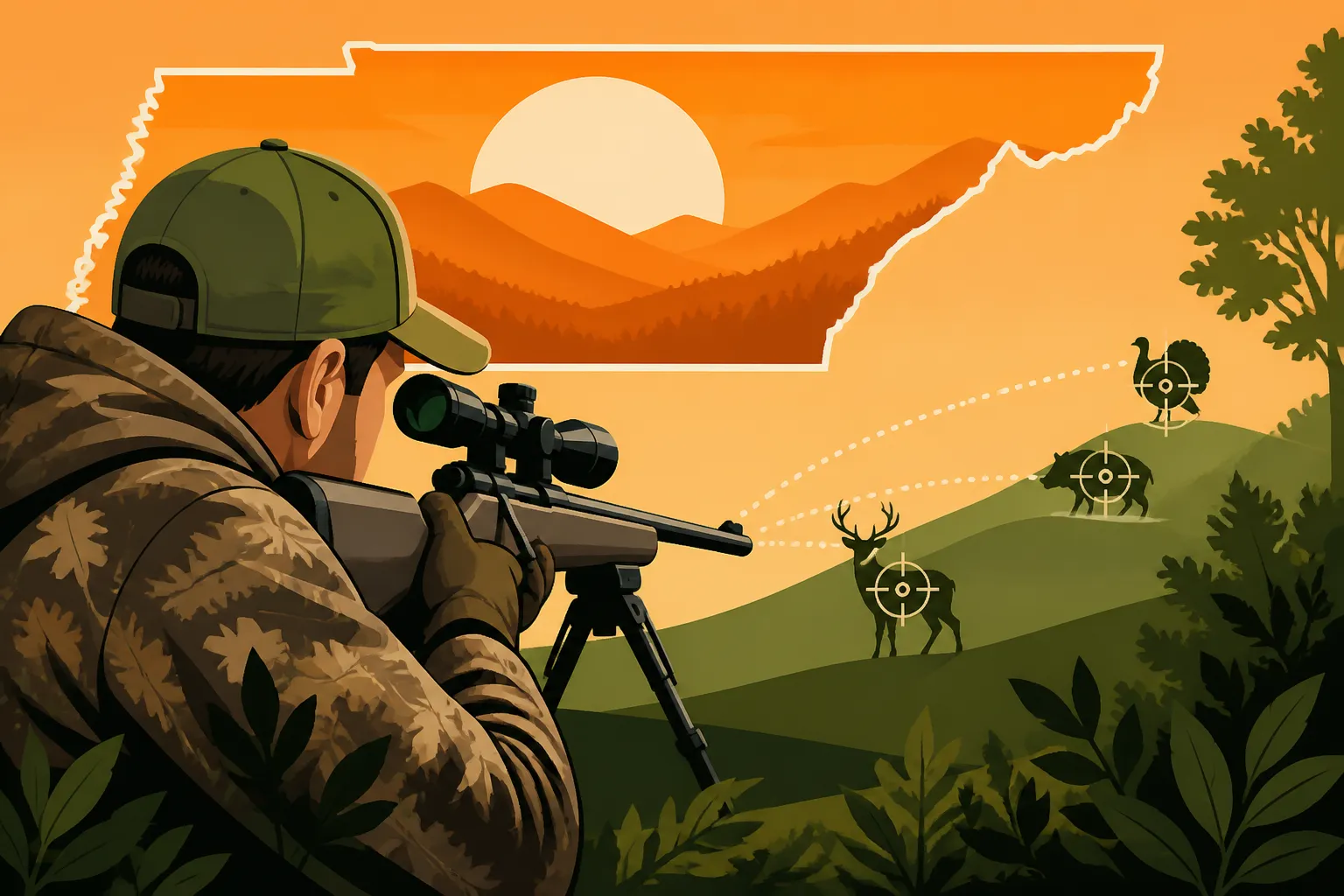
Zeroing a Rifle for Mixed Distances
It’s a common frustration many Tennessee hunters face: you’ve spent countless hours Scouting Tennessee Public Land Before Season, found that perfect oak ridge on the Cumberland Plateau, or identified a prime creek bottom funnel, only to wonder how to set up your rifle for the unpredictable shot distances our varied landscape throws at you. You might get a 40-yard chip shot in thick timber one minute and then a 250-yard opportunity across a clear-cut the next. This comprehensive guide will walk you through the nuances of zeroing your rifle specifically for these mixed distances, helping you build confidence in your shot, no matter where you hunt in the Volunteer State.
Understanding Tennessee's Varied Terrain and Its Impact on Shots
Tennessee isn't just one type of hunting ground. From the rolling hills of West Tennessee to the steep, rugged mountains of the east, our state presents a diverse range of shooting scenarios. Ignoring these geographical realities when zeroing your rifle is a sure path to missed opportunities and frustration in the field.
The Ridge and Hollow Conundrum
When you're still-hunting the steep slopes of the Cherokee National Forest or negotiating the broken terrain of the Cumberland Plateau, you're constantly dealing with significant elevation changes. A deer might appear just over the crest of a ridge at 50 yards, or it could be bedded down on a bench across a deep hollow at 200 yards. The line of sight can be deceptive, and what looks like a flat shot might actually be sharply uphill or downhill, subtly affecting your bullet's trajectory. These tight, timbered environments also mean that quick, decisive shots are often the norm, leaving little time for complex rangefinding or scope adjustments. Knowing your rifle's capabilities and your zero's hold points for these short-to-medium, often angled, shots is paramount. Hunting Cumberland Plateau Ridgelines often presents these exact challenges.
Farmland Edges and Open Bottomlands
Move west, and the landscape shifts dramatically. West Tennessee bottomlands and the farmlands stretching across the middle of the state present a different challenge: potentially longer, more open shots. While you might still encounter thick fencerows or creek bottoms where a deer jumps out at spitting distance, opportunities can also arise when a mature buck crosses a cut bean field at 250 yards or steps out into a powerline clearing. In these areas, wind can also become a much more significant factor. Your zero needs to account for those extended distances without making short shots overly complicated. It's a balance, trying to prepare for both the close-quarters ambush and the longer, more deliberate shot.
The Core Principles of Zeroing a Rifle
Before we dive into specific distances and strategies, let's nail down what "zeroing" truly means and why it's so critical for ethical, successful hunting. It's more than just putting a bullet on paper; it's about establishing a predictable relationship between your aiming point and your bullet's point of impact.
What is "Zeroing" Anyway?
At its heart, zeroing a rifle is the process of adjusting your scope's aiming point (reticle) so that your bullet consistently hits where the reticle is aimed at a specific distance. When you "zero" your rifle at, say, 100 yards, you are ensuring that if you hold your crosshairs directly on the bullseye at that range, your bullet will strike that same spot. This is achieved by making precise adjustments to your scope's windage (side-to-side) and elevation (up-and-down) turrets. Each click typically moves the point of impact a small, measurable amount at a given distance – for instance, 1/4 MOA (minute of angle) at 100 yards means one click moves the impact 1/4 inch. It’s about creating a known point of reference for your bullet's path.
Why a Single Zero Isn't Always Enough
Here's the rub: once a bullet leaves the barrel, gravity immediately begins to pull it downwards. It doesn't fly in a straight line forever; it arcs. This means a rifle zeroed at 100 yards will likely shoot high at 50 yards and low at 200 yards. The bullet's trajectory is like a rainbow, peaking at some point before dropping. For target shooting, knowing exactly where your bullet will hit at every single yardage is feasible. But in a real-world hunting scenario, especially in Tennessee's mixed terrain, you rarely have the luxury of knowing the exact yardage beforehand or the time to make precise scope adjustments. That's why relying on a single, fixed zero for all distances can lead to shots that are either too high or too low, potentially resulting in a missed animal or, worse, a wounded one. The goal is to choose a zero that maximizes your effective range for the vital zone of your target species, allowing for minimal guesswork on holdovers or holdunders.
Popular Zeroing Distances for Tennessee Hunting
When you head to the range, you'll hear hunters talking about different zeroing distances. Each has its merits, and understanding them is key to choosing the best strategy for your particular hunting style and the terrain you frequent.
The 100-Yard Zero: A Solid Foundation
A 100-yard zero is often considered the default starting point for many hunters, and for good reason. It's easy to achieve at most public or private shooting ranges, and it provides a very intuitive understanding of your bullet's flight path. At 100 yards, your bullet hits precisely where you aim. For shots shorter than 100 yards, your bullet will typically hit slightly high, and for shots longer than 100 yards, it will begin to drop.
For instance, with a common deer hunting cartridge like a .308 Winchester zeroed at 100 yards, your bullet might be about an inch high at 50 yards, dead on at 100, and then start to drop, perhaps 3-4 inches low at 200 yards and 10-12 inches low at 250 yards. This zero is excellent for dense timber hunting, thick creek bottoms, or the close-range encounters that are common in areas like the Cherokee National Forest. Many hunters who stick to shorter, more controlled shots, or those who meticulously practice their holdovers, find great success with a 100-yard zero. If you spend most of your time still-hunting ridges and hollows where shots are rarely over 150 yards, a Zeroing at 100 Yards for Ridge Hunting strategy might be ideal.
The 200-Yard Zero: Extending Your Reach
As you move into more open terrain, like larger food plots, powerline cuts, or those expansive West Tennessee crop fields, a 200-yard zero starts to make a lot of sense. With a 200-yard zero, your bullet will rise above your aiming point before falling back through it at 200 yards. This effectively flattens out your trajectory over a longer distance.
Consider that same .308 Winchester. With a 200-yard zero, your bullet might be 1.5 to 2 inches high at 100 yards, peak around 2-3 inches high at 125-150 yards, and then hit dead on at 200 yards. Beyond 200 yards, the drop becomes more pronounced, perhaps 6-8 inches low at 250 yards and 15-20 inches low at 300 yards. This zero is fantastic for hunters who anticipate longer shots but still want a manageable hold for closer ranges. It requires a bit more understanding of your bullet's intermediate trajectory (how high it shoots between 0 and 200 yards), but it drastically simplifies holdover calculations for that critical 100-250 yard window, which covers a huge percentage of Tennessee hunting scenarios.
The "Maximum Point Blank Range" Zero (MPBR)
This is where things get really interesting for mixed-distance hunting. The Maximum Point Blank Range (MPBR) zero is designed to keep your bullet within the vital zone of your target animal from the muzzle out to the furthest practical distance, without requiring you to make any holdover or holdunder adjustments. You simply aim center mass, and if the animal is within your MPBR, you'll hit the vitals.
To achieve an MPBR zero, you first define the size of your target's vital zone – for deer, this is typically an 8-inch to 10-inch circle. Then, using ballistic data for your specific ammunition, you calculate the zero distance that allows your bullet to stay within that vertical window (e.g., never more than 4 inches high or 4 inches low) from the muzzle out to the maximum possible range. This often results in a zero somewhere between 200 and 250 yards, depending on your cartridge and bullet. For a .308, this might mean a 225-yard zero, where your bullet never deviates more than about +/- 4 inches from your aiming point out to roughly 250 yards. This zero minimizes mental calculations in the heat of the moment, making it incredibly effective for varied and fast-paced hunting.
Practical Zeroing Strategies for Mixed Distances
Now that we understand the different zero concepts, let's talk about how to apply them effectively in the field to maximize your success across Tennessee's diverse hunting opportunities. It’s all about choosing a system that works for you and your equipment.
The "Set and Forget" Approach (MPBR in Action)
For many hunters, especially those who appreciate simplicity and don't want to fiddle with scope adjustments in the field, the MPBR approach is a game-changer. Once you've determined your MPBR for an 8-inch vital zone (a good baseline for a Tennessee whitetail), you zero your rifle to the corresponding distance. This typically means your bullet will impact a couple of inches high at 100 yards and be dead-on at your MPBR zero distance, then drop to the bottom of your vital zone at the maximum range.
The beauty of this is that within that entire MPBR window, you aim for the center of the deer's chest, and you know you'll hit vitals. For example, if your 6.5 Creedmoor, shooting a specific load, has an MPBR of 275 yards with an 8-inch vital zone, you'd zero it so that at 275 yards, it's about 4 inches low. This will mean it's likely 2.5-3 inches high at 100 yards. This strategy is fantastic for scenarios where a deer might appear at 50 yards, 150 yards, or 250 yards, and you don't have time to range or dial. You can use ballistic calculators, many of which are available through apps like those offered by GoHunt, to precisely determine your MPBR for your specific rifle, caliber, and ammunition. This gives you the confidence to simply aim and squeeze the trigger. 6.5 Creedmoor for Cumberland Ridges often benefits greatly from an MPBR zero.
Dialing vs. Holdovers: When to Use What
This is a fundamental choice for extending your effective range beyond a simple point-and-shoot MPBR.
- Holdovers (and Holdunders): This involves using your reticle (the crosshairs in your scope) to compensate for bullet drop. Instead of aiming dead center, you aim slightly high (for shots closer than your zero if you have a 200-yard or MPBR zero) or slightly low (for shots farther than your zero). Many modern scopes come with BDC (Bullet Drop Compensator) reticles, which have aiming points or hash marks below the center crosshair corresponding to different distances. With practice and knowing your bullet's trajectory, you can quickly estimate the distance, select the appropriate hash mark, and make the shot. This is generally faster than dialing and excellent for shots out to 300-400 yards where speed is essential, and you might not have time to manipulate turrets.
- Dialing (Using Turrets): This method involves physically adjusting your scope's elevation turret to match the precise bullet drop for a given distance. You range the target (which is where a good rangefinder comes in handy, especially with apps like GoHunt that integrate with them), look up the corresponding adjustment (often on a pre-made "dope card" or ballistic app), dial the necessary clicks, and then aim dead center. This is the most precise method for longer-range shooting (typically beyond 300-400 yards), but it requires more time, a stable shooting position, and meticulous preparation. In thick Tennessee timber, where shots are generally short, dialing is rarely practical. However, in wide-open fields or during an elk hunt, it can be invaluable.
Practice, Practice, Practice
No matter which zeroing strategy you choose, it's absolutely meaningless without consistent practice. You need to become intimately familiar with how your rifle shoots at various distances, not just your zero.
- Shoot at Varying Ranges: Don't just shoot at 100 yards. Set up targets at 50, 75, 100, 150, 200, 250, and even 300 yards. Observe where your bullets are actually hitting with your chosen zero. Make notes. This empirical data is far more valuable than any ballistic chart.
- Shoot from Hunting Positions: Practice shooting from kneeling, sitting, and even standing with support, just as you would in the field. Recreating realistic hunting scenarios on the range will build muscle memory and confidence.
- Simulate Time Constraints: Practice quick target acquisition and making a shot within a few seconds. This helps you understand when a holdover is feasible and when a shot might be too rushed.
The more you shoot and understand your chosen zero and its implications across different distances, the more confident and ethical you'll be in the field.
Considerations Beyond the Zero
While a good zero is foundational, it's only one piece of the puzzle. Several other factors play a crucial role in how your bullet performs at mixed distances, and a complete understanding of them will make you a far more effective hunter.
Ammunition Choice and Ballistics
The ammunition you choose has a profound impact on your rifle's trajectory. Different bullet weights, bullet types, and manufacturers will yield different muzzle velocities and ballistic coefficients (a measure of a bullet's ability to overcome air resistance). A lighter, faster bullet might have a flatter trajectory out to a certain point, while a heavier, more aerodynamic bullet might retain energy better at longer ranges.
Always zero your rifle with the exact ammunition you intend to hunt with. Switching brands, bullet weights, or even different lots of the same bullet can change your point of impact significantly. If you typically hunt with a 150-grain soft point for deer, don't zero with 180-grain target rounds and expect consistent results. Apps like GoHunt often have extensive ballistic databases that can help you compare different ammunition types for your caliber, but nothing beats shooting your chosen load at the range. Ammunition Availability Before Opening Day is also a practical consideration; ensure you have enough of your preferred load for practice and hunting.
Environmental Factors (Wind and Thermals)
Tennessee's weather can be famously fickle, and environmental factors can wreak havoc on your bullet's flight path, especially at longer distances.
- Wind: This is the arch-nemesis of precise long-range shooting. A brisk crosswind can push your bullet several inches off target at 200 yards and even more at 300. There's no magical "wind zero" – it's something you have to learn to read and compensate for in real-time. Practice shooting on windy days (safely!) to understand how much your bullet drifts. Pay attention to how the trees are swaying, the grass is bending, and use wind flags at the range if possible.
- Thermals: Particularly in mountainous or heavily broken terrain like the Cherokee National Forest or the Cumberland Plateau, thermals (rising or falling air currents) can subtly affect bullet flight, especially for very long shots. While less dramatic than wind, understanding Wind and Thermals on a Ridge System is part of becoming a complete hunter. For typical Tennessee hunting distances (under 300 yards), wind is the primary environmental concern.
Gear Up: Rangefinders and Ballistic Apps
In Tennessee's varied landscapes, guessing the distance is a recipe for disaster. Investing in the right tools is crucial for confident shot placement.
- Rangefinders: A good quality laser rangefinder is non-negotiable for hunting mixed distances. It removes all doubt about how far your target is, allowing you to apply your zeroing knowledge, whether it's an MPBR hold or dialing for a specific distance. When hunting in thick cover or on uneven terrain, a rangefinder that can quickly give accurate readings, even through light brush, is invaluable. Consider models that offer angle compensation, which is critical for uphill and downhill shots common in our mountains. A feature-rich hunting app, perhaps one from GoHunt, can often integrate with your rangefinder or provide robust mapping capabilities that assist with range estimation. Rangefinders in Thick Cumberland Cover can be tricky, so practice with yours.
- Ballistic Apps: Modern smartphone ballistic apps are incredibly powerful tools. They allow you to input your specific rifle, caliber, bullet, velocity, and environmental conditions (temperature, humidity, altitude) to generate precise ballistic solutions. These apps can tell you exactly how many clicks of elevation to dial or which reticle hashmark to use for any given distance. Some, like those from GoHunt, can even build custom dope cards for your rifle and save multiple load data profiles. While you won't be staring at your phone during a shot, having this data readily accessible during scouting or for pre-hunt planning is a huge advantage.
Fine-Tuning Your System for Tennessee Success
Becoming proficient at shooting mixed distances isn't just about setting a zero; it's about developing a comprehensive system that you can trust under pressure. This includes understanding your equipment and having a reliable way to reference your data.
Understanding Your Scope's Reticle
Your scope's reticle is your primary tool for aiming, and modern reticles offer much more than just a simple crosshair.
- Duplex/Standard Reticles: These are basic crosshairs. With these, you'll rely heavily on knowing your MPBR and practicing holdovers by estimating how much "air" to hold over or under your target. This requires a lot of repetition to ingrain those hold points.
- BDC (Bullet Drop Compensating) Reticles: These reticles have a series of dots or hash marks below the main crosshair, designed to correspond to specific distances (e.g., 200, 300, 400 yards). While convenient, these are often calibrated for specific cartridges and velocities, so it's crucial to verify their accuracy with your chosen ammunition at the range. You might find that the 300-yard mark on your reticle is actually closer to 285 yards with your specific load.
- Christmas Tree/Tactical Reticles: These are more complex, with multiple horizontal and vertical hash marks. They offer precise holdovers for both elevation and windage, making them popular for long-range shooting. While perhaps overkill for most Tennessee deer hunting, understanding their capabilities can inform your choice if you anticipate very long shots.
No matter the reticle type, the key is to know your specific reticle and how your bullet interacts with its aiming points. This is where range time and good record-keeping become invaluable.
Recording Your Dope
"Dope" is a shooter's term for "Data On Previous Engagements" – essentially, a record of how your rifle and ammunition perform at various distances and under different conditions. Having your dope readily available is crucial for making informed decisions, especially if you plan to dial your scope for longer shots.
You can create a physical dope card, laminating it and attaching it to your rifle sling, scope cap, or even inside your hunting pack. This card would list your elevation adjustments (in clicks or MOA/Mils) for specific distances (e.g., 200 yards = 2 clicks up, 250 yards = 4 clicks up, etc.). Ballistic apps, like the robust tools found in GoHunt, can generate these dope cards digitally and even adjust for real-time environmental data. Some even allow you to print them out. This way, if you range a deer at 275 yards, you can quickly reference your card, dial the correct number of clicks, and confidently place your shot. For hunters venturing into more open country or planning for a North Cumberland elk hunt, having this information is non-negotiable.
Real-World Scenarios and Adaptability
Ultimately, all this preparation culminates in real-world hunting scenarios. The Tennessee woods are dynamic, and you need to be adaptable.
- The Quick Shot: Sometimes, a deer might burst out of cover at 70 yards, offering only a few seconds. In these moments, relying on an MPBR zero and your practiced point-and-shoot instincts is key. There's no time to range, dial, or even think too much about holdovers.
- The Steep Angle Shot: When hunting in mountainous terrain, a deer might be directly below you or far above you. Both uphill and downhill shots change the effective range due to gravity. Many modern rangefinders have angle compensation, which gives you the "shoot-to" distance rather than the line-of-sight distance. Learn to use this feature.
- Knowing Your Limits: Perhaps the most important aspect of effective shooting at mixed distances is knowing your personal and your rifle's ethical limits. Just because your rifle can hit a target at 400 yards on a static range bench doesn't mean you should attempt that shot on an animal in variable field conditions. Be honest with yourself about your comfort zone and practice within it. For many hunters in the thick parts of the state, Practical Range in Cherokee Forest Timber might mean limiting shots to under 200 yards.
By combining a smart zeroing strategy, understanding your ammunition, preparing for environmental factors, utilizing modern tools, and practicing diligently, you'll be well-equipped to make ethical, confident shots across the incredible diversity of Tennessee's hunting landscapes.
Zeroing Distance Comparison Table (Hypothetical .308 Winchester)
This table illustrates how different zeroing distances affect point of impact for a common deer hunting cartridge, assuming a muzzle velocity of approximately 2700 fps for a 150-grain bullet.
| Zero Distance (Yards) | Point of Impact at 50 Yards | Point of Impact at 100 Yards | Point of Impact at 150 Yards | Point of Impact at 200 Yards | Point of Impact at 250 Yards | Point of Impact at 300 Yards | Pros | Cons |
|---|---|---|---|---|---|---|---|---|
| 100-Yard Zero | +1.0" High | Dead On | -1.5" Low | -4.5" Low | -9.0" Low | -15.5" Low | Simple, intuitive for close-range hunting. | Requires significant holdover past 150 yards. |
| 200-Yard Zero | +1.5" High | +2.0" High | +1.5" High | Dead On | -5.0" Low | -12.5" Low | Flatter trajectory for medium distances. | Hits high at closer ranges; still needs holdover for longer shots. |
| MPBR (8" Vital Zone) | +0.5" High | +2.5" High | +3.0" High | +1.5" High | -2.0" Low | -8.0" Low | "Aim center mass" simplicity within range. | Requires precise ballistic calculation and understanding of its specific range limits. |
Note: All values are approximate and will vary based on specific rifle, ammunition, barrel length, and environmental conditions. Always confirm with your own rifle at the range.
Disclaimer
This article is for general informational purposes only and does not constitute professional advice. Laws, prices and regulations vary by location and change over time. Consult a qualified professional for guidance on your specific situation.