Treestands and Saddles on Public Land
Hunting public land in Tennessee offers incredible opportunities, but it also comes with its own unique set of challenges, especially when it comes to elevated hunting. Deciding between a treestand or a saddle, understanding the regulations, and packing smart for those long walks can feel like deciphering a secret code. This guide is all about helping you navigate the world of treestands and saddles on Tennessee's public lands, from the legalities to the practicalities, ensuring you stay safe, legal, and effective in your pursuit.
Understanding the Rules of the Game: Public Land Regulations
One of the biggest hurdles for any public land hunter in Tennessee is understanding and adhering to the labyrinth of regulations that govern everything from season dates to how you can set up your deer stand. It's not enough to just know the state-wide rules; many Wildlife Management Areas (WMAs) have their own specific quirks. Ignorance of the law is never an excuse, and a simple oversight could cost you your hunting privileges or worse.
General Treestand and Ground Blind Regulations
Generally speaking, on most public lands overseen by the Tennessee Wildlife Resources Agency (TWRA), you're often dealing with regulations designed to prevent permanent damage to timber and ensure fair access for all hunters. This means you can't go cutting limbs, driving nails, or otherwise modifying a tree to set up a permanent stand. That old ladder stand you bolted to a oak on private ground? Forget about it here. Treestands, whether they are climbers, hang-ons, or tripods, must typically be removed seasonally. Some public lands might even require removal after each hunt, or within a specific timeframe like 24 hours after your hunt is done. Always consult the most current TWRA hunting guide and any specific WMA regulations for precise dates and requirements.
When using any elevated stand or ground blind on public land during deer season, remember the very important rule about visibility. Hunters utilizing a ground blind, whether it's a pop-up or one you constructed from natural materials, are generally required to have a minimum amount of blaze orange visible from all sides. Similarly, if you are walking to or from your treestand, you'll need to wear blaze orange. This is for your safety and the safety of others. While you might take off some of your outer blaze orange layers once safely secured in your stand if permitted by specific WMA rules, carrying and displaying it is a critical safety measure. Always double-check the current Tennessee Blaze Orange Requirements as these rules can change and vary by specific hunting scenario and WMA.
Specific WMA Rules and the GoHunt Advantage
Here’s where things get really interesting – and sometimes frustrating. While statewide regulations provide a baseline, many of Tennessee's excellent Wildlife Management Areas (WMAs) operate under their own distinct sets of rules. What's perfectly fine on one WMA might be a violation on another. For example, some WMAs might have different stand removal dates, restrict certain types of climbing aids, or even prohibit the use of screw-in steps entirely to protect the trees. Places like Catoosa WMA or Chuck Swan WMA, known for their managed hunts and unique ecosystems, often have more stringent regulations to maintain habitat quality and manage hunter impact.
This is where planning and good resources become your best friends. Before you even pack your truck, you need to know the specific rules for the WMA you plan to hunt. A thorough check of the TWRA website for the specific WMA is non-negotiable. This is also where a tool like GoHunt can be incredibly useful. While I can't speak to its real-time data, mapping applications like GoHunt typically integrate layers that show public land boundaries, WMA borders, and often include links or summaries of specific WMA regulations, making it easier to research from your phone or computer. Imagine pulling up a map, seeing the boundary of the WMA you're interested in, and with a tap, being able to review the specific treestand rules for that area. It can save you a lot of headache and ensure you’re hunting legally. These types of apps offer a powerful advantage for scouting and planning, making sure you don't step across a line you shouldn't. You can also compare this functionality to the official state tools described in Scouting With the Tennessee TWRA App.
Choosing Your Perch: Treestand Types for Public Land
The type of elevated stand you choose can dramatically impact your success and comfort on Tennessee's public lands. Each style has its own strengths and weaknesses, making some better suited for specific terrains or hunting styles. From mobility to setup time, considering your priorities will help you pick the right tool for the job.
Climber Stands: The Mobile Workhorse
Climber stands are a classic choice for public land hunters, and for good reason. They offer a self-contained, highly mobile solution, allowing you to pick a tree and ascend with minimal fuss (once you get the hang of it). The beauty of a climber is its simplicity: two pieces, often lightweight aluminum, that you "walk" up the tree trunk. This makes them ideal for hunters who like to scout on the fly, move with changing conditions, or simply don't want to leave a stand out. Imagine walking deep into a remote section of the Cherokee National Forest, finding a fresh scrape line, and within minutes, having a comfortable perch overlooking the action.
However, the major downside of a climber is its reliance on a specific type of tree. You need a relatively straight, limbless trunk from about waist-high up to your desired hunting height. This can be a significant limitation in areas with dense undergrowth, twisted hardwoods, or multi-trunked trees common in parts of the Cumberland Plateau. Hauling a bulky climber through thick brush to find that perfect tree can be exhausting and noisy. Also, getting proficient with a climber takes practice. Learning to ascend quietly and efficiently, especially in the dark of pre-dawn, is a skill developed over time. But when the conditions are right, and you find that perfect oak or pine with a straight trunk, a climber stand can put you exactly where you need to be. Many experienced hunters rely on them for their ability to quickly adapt to changing deer patterns. For a deeper dive into this, check out Climber Stands on Straight Trunks.
Hang-on Stands and Climbing Sticks: Versatility and Stealth
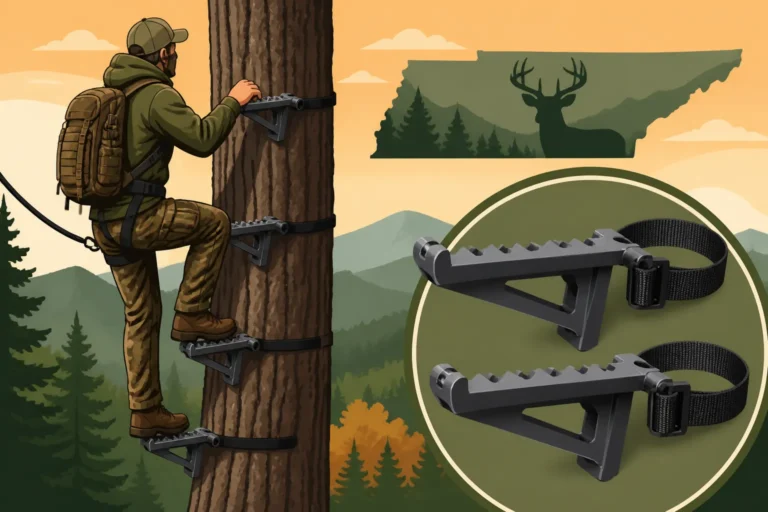
When the terrain and tree availability don't favor a climber, hang-on stands paired with climbing sticks or steps become the go-to option. This system offers incredible versatility, allowing you to hunt almost any tree that's sturdy enough to hold you, regardless of how many limbs it has or how crooked its trunk might be. The stand itself is typically a smaller platform that "hangs" from a strap or chain around the tree, while separate climbing sticks or sections of rope/strap-on steps get you to hunting height. This modularity means you can choose lighter components and distribute the weight more evenly in your pack. For those gnarly hardwoods in East Tennessee, where straight, limbless trees are a rarity, a hang-on and sticks are often the only way to get elevated.
The trade-off, of course, is that it's more pieces of gear to carry and manage. Setting up a hang-on and sticks can also be more involved and potentially noisier than a climber, especially if you're trying to do it in the dark without alerting every deer in the county. However, with practice, you can become remarkably efficient and silent. Many public land hunters will carry a lightweight hang-on and a few sticks deep into a property, allowing them to adapt to specific features like a saddle between two ridges or a pinch point along a creek bottom. They can position their stand perfectly, even if it means navigating around lower limbs or setting up on a tree that isn't perfectly straight. This system truly shines when you need to be stealthy and adaptable. When hunting tricky timber, knowing how to use Climbing Sticks for Tennessee Hardwoods effectively can make all the difference.
Ground Blinds: A Different Angle
While our main focus here is elevated hunting, it's worth a moment to consider ground blinds as an alternative, especially on public land where tree availability or specific WMA rules might make treestands less feasible. Ground blinds offer a completely different set of advantages, chief among them being concealment from the ground up, protection from the elements, and the ability to hunt virtually anywhere, regardless of tree cover. If you're hunting open fields, brushy fencerows, or thick cedars where good stand trees are scarce, a ground blind can be a fantastic option.
However, ground blinds come with their own set of considerations. You lose the elevated vantage point, meaning your sightlines are often limited, and scent control becomes even more critical as your scent cone stays closer to the ground. Packing a pop-up blind can be cumbersome, and setting it up quietly in the dark requires practice. Furthermore, you'll need to pay close attention to the blaze orange requirements mentioned earlier, as many WMAs require hunters in ground blinds to display an adequate amount of orange on the exterior. Despite these challenges, a well-placed and brushed-in ground blind can offer an incredibly comfortable and effective way to hunt, especially for those longer sits in colder weather, or if you're hunting with a youth or new hunter. For situations where elevation isn't possible or desirable, learning to be effective from a blind is a skill every public land hunter should have. Consider reading Using a Ground Blind on Tennessee Public Land for more details.
The Modern Hunter's Edge: Saddle Hunting on Public Land
Saddle hunting has exploded in popularity over the last decade, and for good reason, especially for those venturing onto public land. It's a method that combines minimalist gear with maximum versatility, offering a unique approach to elevated hunting that can be incredibly effective when facing the challenges of pressured public tracts and varied timber.
What is Saddle Hunting and Why It's Gaining Popularity
At its core, saddle hunting involves wearing a specialized harness – the "saddle" – that suspends you around a tree, rather than sitting in a stand. You ascend the tree using climbing sticks or rope methods, attach yourself to the tree via a tether and carabiner, and then lean back into the saddle, allowing you to rotate 360 degrees around the trunk. You shoot from a standing or leaning position, using the tree for cover. It's a system that takes some getting used to, but the benefits are undeniable.
The primary draw for public land hunters is the sheer portability and stealth. A complete saddle setup, including sticks, can weigh significantly less than most traditional hang-on or climber stands, often fitting into a compact backpack. This light weight allows hunters to go deeper into remote areas, covering more ground with less fatigue. Because you're literally hugging the tree, your profile is incredibly small, offering superior concealment from wary deer. You become part of the tree, fading into its outline. Furthermore, the 360-degree shooting capability means you can take shots from any angle, a huge advantage when a buck circles behind your setup. The adaptability to any climbable tree, regardless of its shape or limb configuration (within reason), means you're never limited by "finding the perfect tree" like with a climber. This can be a game-changer on heavily hunted public lands where easily accessible, perfect stand trees are often already scouted or pressured. While there is an initial learning curve and an investment in specialized gear, the freedom and stealth it provides are making more and more Tennessee hunters swear by it. Saddle Hunting in Tennessee Hardwoods further explores this dynamic method.
Integrating Saddle Hunting with Public Land Tactics
The inherent advantages of saddle hunting align perfectly with the demands of hunting Tennessee's public lands. When you're dealing with pressured deer and often difficult access, mobility and stealth are paramount. Saddle hunting allows you to be an agile predator, capable of adapting to changing conditions and pursuing deer where others might not dare to go.
Imagine a scenario on the Cumberland Plateau: you've been monitoring a specific ridge line, perhaps using a mapping tool like GoHunt to analyze aerial photos and terrain features. You identify a potential pinch point, but the only trees available are mature oaks with lower limbs and a slightly crooked trunk – too difficult for a climber, and a hang-on might expose you too much. With a saddle, you can quietly ascend that oak, positioning yourself on the "backside" of the tree from the deer's likely approach, using the trunk itself for maximum cover. Your lightweight setup means you can pack in quickly, set up efficiently, and be ready to hunt before daylight without leaving a huge footprint. This minimal disturbance is crucial on public ground where deer are more likely to be sensitive to human presence. The ability to quickly relocate based on fresh sign or shifting winds becomes effortless. Using a detailed map from an app like GoHunt can help you identify these spots visually before you ever step foot in the woods, highlighting potential travel corridors or bedding areas that dictate exactly where you might want to strap into a tree. The combination of modern mapping tools and the saddle's mobility truly gives public land hunters an edge in locating Finding Ground Others Walk Past and outsmarting those wary public land whitetails.
Safety First: Essential Practices for Elevated Hunting
No matter what type of stand or saddle you choose, or how experienced you are, safety must always be your absolute top priority when hunting from an elevated position. The exhilaration of the hunt can sometimes make us complacent, but a fall from even a moderate height can lead to life-altering injuries or worse. It's a sobering fact that falls from treestands are a leading cause of hunting-related accidents.
The Non-Negotiable: Full-Body Harnesses and Lifelines
Let me be crystal clear: if you are going more than a few feet off the ground, you MUST wear a full-body harness, and it must be attached to the tree from the moment your feet leave the ground until they are back on solid earth. This isn't optional; it's the single most important piece of safety equipment you own as an elevated hunter. Many accidents happen while climbing up or down, not just while sitting in the stand. A lifeline system that attaches to the tree and allows you to clip into it from the ground and remain attached throughout your ascent and descent is absolutely critical.
Think about it: a misstep, a broken branch, a strap failure, or even a moment of dizziness can send you plummeting. A full-body harness distributes the impact and holds you upright, preventing serious injury and giving you a chance to recover or call for help. Don't rely on old, outdated safety belts that only cinch around your waist; these can cause severe internal injuries in a fall. Invest in a quality, comfortable full-body harness and use it, every single time. It might feel like a minor inconvenience, but it could literally save your life. Make sure to understand and practice with your Safety Harnesses and Lifelines before you ever hit the woods.
Pre-Season Checks and Gear Maintenance
Your hunting gear, especially anything related to elevated positions, takes a beating. Exposure to the elements, repeated use, and the stresses of climbing can cause wear and tear that might not be immediately obvious. Before each season, and ideally before each hunt, conduct a thorough inspection of all your elevated hunting equipment.
This includes checking straps for fraying or cuts, inspecting buckles and carabiners for cracks or deformation, looking at bolts and welds on your stand for rust or looseness, and examining ropes or cables for wear. UV exposure can degrade synthetic straps and ropes over time, even if they look fine on the surface. If you see any signs of wear, damage, or degradation, replace the component immediately. Don't try to get "one more season" out of questionable gear. Pay attention to manufacturers' recommended lifespans for harnesses and straps, as some materials have a limited lifespan regardless of visible wear. Practice setting up your stand or saddle in your backyard or a low-stress environment. This not only builds muscle memory and efficiency but also allows you to identify any creaks, groans, or malfunctions in a safe setting, long before you're trying to set up in the dark 20 feet up a tree on public land.
Situational Awareness: Wind, Weather, and Tree Health
Beyond your equipment, your environment plays a huge role in elevated hunting safety. Before you pick a tree, give it a thorough once-over. Is it alive? A dead tree might look sturdy, but internal rot could make it incredibly dangerous. Are there any dead limbs overhead that could come crashing down in a stiff breeze? Are there any bee nests or wasp nests that could pose a sudden, painful threat?
Wind and weather are also critical factors. High winds can make a treestand sway significantly, making it uncomfortable, difficult to shoot accurately, and potentially dangerous. Rain or ice can make climbing sticks and stand platforms incredibly slick, increasing the risk of a slip. If there's ice or a strong storm rolling in, it's often wiser to opt for a ground hunt or simply postpone your outing. Also, consider the angle of the sun and how it might impact your visibility or the tree's bark when climbing. Being aware of your surroundings – the stability of the tree, the forecast, and potential environmental hazards – is just as important as the gear you carry.
Advanced Strategies for Public Land Elevation
Getting elevated on public land isn't just about picking a tree and climbing up. It's about strategic thinking, understanding deer movement, and minimizing your impact in areas that often see significant hunting pressure. Mastering these advanced strategies can significantly increase your odds of success.
Scouting for Success from Above
Gone are the days when scouting was solely about walking miles in the woods, hoping to stumble upon fresh sign. While boots-on-the-ground scouting is still invaluable, modern tools allow you to "scout from above" before you ever leave your home. Mapping applications, like GoHunt, provide incredibly detailed aerial photos and topographical maps that can reveal subtle terrain features, pinch points, funnels, and potential bedding or feeding areas that are difficult to discern on the ground.
By studying these maps, you can identify potential stand locations long before the season opens. Look for ridge saddles, where deer often cross from one side to another, or creek bottoms that act as natural travel corridors. Identify areas with a mix of cover and potential food sources. These maps can also help you plan your access and exit routes to be as quiet and undetected as possible. Imagine seeing a dense thicket on the map, realizing it's surrounded by more open hardwoods, and then identifying a perfect stand tree on the edge of that cover – a spot you might have walked past without the bird's-eye view. This remote scouting helps you narrow down vast public land tracts, focusing your valuable in-the-field time on the most promising areas. You can also utilize these mapping techniques as covered in Reading Aerial Photos for Cumberland Plateau Deer. This level of pre-hunt planning can make you far more efficient and effective once you're on the ground, helping you make the most of your time in the woods.
Minimizing Your Footprint and Impact
Public land hunting comes with a responsibility: to leave the area as you found it, minimizing your impact on the habitat and on other hunters. This is especially true for elevated hunting. The "pack in, pack out" philosophy is paramount. This means everything you bring with you – your stand, your sticks, your trash, even your water bottles – must come back out with you. Leaving stands permanently affixed to trees, even if regulations allowed it (which they rarely do on public land), not only damages the trees but also clutters the landscape and signals your presence to other hunters and game.
Public land regulations regarding stand removal exist for good reason: they ensure that no single hunter lays permanent claim to a spot and that the natural environment is preserved. If you're required to remove your stand daily or seasonally, adhere to those rules without fail. Beyond the regulations, consider the subtle ways you leave a footprint. Be mindful of scent, noise, and physical disturbance. Avoid breaking branches unnecessarily or trampling vegetation more than needed for access. The goal is to be a ghost in the woods, observing and interacting with nature without leaving a lasting mark. This approach not only respects the land and other users but also makes you a more effective hunter, as minimizing disturbance means deer are less likely to detect your presence or associate a specific area with human activity. Being conscious of your impact is a fundamental aspect of ethical public land hunting, and can help you avoid the pitfalls of Hunting Pressure on Tennessee Public Land. Remember, understanding and adhering to Treestand Rules on Tennessee Public Land is vital for maintaining access and preserving the hunting experience for everyone.
Treestand and Saddle Comparison for Public Land
| Feature | Climber Stand | Hang-on Stand & Sticks | Saddle Hunting System |
|---|---|---|---|
| Mobility | High (self-contained, easy to move) | Moderate (more pieces, but versatile) | Extremely High (ultra-light, compact) |
| Tree Selection | Limited (straight, limbless trunks) | Versatile (most sturdy trees) | Extremely Versatile (any sturdy tree) |
| Stealth (Setup) | Can be noisy if not practiced | Can be noisy with multiple pieces | Generally very quiet, minimal profile |
| Concealment | Moderate (exposed, sitting in stand) | Moderate (exposed, sitting in stand) | Excellent (hugs tree, low profile) |
| Weight (Typical) | Moderate to Heavy (18-30 lbs) | Light to Moderate (10-25 lbs, depending on sticks) | Very Light (5-15 lbs, including sticks) |
| Comfort (Long Sit) | Generally Good (seat, platform) | Varies by model (seat, platform) | Varies (can be less comfortable for long sits) |
| Shooting Angles | Limited (fixed position) | Limited (fixed position) | 360-degree rotation, excellent angles |
| Public Land Ideal For | Open hardwoods, pine stands, quick moves | Varied timber, deep woods, specific features | Remote areas, high pressure, ultimate stealth |
No matter your preference, mastering the art of elevated hunting on Tennessee's public lands requires a combination of smart gear choices, a deep understanding of regulations, unwavering commitment to safety, and a strategic approach to scouting and setup. Whether you're a traditional treestand user or exploring the agile world of saddle hunting, the goal remains the same: to immerse yourself in the natural world and ethically pursue game. Embrace the challenge, stay safe, and make the most of the incredible hunting opportunities our state has to offer. Don't forget that utilizing these methods can be highly effective when hunting specific terrain features, such as discussed in Hunting a Ridge-Top Saddle for Rutting Bucks.
Disclaimer
This article is for general informational purposes only and does not constitute professional advice. Laws, prices and regulations vary by location and change over time. Consult a qualified professional for guidance on your specific situation.