Best Tennessee Ground for Public Land Bear
Finding a solid public land spot to chase black bears in Tennessee can feel like trying to find a needle in a hayfield, especially if you're used to deer hunting where the signs are often more obvious and the terrain a bit more forgiving. Bear hunting on public land in our state demands a different kind of scouting, a deep understanding of habitat, and a willingness to put in the miles. This guide is here to cut through the confusion and point you toward the most promising public lands where you might just tag a bruin, offering practical advice on what to look for and how to approach these rugged areas.
Understanding Tennessee's Bear Hunting Zones
Tennessee isn't a "one size fits all" state when it comes to bear hunting. Our wildlife agency, the TWRA, has meticulously divided the state into different bear zones, each with its own season dates, regulations, and distinct characteristics. You can't just expect to wander into any chunk of public timber and find bears; you need to understand where they thrive and where the seasons are open. This zonal approach is designed to manage the bear population effectively, recognizing that habitat and bear density vary significantly from east to west.
Think of it like this: if you're targeting big deer, you scout different areas than if you're trying to fill a freezer with antlerless tags. Bear hunting is even more specialized. The frustrations often stem from misunderstanding these zones and the unique challenges each presents. You might spend days in an area that simply doesn't hold many bears, or worse, doesn't have an open season during your hunt. Knowing the zones is your first, and arguably most important, step in finding success. You can dive deeper into the specific regulations by reading about Tennessee's Three Bear Hunting Zones.
Bear Zone One: Northeast Tennessee Mountains
This is, for many, the quintessential bear hunting country in Tennessee. Zone One covers the rugged, sprawling terrain of the Appalachian Mountains in the northeastern part of the state, primarily within the Cherokee National Forest. We're talking about vast expanses of steep ridges, deep hollows, and dense hardwood forests that provide incredible cover and natural food sources for bears. It's truly wild country, and it takes a commitment to penetrate these areas.
If you're looking for an honest backcountry experience, this is where you'll find it. Bears here are accustomed to minimal human interaction, and their movements are largely dictated by natural mast crops like acorns and berries. Access can be challenging, often requiring long hikes up and down steep slopes. This isn't the place for a quick morning hunt from the truck; you'll earn every step. The sheer size of the Cherokee National Forest Hunting means you can find solitude, but it also means you have to be prepared for the wilderness. Hunters often report seeing more sign the deeper they get, away from easy road access.
Bear Zone Two: The Smoky Mountain Foothills
Bear Zone Two wraps around the perimeter of the Great Smoky Mountains National Park, extending into the foothills of East Tennessee. This zone is a bit different from Zone One. While still mountainous and rugged in many places, it often borders more populated areas and private lands. The bears here sometimes have a higher tolerance for human activity, and their movements can be influenced by agricultural lands or even suburban fringes adjacent to public forests.
Hunting pressure can be higher in some accessible parts of Zone Two due to its proximity to larger towns. However, the habitat remains excellent, with a mix of national forest, state forests, and WMAs offering opportunities. You'll often find bears utilizing dense thickets in hollows during the day and moving to feed on mast in higher elevations or even venturing closer to agricultural fields at night. The challenge here is often finding undisturbed pockets amidst a more fragmented landscape, and being acutely aware of private land boundaries. Understanding how bears use areas close to human development, especially during seasonal food shifts, is key. Hunters should definitely consult a mapping app like onX Hunt to ensure they're on public land.
Bear Zone Three: South Cherokee
Zone Three encompasses the southern portion of the Cherokee National Forest, specifically in the lower sections of the state that border Georgia and North Carolina. This area offers a similar rugged, forested environment to Zone One but might be slightly less recognized by some hunters, which can sometimes mean slightly less pressure in certain spots. It’s still prime bear country with vast tracts of public land.
The terrain in Zone Three is characterized by steep, heavily timbered slopes, dense laurel thickets, and deep river drainages that provide ideal habitat for bears. Mast crops are abundant, and the dense cover allows bears to feel secure. Hunters pursuing bear in this zone often find success by focusing on traditional backcountry tactics, such as extensive scouting for fresh sign, identifying natural travel corridors, and patiently still-hunting through promising areas. For more targeted strategies in this specific region, check out Hunting Bear Zone Three on South Cherokee. It’s a place where perseverance and a good understanding of mountain hunting can really pay off.
Key Characteristics of Good Public Bear Habitat
You can stare at a topo map all day, but until you understand what actually draws a bear to a specific spot, you're just guessing. Bears, like any wildlife, prioritize food, water, and cover. On public land, especially in Tennessee's mountains, these elements aren't always distributed evenly. Knowing what to look for can drastically narrow down your search and increase your chances of success. It's not enough to just see "green" on a map; you need to interpret that green in terms of bear biology and behavior.
The frustration of hunting bears often comes from covering miles and seeing no sign. This usually means you're in good general habitat, but not great bear habitat. Identifying these crucial characteristics helps you move from simply being in the woods to being in a bear's living room.
Mast Crops and Food Sources
Bears are opportunistic omnivores, but in the fall, mast crops are king. Hard mast, primarily acorns from various oak species, is a critical food source that dictates bear movement and density. When acorns are abundant, bears will concentrate in areas where these trees are producing heavily. Soft mast, like berries (blackberries, blueberries, huckleberries) and wild grapes, also play a significant role, especially earlier in the season.
Scouting for mast is paramount. Before the season opens, you need to be in the woods, or at least glassing hillsides, to identify which oak ridges are dropping. Not all oaks produce every year, and some species are preferred over others. For instance, white oaks drop earlier and are often preferred, while red oaks hold their acorns longer into the season. Looking for fresh droppings, torn-up logs, and overturned rocks are all signs of a bear actively feeding. If you find an area with abundant mast, especially in a thick, remote hollow, you've found a gold mine. This seasonal dependency means that what was a great spot last year might be barren this year, leading to much frustration if you don't adapt.
Thick Cover and Remote Areas
Bears crave security, and in heavily hunted areas, that means thick cover and remote terrain. They will bed down in the densest rhododendron thickets, laurel slicks, or regenerating clear-cuts they can find during the day, especially if they’re being pressured. These areas are often difficult for hunters to penetrate, which is precisely why bears choose them. Think of those nasty places you usually try to skirt around – that's where the bears want to be.
Public land offers plenty of these challenging spots. Look for steep, north-facing slopes with dense evergreen undergrowth or areas that have been clear-cut 5-15 years ago, now regenerating into an impenetrable tangle of briars and saplings. Deep hollows and remote benches that are miles from any road or trail are also prime candidates. The less human disturbance, the more comfortable bears feel. This often means embracing a truly arduous hike, but the reward can be finding a bear that hasn't been educated by constant pressure. You can learn a lot about this by reading Finding Sign in Big Cherokee Forest Timber.
Water Sources and Travel Corridors
Just like all animals, bears need water. Creeks, springs, and even standing pools after a rain can be magnets, especially during warmer parts of the season. Bears will often follow drainages and creek bottoms as natural travel corridors, moving between feeding areas, bedding sites, and water. These low-lying areas often offer cooler temperatures and denser vegetation, providing both sustenance and cover.
Identifying these travel corridors is a critical part of successful bear hunting. Look for game trails running parallel to creeks, especially where they intersect with saddles or benches that lead up to ridge tops. These intersections are natural funnels where bears are likely to pass through. Understanding the interplay between water sources, dense cover, and food production is key. A remote, thick hollow with a year-round spring and abundant acorn trees on the surrounding slopes is about as good as it gets for public land bear hunting.
Scouting and Accessing Prime Bear Ground
You can't just stumble into bear country and expect to find them. Unlike deer, whose sign can be relatively widespread, concentrated bear sign points to specific areas they are actively using. Scouting is an ongoing process, not just a pre-season checklist item. And once you find those spots, you need a plan to get in and out efficiently and quietly. This is where modern tools meet old-school grit.
Many hunters get discouraged because they scout hard but don't know what to look for, or they find good sign but can't figure out a reliable way to access it without blowing out the area. These frustrations are common, but they can be overcome with a methodical approach and the right equipment.
Digital Scouting Tools
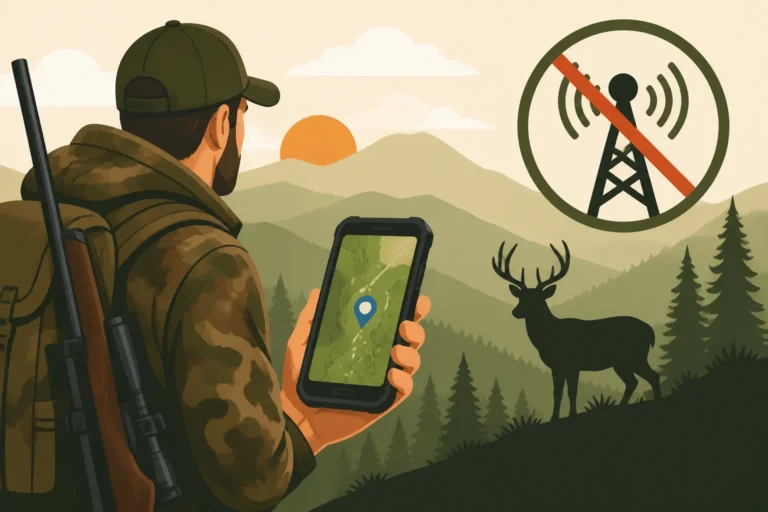
Before you even step foot in the woods, the best scouting happens from your couch. Digital mapping applications are absolute game-changers for public land bear hunters. Programs like onX Hunt and GoHunt allow you to overlay public and private land boundaries, topo maps, satellite imagery, and even timber cut data. You can identify potential access points, remote hollows, dense thickets, and steep drainages that might hold bears.
I've spent countless hours scrolling through onX Hunt, looking for those dark green spots on the topo map that indicate dense cover, or identifying logging roads that might provide access deep into the Cherokee National Forest. You can mark potential bedding areas, feeding zones, and travel corridors, and then create a detailed plan for a boots-on-the-ground scouting trip. This saves an incredible amount of time and effort, letting you focus your physical energy on the most promising areas rather than blindly wandering. For broader regional analysis, tools like GoHunt offer insights that can sometimes highlight larger-scale habitat features important for bear movement.
Boots-on-the-Ground Reconnaissance
Digital scouting is a powerful starting point, but there's no substitute for getting your boots dirty. Actual reconnaissance in the field allows you to confirm what your maps show and find the fresh, nuanced sign that digital tools can't detect. Look for fresh tracks in soft soil around springs or creek bottoms, claw marks on trees (especially softer bark species like beech or pine), overturned rocks and logs from bears foraging for grubs, and, of course, droppings. The freshness of droppings can tell you how recently a bear was in the area.
Pay close attention to topography and vegetation changes. How steep is that ridge really? How thick is that laurel patch? Where are the natural funnels created by saddles or benches? This is also the time to identify good stand sites if you plan to hunt from a stationary position, or to understand the best routes for still-hunting. Take your time, move slowly, and observe everything. Scouting Tennessee Public Land Before Season is not just for deer; it's absolutely vital for bear.
Access and Hiking Considerations
Public land bear hunting, particularly in zones like the Cherokee National Forest, demands physical fitness and a robust plan for access. Many of the best bear areas are miles from the nearest paved road, requiring long hikes, often over steep, uneven terrain. You need to be prepared for this physical challenge and carry appropriate gear, including a good pack, plenty of water, and navigation tools. Think about Packs for a Cherokee Forest Day Hunt to ensure you have what you need.
Consider your entry and exit routes carefully. Bears have incredible senses, and disturbing an area with a noisy approach can ruin a hunt before it starts. Use natural cover to conceal your movements, and try to hunt into the wind. If you're going deep, think about how you'll get a bear out. Dragging a bear out of a steep hollow is no small feat, so having a plan or equipment like a game cart for more accessible areas can make a huge difference. Sometimes, the most frustrating part isn't finding the bear, but getting it back to the truck.
Tactical Approaches for Public Land Bear
Once you've done your scouting and understand the terrain, it's time to think about how you'll actually hunt. Public land bears are often highly educated and wary, especially in areas with moderate to heavy pressure. Your tactics need to be adaptable, patient, and tailored to the specific environment you're in. This isn't usually a game of calling them in from a field edge; it requires a more intimate knowledge of their habits and movements.
Many hunters get frustrated trying the same tactics they use for deer, only to come up empty. Bear hunting is different. It often means slowing down, observing more, and sometimes, pushing harder into places other hunters avoid.
Still-Hunting and Spot-and-Stalk
In the rugged, timbered terrain of Tennessee's public lands, still-hunting is often one of the most effective strategies for black bears. This involves moving incredibly slowly through promising areas, taking a few steps, and then pausing for several minutes to scan the woods. You're looking for any movement, any unusual color, or any slight sound that indicates a bear. Focus on areas with good mast production, dense cover, and near water sources.
Spot-and-stalk tactics can also be effective, particularly in areas with more open timber or powerline cuts, or if you can gain an elevated vantage point to glass. Getting above an area at first light or last light and carefully scanning for bears moving between feeding and bedding areas can pay off. Once a bear is spotted, a careful, deliberate stalk is required, utilizing terrain and cover to close the distance undetected. This requires patience, stealth, and a keen eye for details, much like Spot-and-Stalk Tactics for Cherokee Forest Bears.
Utilizing Bear Dogs Where Permitted
For many, bear hunting in Tennessee is synonymous with running hounds. Where permitted, using well-trained bear dogs can be an incredibly effective and exciting way to pursue bears on public land. The dogs are released on a fresh track, or in an area known to hold bears, and they track the bear until it either bays on the ground or, more commonly, trees. The hunters then follow the dogs, often on a grueling chase through some of the toughest terrain imaginable, until they can get to the treed bear.
It's important to remember that not all public lands allow hound hunting for bear, and the rules can vary by zone and WMA. Always check the current regulations for the specific area you plan to hunt. Running hounds requires a special kind of dedication, not just to the hunt itself, but to the care and training of the dogs. It's a deeply rooted tradition in many parts of Tennessee, and a very social form of hunting. If you're considering this method, make sure you understand the nuances and commitment involved, which you can learn more about by reading Running Hounds for Cherokee Forest Bears.
| Feature | Bear Zone One (Northeast Mountains) | Bear Zone Two (Smoky Mtn. Foothills) | Bear Zone Three (South Cherokee) |
|---|---|---|---|
| Primary Habitat | Vast, rugged, steep Appalachian ridges & hollows, dense hardwoods | Mix of mountainous terrain, foothills, proximity to private/ag land | Steep, heavily timbered slopes, river drainages, dense laurel |
| Typical Pressure | Generally lower in remote interior, higher near access | Variable, can be higher due to proximity to towns | Moderate, potentially less recognized than Zone One |
| Access | Often requires long, arduous hikes, primitive roads | Easier road access in some areas, challenging backcountry in others | Challenging, similar to Zone One in remoteness |
| Key Food Sources | Abundant hard mast (acorns), various soft mast | Hard and soft mast, potential for agricultural influence | Abundant hard mast, varied soft mast |
| Hunting Methods | Still-hunting, spot-and-stalk, hound hunting | Still-hunting, spot-and-stalk, hound hunting (check local rules) | Still-hunting, spot-and-stalk, hound hunting |
| Overall Character | True wilderness experience, high physical demands | Diverse, requires navigating human/wildlife interfaces | Rugged backcountry, good potential for solitude |
Disclaimer
This article is for general informational purposes only and does not constitute professional advice. Laws, prices and regulations vary by location and change over time. Consult a qualified professional for guidance on your specific situation.