Tennessee Firearms Discharge Setback Rules
Navigating the complex landscape of hunting regulations can be a real headache, and one area that often trips up even seasoned hunters is understanding the specific rules surrounding firearms discharge setbacks. It’s not just about knowing when and where you can hunt, but how you can safely and legally discharge your firearm without infringing on others' safety or property rights. This comprehensive guide will meticulously break down Tennessee's firearms discharge setback rules, offering clarity and practical advice to keep you on the right side of the law and ensure everyone's safety in the field.
Understanding the Fundamentals of Firearms Discharge Rules
The rules governing where you can and cannot discharge a firearm in Tennessee are rooted deeply in public safety and the protection of private property. These aren't just arbitrary lines on a map; they're in place to prevent accidents, minimize disturbances, and maintain a respectful coexistence between hunters, landowners, and the general public. Ignoring these rules, whether intentionally or not, can lead to serious legal consequences, including fines, loss of hunting privileges, and even criminal charges. It's an essential part of responsible hunting to know these boundaries.
The Core Principle: Safety First
At its heart, every setback rule boils down to safety. When you discharge a firearm, especially a high-powered rifle, the projectile travels a significant distance and can pose a severe risk to anything in its path, far beyond your immediate target. Think about a rifle round; it can travel for miles, often unseen and unheard, well past where you'd ever imagine it could go. This ballistic reality is why setbacks from houses, roads, and other occupied structures are so critical. It’s not just about your safety or the deer's, but the safety of innocent bystanders, pets, and property that might be out of your line of sight or even over the next ridge. Ensuring you have a clear, safe backdrop for every shot is paramount, even if it means letting an animal walk.
Distinguishing Between Public and Private Land
While the general principles of firearms discharge apply across the board, the specific enforcement and interpretation of setback rules can feel a little different depending on whether you're hunting on private land or one of Tennessee's many public hunting areas, like a Wildlife Management Area (WMA) or sections of the Cherokee National Forest. On private land, landowners often have additional rules or preferences beyond state law, and permission is key. You might have permission to hunt a parcel, but that doesn't automatically give you carte blanche to shoot in any direction. Always discuss these nuances with the landowner. On public lands, the state rules are king, and ignorance is no excuse. It's your responsibility to know the boundaries of the WMA you're hunting and any special regulations that might apply there, which you can often find detailed using mapping tools like GoHunt that layer public land boundaries.
Specific Setback Distances and Legal Provisions
Tennessee law, like many states, defines specific distances that must be observed when discharging a firearm. These distances are not merely suggestions; they are legal requirements designed to create buffers around areas where people live, work, or gather. Understanding these exact measurements is crucial for any hunter.
Occupied Dwellings and Buildings
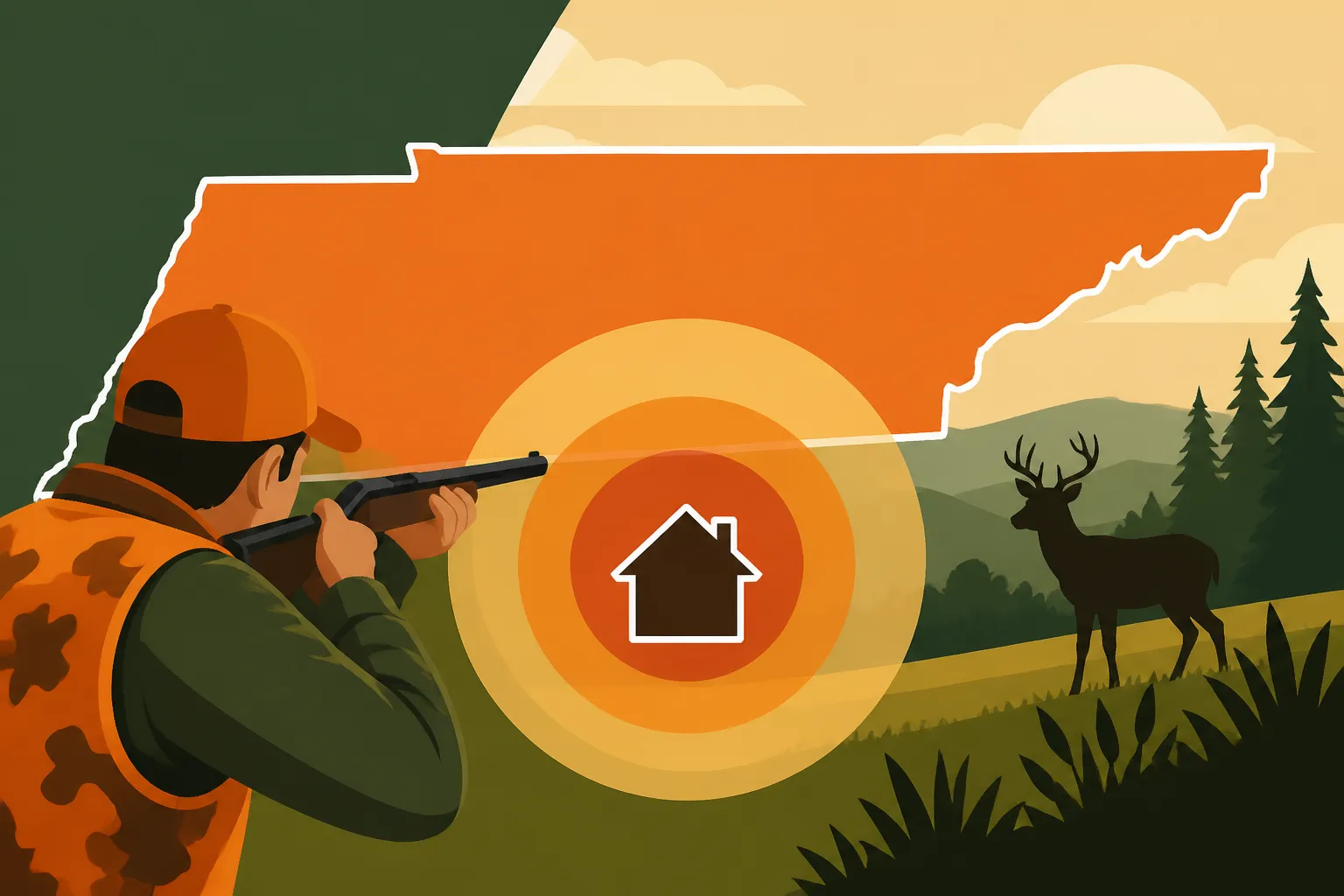
Perhaps the most critical setback rule involves occupied dwellings. In Tennessee, it is generally unlawful to discharge a firearm within 100 yards (300 feet) of an occupied dwelling, house, or other building used for human habitation without the owner's permission. This is a fundamental rule that every hunter must engrain in their mind. This isn't just about avoiding shooting into a house; it's about the potential for stray bullets, ricochets, or even just the intimidation and noise impacting residents.
Consider a scenario: you're hunting a woodlot that borders a subdivision. You might see a deer at 80 yards, but if that shot is pointed towards a house even 200 yards away, you're potentially violating the law and creating a dangerous situation. Even if you're on private property with permission, if that property borders another private property with an occupied dwelling within that 100-yard buffer, you still need permission from that dwelling's owner to discharge a firearm in that direction. This often leads to difficult situations where hunters have to pass on shots, even on property where they have permission, simply because of proximity to others. Always keep in mind the potential trajectory of your bullet and err on the side of caution.
Roads, Highways, and Public Areas
Another significant area of concern for firearms discharge is proximity to roads, highways, and other public rights-of-way. While Tennessee law prohibits shooting from or across a public road, street, or highway, it also addresses shooting near them. You cannot discharge a firearm into or on any public road or highway. Additionally, many local ordinances often have stricter rules about discharging firearms near public spaces, including playgrounds, schools, and parks. Always check county and municipal ordinances in addition to state law, especially if you're hunting closer to developed areas.
For hunters using vehicles, remember that Tennessee Legal Firearms for Deer Hunting specifies rules around carrying loaded firearms. It's generally illegal to have a loaded firearm in or on any motorized vehicle on public roads or rights-of-way, except when retrieving game. This means your gun should be unloaded when you're driving to your hunting spot, even on dirt roads that cut through public land. Understanding these distinctions is vital, especially when scouting for deer or hunting small game like rabbits along fencerows adjacent to rural roads.
Specific Setback Distances Summary
To help clarify these critical distances, here’s a quick overview of the most common setback rules for discharging firearms in Tennessee. Remember, these are general guidelines, and local ordinances or specific WMA rules might impose stricter limits.
| Location Type | Minimum Setback Distance (Approximate) | Key Regulation Detail |
|---|---|---|
| Occupied Dwelling/Building | 100 yards (300 feet) | Requires owner's permission if shooting towards within this range. |
| Public Road/Highway | N/A (Cannot shoot from or across) | Cannot discharge into or on a public road. Often implies a safety buffer. |
| State/Federal Property | Varies by specific regulation | Check WMA rules, National Forest rules, and local ordinances. |
| School Grounds/Playgrounds | Varies (Often 1000 feet or more) | Local ordinances frequently prohibit discharge within significant distances of schools. |
It's a good practice to always maintain a substantial buffer, even beyond the legal minimums, to ensure maximum safety. For instance, if you're hunting a field edge and there's a road 150 yards away, choosing a shot that directs your projectile away from the road is always the safest and most responsible option.
Common Scenarios and Legal Nuances for Hunters
The written law often feels straightforward, but applying it to real-world hunting situations can be tricky. What about dense woods? What if you can't see the dwelling? What are the implications if you're an apprentice hunter? These are the kinds of questions that require a deeper look into the practical side of Tennessee's firearms discharge rules.
Navigating Dense Cover and Unseen Structures
One of the biggest challenges in a state like Tennessee, with its rolling hills and thick timber, is that you might not always see what's beyond your immediate target. A deer could be standing in a thicket, and while you have a clear shot at it, you might not realize there's a cabin or a road just over the rise, hidden by topography or vegetation. This is where pre-season Scouting Tennessee Public Land Before Season becomes invaluable. Using mapping applications, even offline with tools like GoHunt, to identify potential structures or property lines near your hunting spot can prevent a dangerous and illegal shot.
It's not enough to say, "I didn't see it." The responsibility is on the hunter to ensure a safe shot. If you're in doubt about what lies beyond, or if you can't guarantee a clear, safe trajectory for your bullet for its entire potential travel distance, the safest bet is to hold your shot. This is especially true for long-range calibers, where a bullet can maintain lethal energy for much farther than you might imagine. When hunting areas with high populations or adjacent properties, always consider how Hunting Pressure on Tennessee Public Land might push deer into closer proximity to dwellings or roads, increasing the risk of an unsafe shot.
Youth Hunters and Apprentice Licenses
Special considerations apply when it comes to youth hunters and those hunting under an Tennessee Apprentice Hunter License Rules. While the setback rules themselves don't change based on the hunter's age or license type, the requirement for direct supervision adds another layer of responsibility for the mentor. The mentor, who must be properly licensed and of age, is ultimately responsible for ensuring the apprentice adheres to all hunting laws, including firearms discharge setbacks.
If you're mentoring a young hunter during the Tennessee Youth Deer Hunt Rules, for example, you must be in a position to constantly assess the surroundings, the shot angle, and the backdrop to ensure every shot taken is safe and legal. This means actively scanning for dwellings, roads, and property lines, and being prepared to instruct the youth to pass on a shot if any safety concerns arise. It's a critical teaching moment that reinforces responsible hunting ethics from a young age.
Consequences of Non-Compliance
The penalties for violating firearms discharge setback rules can be severe and vary depending on the specific circumstances and the outcome of the violation. At minimum, you could face fines and revocation of your hunting license. If property damage occurs, you could be liable for civil damages. In cases where a person is injured or killed, the legal ramifications escalate dramatically to criminal charges, including reckless endangerment, assault, or even homicide, regardless of intent.
It's not just about the legal consequences, though those are serious enough. There's also the profound ethical and reputational damage. An incident involving an unsafe discharge reflects poorly on all hunters and can fuel anti-hunting sentiment, potentially leading to even stricter regulations for everyone. That's why reporting any observed violations to the TWRA, such as when you need to Reporting a Poacher in Tennessee, is not just about enforcing the law, but also about protecting the integrity of the hunting community.
Ensuring Safety and Compliance While Hunting
Proactive measures are key to staying safe and compliant with Tennessee's firearms discharge setback rules. It's about more than just reading the regulations once; it's about making them a fundamental part of your hunting preparation and execution.
Pre-Season Planning and Mapping Tools
Before you ever step foot in the woods, thorough pre-season planning is your first line of defense against accidental violations. This involves studying maps, both topographical and aerial, to understand the lay of the land, identifying potential structures, and marking property lines. Modern hunting apps and tools like GoHunt have revolutionized this process, allowing you to overlay property boundaries, public land designations, and even identify specific points of interest. You can download maps for offline use, which is critical for areas with spotty cell service in places like the Cumberland Plateau.
During your scouting trips, physically walk the boundaries of your hunting area, paying close attention to neighboring properties, roads, and any structures. Visualize potential shot opportunities and mentally note safe and unsafe shooting lanes. This is also a good time to consider your stand placement. For instance, when thinking about Treestand Setups in Cherokee National Forest, you're often in vast public land, but even there, roads and trails exist, and knowing your surroundings is key. Ensure your stand offers safe shooting lanes away from any potential hazards, and always consider your entry and exit routes to avoid disturbing nearby residences.
Communication and Respect for Landowners
When hunting private land, open and honest communication with the landowner is paramount. Don't just assume they know what you're doing. Discuss your planned stand locations, potential shot directions, and any concerns about nearby structures or roads. This not only shows respect but also builds trust. The landowner might even offer valuable insights into safe shooting directions or areas to avoid that aren't obvious from a map.
If you are hunting near a property line, consider asking the neighboring landowner for permission if any part of your intended shooting zone falls within the setback of their dwelling. This extra step, while sometimes uncomfortable, can prevent potential conflicts and legal issues down the line. Remember, Tennessee Posted Land Rules makes it clear that written permission is often preferred, but even with verbal permission, clear communication about discharge zones can prevent misunderstandings.
Maintaining Situational Awareness
Finally, while you're in the field, constant situational awareness is crucial. This means not just focusing on finding game, but always being aware of your surroundings: where you are, where your bullet could go, and what might be in the path beyond your target. Before you even shoulder your firearm, take a moment to confirm your target, identify your backstop, and assess the broader area for any potential hazards. This is an ongoing process throughout your hunt, from the first light of morning to the final moments of legal shooting light.
Always consider variables like bullet trajectory, especially when shooting from elevated positions like a treestand. A downward shot can impact the ground much closer, reducing the risk of a faraway stray, but also consider ricochets. Conversely, an uphill shot can send a bullet traveling much farther with a flatter trajectory. Even when Hunting the Rut in Early November when adrenaline is high, a disciplined approach to shot selection and safety must always prevail.
Ultimately, adhering to Tennessee's firearms discharge setback rules is a fundamental aspect of ethical and legal hunting. By understanding these regulations, preparing diligently, and maintaining constant awareness in the field, you contribute to a safer environment for everyone and help preserve the cherished tradition of hunting in our beautiful state.
Disclaimer
The information provided in this guide is for informational purposes only and does not constitute legal advice. Hunters are responsible for knowing and abiding by all current Tennessee hunting laws and regulations, as well as any applicable local ordinances. Always consult the latest Tennessee Wildlife Resources Agency (TWRA) regulations and local authorities for precise legal requirements.