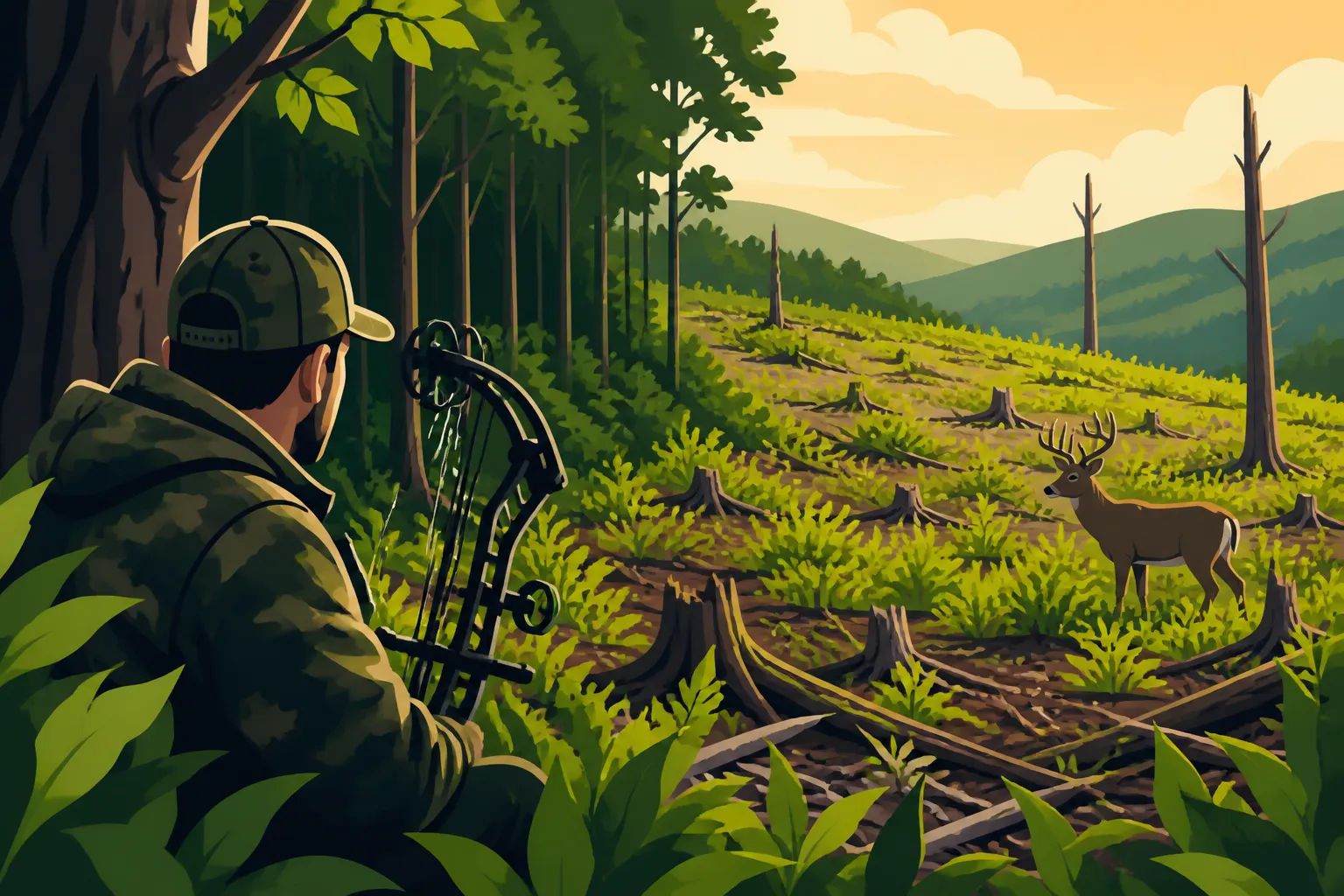
Hunting a Clear-Cut Regrowth Edge
Clear-cuts can look like a disaster zone, right? You see all that timber gone, and it’s easy to think there’s nothing left for deer. But I'm here to tell you, as a veteran hunter in Tennessee, those regenerating clear-cuts are actually secret goldmines for whitetails, offering unparalleled food and cover. This guide will walk you through exactly how to identify, scout, and effectively hunt these challenging yet incredibly rewarding areas.
Why Clear-Cuts are Irresistible to Tennessee Whitetails
Hunters often eye a fresh clear-cut with skepticism, sometimes even dread. The thought of all that mature timber gone can be disheartening. But what looks like a barren wasteland to us is, in fact, a thriving nursery for wildlife, especially white-tailed deer. These areas aren't just good for deer; they're absolutely vital, especially in a state like Tennessee where diverse habitats lead to diverse hunting opportunities across the landscape.
Habitat Transformation and Benefits
When a logging operation clears a section of timber, it dramatically changes the landscape, and not always for the worse from a deer's perspective. Think of it as nature's reset button. Sunlight, which was once blocked by a dense canopy, now floods the forest floor. This sudden influx of light sparks an explosion of new plant growth, creating a dense, tangled buffet line that deer simply can't resist. This rapid regrowth, often consisting of briars, young saplings, and various herbaceous plants, offers both abundant food and incredible security. In areas like the Cumberland Plateau or sections of the Cherokee National Forest, these habitat changes are key drivers for deer movement and population health, impacting everything from bedding locations to rutting activity.
The benefits extend beyond just deer. Many small game species, like rabbits and grouse, also thrive in these regenerating areas. For deer, the transition from mature, open woods to a thick, young forest provides a stark contrast in cover, forcing them to adapt their movement patterns, which savvy hunters can learn to predict.
Food Sources and Browse Production
The sheer volume and variety of food that sprouts up in a clear-cut is astonishing. Within a year or two, you'll see a dense thicket of blackberry, greenbrier, honeysuckle, young oaks, maples, and countless other species. These aren't just filler; they are high-quality browse, packed with the nutrients deer need for antler growth and fawn development. During different times of the year, different plants become prime forage. In the spring and summer, succulent new shoots are abundant. As fall approaches, berries, acorns from regenerating saplings, and the leaves of specific plants like sumac become crucial late-season food sources for Tennessee whitetails. This constant availability of diverse forage means deer spend a significant amount of time in and around these edges, making them prime hunting locations. It's a stark contrast to older, mature timber where the forest floor is often sparse and less appealing to deer.
Many hunters overlook the ground-level browse potential, focusing instead on acorn crops in mature timber. While acorns are undoubtedly important, the year-round buffet offered by a clear-cut edge keeps deer coming back, even in years with poor mast crops. This consistent food source makes clear-cuts especially valuable during the lean times of late winter.
Security Cover and Bedding Areas
Beyond the food, clear-cuts provide unparalleled security. The dense, interwoven regrowth creates an almost impenetrable fortress. A deer can disappear into a clear-cut and be virtually invisible just a few yards in. This thick cover offers protection from predators, harsh weather, and, crucially, from hunters. Mature bucks, in particular, will seek out the densest parts of these clear-cut edges for bedding, knowing they can hear or smell danger long before it reaches them. They often bed just inside the edge, allowing them to survey the surrounding mature timber or open areas before committing to a move. This combination of abundant food and impenetrable cover is what truly makes a clear-cut edge a whitetail haven, attracting deer from surrounding areas, especially when hunting pressure on Tennessee public land increases.
Consider the thermal advantages as well. In winter, the dense growth can help block harsh winds, while in summer, the shade provided by the thick canopy offers respite from the sun. This multi-faceted security is why deer, especially older, wiser bucks, gravitate towards these areas when they feel pressured or when seeking a safe place to rest and digest.
Decoding Deer Movement on a Regrowth Edge
Understanding why deer use clear-cuts is one thing, but figuring out how they use them is the key to successful hunting. Deer aren't just aimlessly wandering through these thickets; their movements are deliberate, driven by their needs for food, cover, and safety. Each clear-cut is unique, but general patterns emerge that can guide your scouting and strategy, helping you interpret the often subtle signs of activity.
Entry and Exit Points
Deer are creatures of habit, and even in chaotic-looking clear-cuts, they'll often use the path of least resistance. Look for well-worn trails, sometimes barely visible, that serve as their highways into and out of the dense regrowth. These entry and exit points are usually dictated by terrain, existing logging roads, old logging skidder trails, or even subtle changes in vegetation density. Deer will typically enter a clear-cut from a mature timber block, often following a ridge line or creek bottom, seeking the quickest way to cover and food. Identifying these main arteries is paramount. Sometimes, the most obvious entry points are along the transition where the young growth meets the older, taller trees. You might find several trails funneling down into one main corridor as they hit the edge of the thick stuff. Keep an eye out for fresh tracks, droppings, and rubbed saplings that signal active use. You can almost feel the deer activity radiating from these key spots when you're scouting.
These entry/exit points are often subtle, not always obvious highways. A barely perceptible worn path beneath the briars, or a series of broken branches at deer height, might be the only clues. Don't be afraid to get on your hands and knees to find these hidden passageways.
Bedding Habits Within the Regrowth
As mentioned, clear-cuts offer incredible bedding cover. Bucks, especially, will often bed just inside the densest parts of the regrowth, typically on a slight rise or knoll if available, allowing them to smell downwind and visually scan areas where danger might approach. They want maximum concealment with an escape route. Doe families might bed deeper within the cut, forming small groups. Their bedding locations are rarely random; they're strategic. Pay attention to how the wind blows through the clear-cut and where the densest cover lies. A mature buck might bed 20-50 yards into the thick stuff from a prevailing wind, allowing the wind to bring him scent from behind, while he watches his downwind approach. This is where tools like GoHunt's mapping layers can really shine, helping you analyze terrain features and wind direction to predict bedding. Don't forget to look for "islands" of mature trees left within the clear-cut; these often become prime bedding or staging areas for deer reluctant to enter the thickest stuff during daylight.
Understanding the specific topography within the clear-cut is key. Small depressions, rock outcroppings, or even a subtle bench can offer a deer a commanding view and a secure hideaway. Learning where Cumberland Plateau bucks bed often involves recognizing these micro-features within large clear-cut areas.
Transition Zones to Mature Timber
The "edge" itself is a crucial transition zone. Deer rarely stay deep in the clear-cut all day. They'll move between the security of the regrowth and the food sources or travel corridors in the adjacent mature timber. These transition zones are where you'll find scrape lines, rub lines, and heavy trails as deer stage before entering open areas or move between bedding and feeding. A funnel, perhaps a narrow strip of mature timber between two clear-cut sections, or a saddle on a ridge connecting the clear-cut to another part of the forest, can be absolute hotspots. These are natural pinch points where deer movements become concentrated. It's also where you'll see the overlap of food and cover preferences – deer feeding on the edges, then dipping back into the thicket to bed down. Understanding how Tennessee's deer season runs archery to January, these transition zones become even more important as deer shift their patterns with increasing pressure and changing food availability.
For example, a clear-cut might be bordered by a steep hollow on one side and a mature oak ridge on the other. Deer might bed in the clear-cut, then use the hollow as a travel corridor to reach the oaks, or vice-versa. The point where the clear-cut meets the top of the ridge, or the mouth of the hollow, will be a high-traffic area.
Strategic Hunting Tactics for Clear-Cut Edges
Hunting clear-cut regrowth edges isn't like sitting over a food plot or cruising timber. It requires specific strategies, patience, and a willingness to adapt. The rewards, however, can be substantial, as these areas often hold some of the biggest and most pressured deer, offering a unique challenge to the Tennessee hunter.
Pre-Season Scouting with Tools like GoHunt
Before you ever step foot into a clear-cut with your weapon, a comprehensive scouting mission is essential. This isn't just a casual walk-through; it's a detective mission. Start by using aerial imagery tools like GoHunt or the TWRA's public land maps to identify potential clear-cuts and analyze their age, size, and surrounding habitat. Look for fingers of timber, saddles, creek beds, or old logging roads that might act as funnels into the regrowth. This digital scouting can save you countless hours of tromping through briars, giving you a better understanding of the terrain before you even hit the dirt.
Once on the ground, focus on the edges. Resist the urge to dive headfirst into the impenetrable thicket. Instead, skirt the perimeter, looking for those key entry and exit trails. Pay close attention to fresh sign: tracks, droppings, rubs, and scrapes. If the clear-cut is a few years old, you might even find old rubs on saplings deep inside that indicate mature buck use in previous seasons. Note prevailing wind directions and how they interact with the terrain around the clear-cut. For deeper insights, learn how to Scout Tennessee Public Land Before Season. Don't forget to check the age of the clear-cut; very recent cuts (1-2 years) might be too sparse for bedding, while older ones (5-10+ years) can be so dense they're almost impossible to navigate quietly. You want that sweet spot of 3-7 years regrowth for optimal hunting – old enough to provide ample cover and browse, but young enough to still allow some limited visibility. Reading aerial photos for Cumberland Plateau deer can reveal subtle clear-cut patterns.
Strategic Stand and Blind Placement
Choosing where to set up your stand or ground blind is critical. Given the density of clear-cuts, visibility is often limited, so you need to capitalize on those narrow shooting lanes.
Table: Stand Type Suitability for Clear-Cut Edge Hunting
| Stand Type | Pros | Cons | Best Use Scenario |
|---|---|---|---|
| Hang-On Stand | Versatile, can go high, quiet to set up. | Requires climbing sticks, limited mobility. | Overlooking distinct deer trails or funnels where mature timber meets the regrowth. |
| Climber Stand | Mobile, can get high quickly. | Requires straight, limbless trees, noisy. | Along the mature timber edge, targeting deer moving into the clear-cut from an open area. |
| Ground Blind | Excellent concealment, comfortable, can hunt in any weather. | Limited visibility, scent control challenging, less mobile. | Brushed-in at a key entry point or a subtle opening along the edge, especially for Bowhunting Tennessee's Long Archery Season. |
| Saddle Hunting | Ultimate mobility, stealthy, comfortable for long sits. | Learning curve, requires practice, less visual obstruction. | Aggressively hunting specific funnels or pinch points on ridges leading to the clear-cut. |
For a treestand, aim for a position that overlooks a primary travel corridor or a funnel, ideally with clear shooting lanes into the edge. Consider a stand placed 20-30 yards into the mature timber, looking into the clear-cut. This gives you a broader view of deer approaching the edge without being silhouetted against the open sky. Think about a saddle on a ridge system that leads directly to the clear-cut, as deer will often utilize these natural crossings. If you're considering a ground blind, ensure it's well-brushed in and allows you to watch a specific entry point or an opening within the clear-cut where deer might pause. You can also strategically place a ground blind for still-hunting Cumberland Plateau ridges. Remember, the goal is to be in a position where deer are comfortable exposing themselves, even briefly. Treestand setups in Cherokee National Forest often rely on these subtle edges.
Playing the Wind and Thermals
Nowhere is wind more critical than when hunting clear-cut edges. The dense cover often creates swirling thermals and unpredictable wind currents, making scent control an absolute must. Deer will always try to use the wind to their advantage, circling downwind of perceived danger. Your setup must account for this, as a deer's nose is its primary defense mechanism.
On clear-cut edges, especially in hilly or mountainous terrain like the Eastern Cumberland Plateau, thermals are a major factor. In the morning, cool air drains downhill, carrying your scent with it. In the afternoon, as the sun warms the slopes, air rises, taking your scent uphill. This phenomenon of Wind and Thermals on a Ridge System is something you absolutely need to factor in. Ideally, you want to set up so your scent is blowing away from where you expect deer to approach or bed. This might mean setting up on the downwind side of a clear-cut, or a spot where the prevailing wind carries your scent out over an open field or into a non-deer holding area. When conditions are tricky, consider using a scent elimination spray or an ozone generator to minimize your scent footprint. Always have an escape route planned that won't blow your scent into the clear-cut if deer are already there. Pay attention to how the clear-cut itself might funnel or block wind, creating unpredictable eddies.
Navigating Challenges and Maximizing Success
Hunting clear-cut regrowth edges isn't always easy. It presents unique challenges that can frustrate even seasoned hunters. However, by understanding these hurdles and implementing smart strategies, you can turn potential frustrations into incredible success stories, proving that persistence pays off in the Tennessee woods.
Navigating Thick Cover and Limited Visibility
The very thing that makes clear-cuts attractive to deer – their dense, tangled nature – makes them incredibly difficult for hunters to navigate. Moving quietly through thick briars, downed timber, and young saplings is a monumental task. The noise alone can alert deer long before you get within range. Furthermore, your visibility is severely restricted, often to only a few yards, making shot placement difficult and tracking a challenge once a shot is taken. This is a common frustration, especially when that monster buck finally steps out, but you only have a split second to react in a tiny shooting window.
To mitigate this, prioritize stealth. Move slowly, deliberately, and wear durable, quiet clothing that won't snag or make noise. Many hunters find that still-hunting or using a ground blind on Tennessee public land from a strategic vantage point on the edge is more effective than trying to penetrate deep into the cut. If you must enter, identify existing deer trails or old logging roads and stick to them as much as possible. These paths, though sometimes overgrown, offer the easiest and quietest routes. When choosing a stand location, prioritize clear shooting lanes, even if they're narrow. A 20-yard lane is better than no lane at all. For tracking, know your shot placement meticulously, and consider waiting longer than usual before tracking, especially if you suspect a marginal hit, to give the deer time to bed down. Blood trailing after dark in Tennessee can be extra challenging in this kind of terrain, so be prepared with a good light and a tracking partner.
Dealing with Hunting Pressure
Clear-cuts, particularly those on public lands like sections of the North Cumberland Wildlife Management Area or Cherokee National Forest, can attract significant hunting pressure. When a promising clear-cut is discovered, it can quickly become crowded, making deer even warier and pushing them deeper into the thickest cover or forcing them to go nocturnal. This pressure can be a real frustration, especially during peak times like Tennessee's gun season opening day, when every hunter seems to have the same idea.
To counter this, consider hunting during the week when pressure is lower, or target less accessible clear-cuts that other hunters might overlook. The more remote and difficult a clear-cut is to reach, the less pressure it generally receives. You might have to walk an extra mile or cross a creek, but the payoff can be substantial. Another tactic is to scout for clear-cuts on the fringes of public land, bordering private properties, as deer often use these areas as sanctuaries when pressured. Learning how to find ground others walk past is a game-changer here. Also, think about hunting the edges of large clear-cuts that abut major bedding areas; deer might not travel far, offering a shorter window of opportunity but one that is often less pressured. The deer population and harvest trends for White-Tailed Deer Across Tennessee are definitely affected by hunting pressure on public lands.
Legal and Access Concerns on Public Land
Hunting on public land clear-cuts in Tennessee also comes with specific regulations and access considerations. While clear-cuts are common on managed timberlands, knowing the specific rules for each Wildlife Management Area (WMA) or National Forest is paramount. Some WMAs might have specific permit requirements, restricted access roads, or unique regulations regarding stand placement and vehicle use. For instance, knowing which counties sit inside Tennessee's CWD zone can affect carcass transport rules if you harvest a deer from a clear-cut in those areas.
Always consult the latest TWRA hunting guide and WMA-specific regulations before planning your hunt. Use mapping tools like GoHunt to ensure you are on public land and understand property boundaries. Pay attention to signage, especially if the clear-cut borders private property, to avoid unintentional trespassing. You can't just assume a clear-cut is fair game. Access to these areas can be tricky, often requiring long walks or navigating rough terrain. Make sure your vehicle is capable of handling the access roads, and always park in designated areas. Understanding Tennessee hunting licenses and what they cost, along with any specific WMA permits, is your first step to a legal hunt. Even a simple detail like Tennessee's blaze orange requirements needs to be followed strictly, especially in thick cover where visibility is limited to protect yourself and others.
Disclaimer
Hunting is an inherently dangerous activity. Always prioritize safety, adhere to all local, state, and federal regulations, and obtain proper licenses and permits before engaging in any hunting activity. This guide provides general information and recommendations; individual results may vary. Always verify current regulations with the Tennessee Wildlife Resources Agency (TWRA).