Treestand Safety Gear for Steep Ground
Hunting steep ground in Tennessee offers incredible opportunities for solitude and mature bucks, but it also comes with a unique set of challenges, especially when it comes to treestand safety. The unforgiving terrain, uneven footing, and increased risks associated with elevated stands on a slope mean that hunters absolutely cannot afford to cut corners on their safety gear or practices. This guide is dedicated to helping you understand the essential treestand safety gear you need for hunting steep ground and how to use it effectively to stay safe while pursuing your passion in the Tennessee hills.
The Unique Dangers of Steep Terrain Hunting in Tennessee
Let's be real, chasing deer in the mountains and across the rugged Cumberland Plateau isn't like hunting flat farm fields in West Tennessee. The ground can drop out from under you in an instant, trees often lean, and even a minor slip can turn into a serious tumble down a rocky incline. When you combine these natural hazards with the inherent risks of climbing into a treestand, you've got a recipe for potential trouble if you're not prepared.
Uneven and Shifting Footing
One of the biggest differences on steep ground is simply the angle of the earth beneath your feet. Setting a ladder stand can be a nightmare trying to level it, and even hang-on stands require careful tree selection to ensure a stable platform. This unevenness extends to your approach and descent, making every step a potential hazard, especially in low light or wet conditions. Mud, loose rock, and leaf litter on a steep slope can easily cause you to lose your footing, and a fall while carrying gear or trying to climb can be devastating. I've personally had moments where I felt like I was ice skating on wet leaves trying to get to a stand pre-dawn.
Increased Risk of Swing and Impact in a Fall
If you were to fall from a treestand on flat ground, the swing from your safety harness would typically be relatively straight down. On steep ground, however, a fall can be much more complex. Gravity pulls you not just down, but also downhill. This can lead to a longer, more violent swing, potentially causing you to impact the trunk of the tree, other trees, or the uneven ground below with greater force. The sheer kinetic energy involved can increase the severity of injuries even if your harness catches you. This isn't just theory; it's a real and terrifying possibility that demands serious consideration when you're 20 feet up a leaning oak.
Difficult Retrieval and Assistance
Imagine the worst: you've fallen, your harness has saved you, but you're now suspended. On flat land, you might be able to reach the ground, or at least be easily spotted and assisted. On steep ground, you could be suspended far from solid footing, potentially tangled in brush, and in an area that's incredibly difficult for emergency services to access. The time it takes for help to arrive, or even for you to self-rescue, can be significantly longer. If you've ever tried Dragging a Deer Out of a Steep Hollow, you know how challenging navigating that terrain can be when you're uninjured and mobile; picture that difficulty multiplied when someone is hurt and helpless. This is why reliable communication and a solid self-rescue plan are absolutely critical.
Your Non-Negotiable Treestand Safety Gear for Hilly Country
When you're dealing with the added risks of steep terrain, your safety gear isn't just a suggestion; it's an absolute necessity. Don't let anyone tell you otherwise. Every piece serves a vital function, and they all work together to keep you safe.
Full-Body Safety Harness
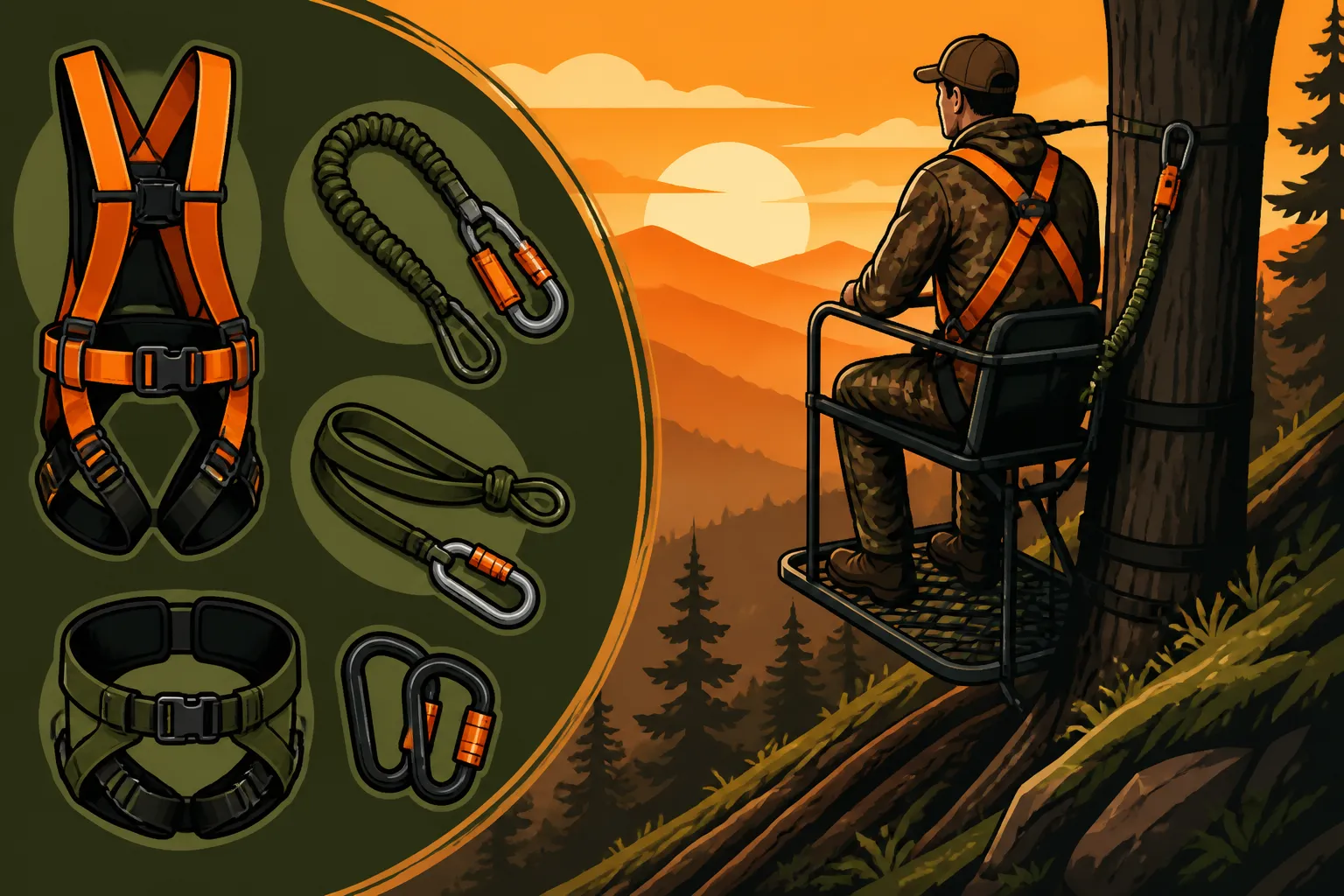
This is your lifeline, your number one piece of safety gear. A good full-body harness distributes the force of a fall across your entire body, preventing single-point impacts that could cause severe injury. For steep ground, pay attention to how adjustable it is, especially for cold-weather layering. You want something that fits snugly but doesn't restrict movement, and crucially, one that is comfortable enough that you will actually wear it from the moment your feet leave the ground until they touch down again. Brands like Hunter Safety System or Muddy are popular choices, offering models designed for comfort and ease of use. Remember, the best harness is useless if it's in your pack.
Lineman's Belt and Tree Strap/Lifeline
These two components are what keep you connected to the tree at all times during the climbing process.
- Lineman's Belt: This adjustable strap wraps around the tree and clips to both sides of your harness, allowing you to use both hands freely while installing climbing sticks or hang-on stands. On steep ground, where balance is even more precarious, having both hands free to grip the tree, adjust your equipment, or clear branches is invaluable.
- Tree Strap/Lifeline: Once you're on the platform, your tree strap or a continuous lifeline is what secures you. A continuous lifeline is often preferred, especially on steep ground, as it allows you to connect to the tree at ground level and stay connected all the way up and down. This eliminates those dangerous moments of being unclipped while transferring from climbing aid to stand or vice-versa. Many hunters overlook the importance of these devices for continuous attachment, but they are absolutely essential for preventing falls from happening in the first place.
Suspension Relief Strap and Knife
Even with a full-body harness, hanging suspended after a fall can quickly lead to suspension trauma, where blood pools in your legs and can cause serious health issues or even death.
- Suspension Relief Strap: This is a small strap that's integrated into or easily deployed from your harness. After a fall, you deploy it, step into it, and use it to stand up, relieving pressure on your femoral arteries. This buys you critical time to self-rescue or wait for help. You should practice deploying and using it before you ever need it in an emergency.
- Knife: A sharp, easily accessible knife is another non-negotiable. It can be used to cut entangled ropes, gear, or clothing if you find yourself in a bind after a fall. Ensure it's fixed-blade and can be operated with one hand in an emergency.
| Safety Gear Component | Primary Function | Steep Ground Benefit |
|---|---|---|
| Full-Body Safety Harness | Distributes fall force, prevents severe injury | Critical for complex falls on slopes, distributes impact |
| Lineman's Belt | Provides hands-free stability during ascent/descent | Ensures balance and control while installing gear on uneven trees |
| Continuous Lifeline/Tree Strap | Keeps you connected from ground to stand and back | Eliminates moments of disconnect, vital for stability on slopes |
| Suspension Relief Strap | Prevents suspension trauma after a fall | Buys critical time for self-rescue or aid on hard-to-access terrain |
| Rescue Descender (optional) | Allows controlled self-descent after a fall | Best solution for getting off the tree safely after a fall on steep ground |
| Safety Knife | Cuts entanglements, assists in self-rescue | Essential for freeing oneself from brush or gear after a fall |
| Communication Device | Calls for help in an emergency | Critical for remote, steep areas where help is far away |
Mastering Your Safety System on Steep Slopes
Having the gear is one thing; knowing how to use it proficiently, especially when the ground isn't playing nice, is another. Practice, foresight, and a disciplined approach are your best allies.
Proper Stand Placement and Leveling
On steep ground, finding the right tree for your stand can be a challenge. Look for a tree that is as straight and vertical as possible, avoiding leaning trees if you can help it. If a slight lean is unavoidable, understand how it affects your stand's angle and adjust accordingly. For hang-on stands, you might need to use wedges or shims to achieve a truly level platform. For ladder stands, you'll almost certainly need to dig out the uphill leg or build up the downhill leg to make the stand safe and stable. Never compromise on a level platform – an uneven stand increases your risk of losing balance and falling. This is where Hanging a Stand on a Cumberland Ridge takes on a whole new level of challenge compared to flat land.
Continuous Connection Protocol
The golden rule of treestand safety, especially on steep ground, is to remain connected to the tree from the moment your feet leave the ground until they return. This means using a lineman's belt while installing climbing sticks and the stand, and then immediately switching to your tree strap or continuous lifeline once you reach your platform. Many falls happen during the transition points. A continuous lifeline is a game-changer for this. It’s a rope with a Prusik knot that allows you to slide it up the tree as you climb, then clip into it at ground level and stay attached the entire climb. It might seem like an extra step, but that consistent connection can prevent a catastrophic fall down a rocky incline.
Practicing Self-Rescue Techniques
Knowing how to use your suspension relief strap isn't enough; you need to practice deploying and standing in it while on the ground. You also need a plan for what to do if you're suspended. Can you reach your climbing sticks to re-establish footing? Do you carry a rescue descender system that allows for a controlled descent? In remote, steep areas, waiting for help might not be an option. Investing in a self-rescue device, like a rope-based descender, could be the smartest money you ever spend. Make sure you've practiced with it multiple times in a safe, controlled environment. Remember, even with a strong cellular signal, emergency responders might struggle to locate and reach you quickly in rough terrain like the Cherokee National Forest Hunting areas. Tools like the mapping features in the GoHunt app can help you pinpoint your exact location for rescuers, but the reality is that steep, dense timber makes any rescue operation difficult.
Pre-Season Checks and In-Season Vigilance for Your Gear
Your safety gear is only as good as its condition. Neglecting inspection and maintenance is a common mistake that can have dire consequences, especially when the stakes are higher on steep ground.
Thorough Pre-Season Inspection
Before the season even begins, give all your treestand safety gear a meticulous inspection.
- Harness: Look for any frayed straps, worn stitching, cracked buckles, or damaged elastic components. Check the manufacture date – many harnesses have a lifespan, typically 3-5 years, after which the materials can degrade.
- Ropes and Straps: Inspect your lineman's belt, tree strap, and any lifelines for cuts, abrasions, excessive wear, or sun damage. Pay close attention to areas where they might rub against the tree or other gear. Synthetic ropes can weaken over time from UV exposure and environmental factors, so don't assume they're still good just because they look okay from a distance.
- Carabiners and Hardware: Ensure all metal components operate smoothly, latch securely, and show no signs of bending, cracks, or corrosion.
If you find any signs of damage or excessive wear, replace the item immediately. Your life is not worth the cost of a new piece of gear.
Regular In-Season Checks
It's not enough to check your gear once a year. Before every hunt, especially if your gear has been stored in a truck or exposed to the elements, give it a quick but thorough once-over. Are all your buckles functioning? Is your lifeline free of tangles? Is your knife sharp and accessible? The constant rubbing against bark, exposure to rain, sweat, and mud, and general wear and tear from climbing can degrade gear surprisingly quickly. If you're constantly setting up and taking down stands, like when Still-Hunting Cumberland Plateau Ridges, this regular inspection becomes even more critical.
Proper Storage and Care
To maximize the lifespan and reliability of your safety gear, store it properly. Keep your harness, ropes, and straps in a dry, cool place away from direct sunlight, chemicals, or rodents. Avoid leaving them exposed to the elements in your truck bed for weeks on end. Clean dirty gear according to the manufacturer's instructions – often just a mild soap and water solution, followed by air drying. Proper care ensures your gear performs as intended when you need it most, giving you peace of mind whether you're Hunting the Rut in Early November or tackling a late-season sit. By taking these steps, you're not just being safe; you're being smart, allowing you to focus on the hunt and make it home safely every time.
Disclaimer
This article is for general informational purposes only and does not constitute professional advice. Laws, prices and regulations vary by location and change over time. Consult a qualified professional for guidance on your specific situation.