Rifle Ranges Realistic in Ridge Country
It's a common dream for many hunters: that perfect, wide-open shot across a vast field or canyon. But if you've spent any time chasing deer, bear, or elk in Tennessee's rugged ridge country, you know that reality often paints a very different picture. The thick timber, steep hollows, and dense undergrowth of places like the Cumberland Plateau or the Cherokee National Forest rarely offer those textbook long-range opportunities, leaving many wondering what "realistic" truly means. This guide will walk you through the practical considerations for rifle ranges when hunting Tennessee's challenging ridges, helping you prepare for the shots you're most likely to encounter.
Understanding Tennessee's Ridge Country Terrain
Hunting the ridges and hollows of Tennessee presents a unique set of challenges that directly impact your effective shooting range. It's not like hunting the wide-open plains out West; here, the landscape dictates a much different approach, often favoring patience and stealth over sheer firepower. Many new hunters, and even some veterans, get caught up in the allure of "long-range" shooting, only to find the terrain makes those shots impossible or highly impractical.
Dense Cover and Visibility Limits
One of the biggest factors is the sheer density of the cover. Even during the late season when deciduous trees have shed their leaves, the understory can be incredibly thick. Rhododendron thickets, mountain laurel, and dense young hardwoods create natural barriers to visibility. You might be able to hear deer moving just fifty yards away, but actually getting a clear shot through the brush is another story entirely. This thick vegetation means that most of your encounters will be at much closer quarters than you might expect, regardless of how powerful your rifle is.
Furthermore, elevation changes play a significant role. When you're sitting on a ridge overlooking a steep hollow, your line of sight often quickly drops into a canopy or dense stand of timber below. That deer you spot might only be 150 yards away horizontally, but the angle of the shot, combined with obstructions, can make it feel like a mile or render it impossible. This is why scouting and understanding the flow of the land is so crucial; you need to know where the natural shooting lanes open up, even if they are few and far between.
Steep Angles and Bullet Trajectory
Tennessee's ridge country is a land of dramatic elevation changes. From the steep slopes of the Unaka Mountains in the Cherokee National Forest Hunting to the rolling hills of the Cumberland Plateau, you're constantly dealing with uphill and downhill shots. These angled shots can play tricks on your bullet's trajectory, causing it to hit higher than where you aim if you don't account for the angle. While modern ballistic calculators can help, in the heat of the moment, most hunters rely on simpler holdover estimations for common ranges.
It's a common misconception that an uphill or downhill shot automatically means you should aim lower. The physics are a bit more nuanced. For practical hunting purposes, on steep angles, gravity has less time to act perpendicular to the bullet's flight path, effectively causing it to shoot "high" relative to your horizontal zero. For typical hunting ranges within Tennessee's timber, this effect is often negligible on deer-sized vital zones for shots under 100 yards, but it becomes more pronounced at longer distances and steeper grades. The key takeaway is to be aware that a 200-yard shot straight down into a hollow will not behave the same as a 200-yard shot across flat ground.
Typical Shot Opportunities in Tennessee Timber
Forget those fancy scope reticles designed for 800-yard shots; most of your opportunities in Tennessee's timber will come at much more intimate distances. It’s a reality that often surprises hunters who are used to hunting agricultural fields or open country. The dense woods, even in relatively open mature hardwoods, simply don’t allow for expansive views.
The 50-150 Yard Sweet Spot
When you're still-hunting a ridge or sitting on a treestand overlooking a bench or a logging road, the vast majority of your shots will fall within the 50 to 150-yard range. This is the sweet spot where you'll typically get a clear enough view of a deer to make an ethical shot. Beyond 150 yards, the chance of a branch deflection, an obscured vital zone, or a quickly disappearing animal increases dramatically.
Think about it: how many times have you had a deer stand perfectly still for more than a few seconds at 200+ yards in thick woods? Usually, they're on the move, picking their way through cover, and only present themselves for a brief window. Being proficient and confident with your rifle at these closer ranges is far more important than dreaming of a half-mile shot. This is where Zeroing a Rifle for Mixed Distances becomes particularly valuable, ensuring your point of aim is solid for the most probable encounters.
Less Common Longer Shots
While less frequent, longer shots – say, 150 to 250 yards – can occasionally present themselves. These usually occur when you're hunting an open powerline cut, a large logging clear-cut, or a wider creek bottom with sparse timber, or perhaps if you get a clear view across a deep, wide hollow. Even then, these are usually across small openings, not vast, unobstructed vistas. Hunters must be incredibly disciplined in these situations, ensuring they have a rock-solid rest, a calm animal, and a completely clear line of sight to the vitals.
It's easy to get excited and rush a shot when a deer steps into a larger opening, but taking the extra seconds to confirm the range, check for obstructions, and steady your aim is paramount. For these specific scenarios, understanding your rifle's ballistic capabilities for a 200-yard shot on a deer is useful, but the frequency of these opportunities means they should not be the primary focus of your practice or gear choices. A good rangefinder, like those from a brand like GoHunt, can be incredibly helpful for quickly verifying those longer distances when they do arise, especially in unfamiliar territory.
| Typical Tennessee Ridge Hunting Shot Distances | Likely Scenarios | Considerations |
|---|---|---|
| Under 50 Yards | Deer busts out of thick cover, close encounter in a dense bedding area, deer passing under your treestand. | Quick, instinctive shots. May require a fast-handling rifle. |
| 50 – 100 Yards | Deer moving through mature timber, crossing a small logging road, feeding on a bench. | Most common range. Practice quick target acquisition. |
| 100 – 150 Yards | Deer pausing in a slightly more open area, crossing a wider trail or small creek. | Requires good shooting fundamentals, stable rest. |
| 150 – 250 Yards | Deer in a powerline cut, clear-cut edge, wide bottomland opening, or across a narrow hollow. | Less common. Demands excellent marksmanship, solid rest, clear line of sight. Confirm range. |
| Over 250 Yards | Extremely rare in typical ridge country. | Often impractical due to terrain, cover, and ethical limits. Focus on closing the distance. |
Ethical Shooting Considerations
When we talk about realistic rifle ranges, we're not just discussing what's physically possible, but also what's ethically responsible. The goal of hunting is to make a quick, clean kill, and pushing the limits of your own skill or your equipment's capability only increases the risk of wounding an animal. This is a topic every hunter should take seriously, especially in challenging environments like Tennessee's rugged mountains.
Knowing Your Personal Limitations
Every hunter has an effective range, and it's almost always shorter in the field than it is on a flat shooting range. Factors like adrenaline, difficult shooting positions (standing, kneeling, steep angles), wind, and quickly moving animals dramatically reduce your practical accuracy. It's crucial to be brutally honest with yourself about what range you can consistently place a shot into a deer's vital zone under hunting conditions. For some, that might be 100 yards, for others, it might be 200. Very few can ethically shoot beyond that in dense, broken country.
Spend time practicing not just from a bench, but from kneeling, standing, and using natural rests like trees or your pack. Simulate those steep uphill and downhill shots. Understand that a 1.5-inch group at 100 yards from a bench doesn't automatically translate to a clean kill at 200 yards from an awkward position in the woods. Your personal ethical limit should be well within what you can do, not what you might do on a perfect day. This self-awareness is a hallmark of a responsible hunter.
The Risk of Obstructions
Unlike a range, the woods are full of obstacles between you and your target. Twigs, small branches, saplings, and even dense leaves can deflect a bullet enough to cause a poor hit. At longer ranges, the amount of air between you and the deer increases, and with it, the likelihood of an unseen obstruction. A bullet striking even a small twig can destabilize it, causing it to tumble or deviate significantly from its intended path.
When you're peering through a scope, especially at higher magnifications, it's incredibly difficult to see these small obstructions. What looks like a clear shot at 150 yards might have a tiny branch directly in the bullet's path that you only notice after the shot. This is why limiting your range in dense cover is not just about accuracy, but about ensuring a completely clear bullet path. If there's any doubt, it's almost always better to try and close the distance or wait for a better opportunity.
Developing Practical Shooting Skills
Hitting your target consistently in the field requires more than just a powerful rifle; it demands specific skills tailored to the hunting environment. In Tennessee's ridge country, these skills often focus on rapid target acquisition, stable shooting positions, and accurate range estimation, even without a rangefinder.
Mastering Off-Hand and Supported Shooting Positions
While bench rest shooting is excellent for sighting in your rifle and understanding its accuracy potential, it bears little resemblance to actual hunting scenarios. In the woods, you'll rarely have a perfect bench. You'll need to be proficient in shooting from various field positions: prone (if the terrain allows), kneeling, sitting, and even standing with support. Using a tree trunk, a sturdy branch, your backpack, or shooting sticks can dramatically improve your stability and accuracy, especially as distances increase.
Practice getting into these positions quickly and quietly. A deer won't wait for you to meticulously set up. Work on finding a stable rest and acquiring your target rapidly. For example, when Hanging a Stand on a Cumberland Ridge, consider how you'll have natural rests available from your perch. The more comfortable you are with different supported positions, the more confident you'll be when that fleeting opportunity arises. For unexpected close encounters, knowing how to execute a controlled off-hand shot, even if it's only accurate to 50 yards, can be the difference between success and a missed opportunity.
Accurate Range Estimation Without a Rangefinder
While a laser rangefinder is an invaluable tool for precise distance measurement, batteries die, and sometimes you just don't have time to pull it out. Developing your ability to visually estimate range is a critical skill, especially in broken terrain where distances can be deceptive. Practice by picking out objects in the landscape and guessing their distance, then verifying with your rangefinder or a mapping app like the one available through GoHunt. This training will help you develop an internal "database" of how far things look in different lighting and terrain.
Key visual cues can help: objects appear smaller and colors less vibrant at longer distances. Knowing the approximate size of a deer's body or rack can also give you clues. If a deer fills your 1x magnification scope nearly completely, it's likely very close. If it's a tiny speck, it's probably out of your practical range. For those of us hunting the Cumberland Plateau, where elevation changes and dense pockets of timber can make judging distances tough, consistent practice with range estimation is vital.
Equipment Considerations for Realistic Ranges
Your gear plays a significant role in your ability to make ethical shots at realistic ranges. While it's tempting to get caught up in the latest long-range craze, for Tennessee's ridge country, practicality, reliability, and precision at closer distances often trump extreme capabilities.
Choosing the Right Rifle and Caliber
For the typical 50-200 yard shots encountered in Tennessee's timber, almost any common deer hunting caliber will perform admirably. Calibers like the .270 Winchester, .308 Winchester, .30-06 Springfield, or even a .243 Winchester are more than sufficient. The key isn't necessarily knockdown power at 500 yards, but rather accuracy and bullet performance at closer ranges. A well-placed shot with a smaller caliber is far more effective than a marginal hit with a magnum.
Consider the overall rifle setup as well. A heavy, long-barreled rifle might be great for bench shooting, but it can be cumbersome to carry through steep terrain and thick brush. A lighter rifle with a 20-22 inch barrel is often a much more practical choice for still-hunting or maneuvering in a treestand. When considering Rifle Setups for Tennessee Deer Hunting, prioritize a rifle that is comfortable to carry, quick to shoulder, and accurate enough to consistently put bullets into a 6-8 inch circle at your maximum ethical range.
Optics for Close and Mid-Range Visibility
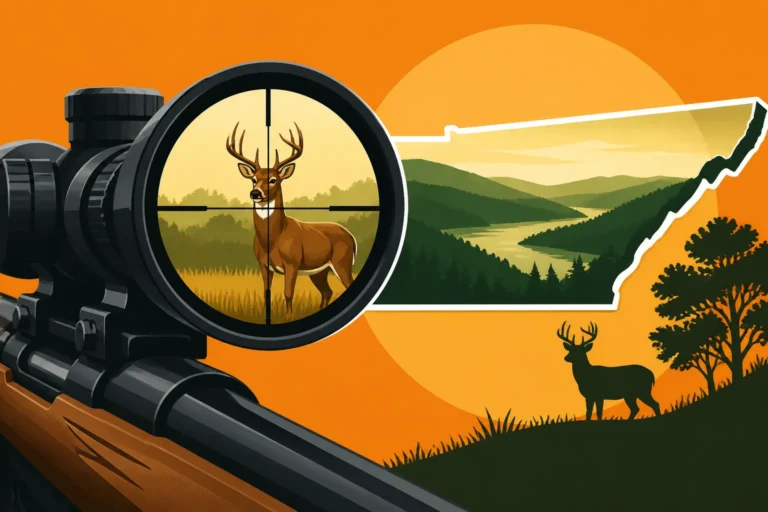
Your rifle scope is arguably one of the most important pieces of gear for accurate shooting. For hunting Tennessee's ridge country, you'll want a scope that excels in low-light conditions and offers a wide field of view at lower magnifications, while still providing enough power for those occasional longer shots. A scope with a magnification range like 2-7x, 3-9x, or 2.5-10x is ideal. These ranges allow for quick target acquisition at close distances (2x or 3x) and precision aiming at 150-200 yards (7x to 10x).
Avoid scopes with overly complex reticles designed for extreme long-range shooting, as they can be distracting at closer ranges. A simple duplex or BDC reticle is often more than sufficient. Additionally, good quality glass is paramount for gathering light in the dark timber of the hollows and during those critical dawn and dusk hours. Optics for Cumberland Plateau Ridges often means prioritizing light transmission and clarity over sheer magnification power. A clear, bright image at 6x magnification is far more useful than a dim, fuzzy image at 16x.
Ammunition Selection for Performance in Timber
The ammunition you choose should be designed for reliable expansion at common impact velocities, which for many standard calibers means excellent performance out to 200-250 yards. Bullets with controlled expansion characteristics, like bonded or partitioned designs, are excellent choices as they retain weight and penetrate well, even after hitting bone.
While some hunters debate bullet weights, for the vast majority of Tennessee deer hunting, a medium-to-heavy-for-caliber bullet (e.g., 150-180 grain in .30 caliber) offers a good balance of accuracy, energy retention, and penetration for the ranges we're discussing. Don't overthink it for the typical ranges you'll encounter here. Focus on consistency and knowing how your chosen load performs in your specific rifle. Understanding Ammunition Availability Before Opening Day is also a key practical consideration, ensuring you have enough of your preferred load to practice and hunt with confidence.
Beyond the Shot: Scouting and Preparation
Understanding realistic rifle ranges is just one piece of the puzzle. The most successful hunters in Tennessee's ridge country combine this knowledge with thorough scouting and preparation, maximizing their chances for a clean shot within their ethical limits. This holistic approach ensures you're not just ready for the shot, but you've put yourself in the best possible position for it.
Using Technology for Terrain Analysis
Before you even set foot in the woods, modern mapping applications can give you a huge advantage in understanding the terrain and potential shot opportunities. Tools like those offered by GoHunt allow you to analyze topography, identify contour lines, locate benches, saddles, and potential travel corridors. You can virtually scout for natural shooting lanes along logging roads, powerline cuts, or creek bottoms. By identifying these areas on a map, you can plan your approach and stand locations to maximize your visibility within your realistic shooting range.
Even with cell service being spotty in some of the more remote parts of the Cherokee National Forest Hunting, many of these apps allow you to download maps for offline use. This pre-season digital scouting is invaluable for understanding how deer might navigate the complex landscape and where they might present a shot. It helps you anticipate those 50-150 yard opportunities rather than just hoping for them. Scouting With the Tennessee TWRA App is another great resource for understanding WMA boundaries and regulations, which can further refine your hunt plan.
Practicing Under Realistic Conditions
The best way to truly internalize realistic rifle ranges is through dedicated practice. Don't just shoot from a bench at 100 yards and call it good. Seek out shooting opportunities that mimic real-world hunting scenarios. If you have access to private land or a suitable range, practice shooting at various distances, from different positions, and on angled terrain if possible. Set up targets at 50, 100, 150, and 200 yards.
Practice quickly acquiring a target and making a shot. Time yourself getting into a stable position. Understand your rifle's point of impact at each of these distances. If you consistently struggle to group shots tightly at 150 yards from a kneeling position, then that's likely beyond your ethical limit in the field. Embrace the fact that most shots in Tennessee's ridges are shorter, and master those close-to-mid-range opportunities. Confidence at 100 yards is far more valuable than hope at 300.
Disclaimer
This article is for general informational purposes only and does not constitute professional advice. Laws, prices and regulations vary by location and change over time. Consult a qualified professional for guidance on your specific situation.