Tennessee Hellbender Salamander Encounters Afield
You're deep in the Tennessee woods, maybe Hunting West Tennessee River Bottoms or following a promising creek bed on the Cumberland Plateau. You step over some slick rocks, or perhaps you're setting up a treestand near a flowing stream, and suddenly, you spot something unusual in the clear water or tucked under a rock. It's too big to be a typical salamander, and its appearance is, well, unique. You might find yourself wondering, "What in the world is that?" and more importantly, "Did I just stumble upon something rare, and what should I do?" This guide will walk you through what to expect if you encounter a Tennessee Hellbender salamander afield, how to identify it, and the crucial steps you need to take to protect these incredible, sensitive creatures that share our hunting grounds.
Understanding the Tennessee Hellbender
Imagine an ancient, wrinkly creature, perfectly adapted to clean, flowing water. That's the Tennessee Hellbender, often affectionately (or sometimes a little less flatteringly) known as the "snot otter" or "Allegheny alligator." These giant aquatic salamanders are a vital, though often unseen, part of our state's rich biodiversity. For hunters who value healthy ecosystems, understanding these unique amphibians is a small but significant step in being a true steward of the land.
The "Snot Otter" of Our Rivers
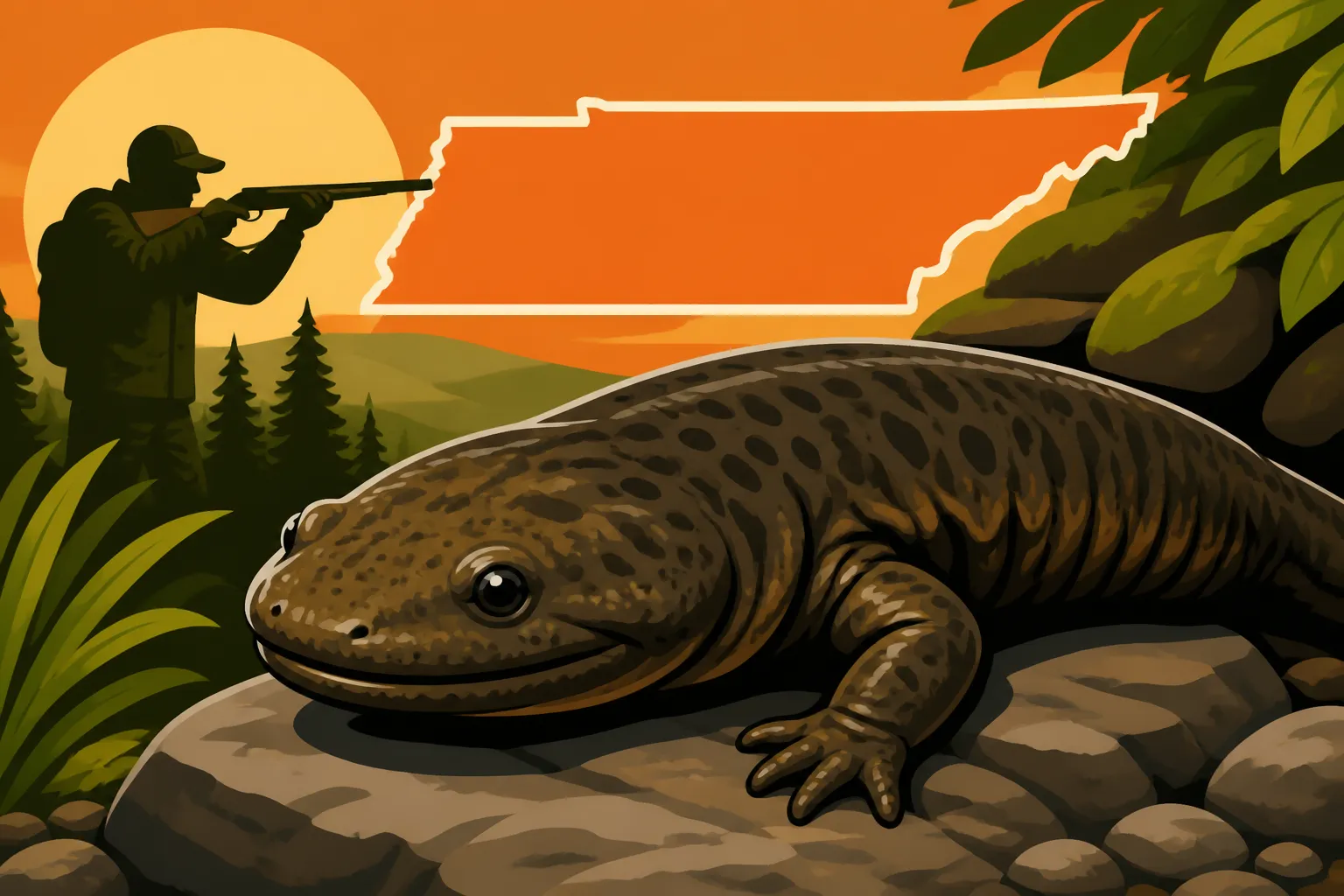
The hellbender (specifically the Eastern Hellbender, Cryptobranchus alleganiensis alleganiensis, in Tennessee) isn't just a big salamander; it's the largest amphibian in North America. They can grow up to two feet long, with a broad, flat head and a rudder-like tail. Their skin is typically mottled brown or reddish-brown, often blending seamlessly with the rocks and gravel of their riverbed homes. What truly sets them apart are the prominent, frilly folds of skin along their sides. These folds aren't just for show; they significantly increase the skin's surface area, allowing the hellbender to absorb oxygen directly from the water, which is crucial for survival in fast-moving, highly oxygenated streams.
Think about the conditions they thrive in: cold, clear, unpolluted water with plenty of large, flat rocks for cover and nesting. This habitat preference makes them excellent indicators of water quality. If hellbenders are thriving in a stream, it's a good sign that the water is healthy – and healthy water often means healthier surrounding terrestrial habitats for the deer, turkey, and small game we pursue. Losing these creatures would be a loud alarm bell for the overall health of our waterways, affecting everything downstream and upstream.
Protected Status and Conservation Efforts
Unfortunately, hellbender populations have been declining for decades across much of their range, including parts of Tennessee. Habitat degradation, siltation (when fine particles like dirt wash into streams and cover rocky bottoms), pollution, and even accidental harm from anglers or unwitting outdoor enthusiasts have taken a toll. Because of these threats, the Tennessee Hellbender is a state-listed endangered species. This designation means they are legally protected, and it is illegal to harass, harm, or possess them without specific permits.
Conservation efforts are underway to study and protect hellbenders, often involving research into water quality, habitat restoration projects, and public education. As hunters, we are often at the forefront of understanding and appreciating healthy ecosystems, and knowing about these sensitive species reinforces our role in broader conservation efforts. It’s not just about the game we pursue, but the entire intricate web of life that supports it. Every creature, from the largest whitetail buck to the most unassuming hellbender, plays a role.
Where Hellbenders Call Home
In Tennessee, hellbenders are primarily found in the eastern part of the state, particularly in the clear, cool, high-gradient streams and rivers flowing off the Appalachian Mountains and parts of the Cumberland Plateau. You're most likely to encounter them in areas with good water quality, rocky bottoms, and a relatively undisturbed environment. Think of the tributaries that feed into major river systems, especially those that aren't heavily impacted by agriculture or development.
Specific river systems where hellbenders have been documented include portions of the upper Tennessee River basin, various streams in the Cherokee National Forest, and some of the more pristine waterways in the Cumberland Mountains. If you're Hunting Near the Great Smoky Mountains or Hunting the Cumberland Plateau, especially in areas with crystal-clear, fast-flowing streams, you're in prime hellbender territory. They often hide under large flat rocks, which provide critical refuge from predators and strong currents, and serve as nesting sites. When you're carefully crossing a stream or setting up near a rocky bank, remember these hidden residents.
Identifying a Hellbender in the Wild
So, you're splashing through a stream, maybe checking for Reading Tennessee Mud for Fresh Deer Movement along the banks, and something catches your eye underwater. It’s long, maybe a foot or more, and slithers oddly. Is it a snake? A fish? Or could it be a hellbender? Proper identification is crucial because your actions could inadvertently affect a protected species.
Distinctive Features
When you encounter one, several features will help you identify a hellbender without needing to get too close. First, their size is a major giveaway—they are large, much larger than most other salamanders you might see in Tennessee. An adult hellbender can easily be over a foot long, sometimes approaching two feet. Their color is usually a camouflaged brown, olive, or reddish-brown, often mottled with darker spots or blotches that help them blend with the rocky river bottom.
But the real clincher is their skin. Hellbenders have loose, baggy, heavily folded skin along their flanks. These folds are incredibly distinct and give them a wrinkled appearance. They also have a very flat, wide head with small, lidless eyes, and a broad, laterally compressed tail that looks almost like a paddle. Unlike some other aquatic salamanders, they do not have external gills once they are adults. They rely on those skin folds for respiration. If you see something large, brown, flat-headed, and incredibly wrinkled in clear stream water, odds are you've spotted a hellbender.
Common Look-Alikes
It's easy to mistake a hellbender for other aquatic creatures, especially at a quick glance or in murky water. The most common look-alike in Tennessee is the mudpuppy (Necturus maculosus), another large aquatic salamander. However, there are key differences:
| Feature | Hellbender (Cryptobranchus alleganiensis) | Mudpuppy (Necturus maculosus) |
|---|---|---|
| Size (Adult) | Up to 24 inches (very large) | Up to 16 inches (large, but typically smaller) |
| Skin Folds | Prominent, loose, frilly folds along sides | Smooth skin, no prominent folds |
| Gills | No external gills as an adult | Prominent, feathery external gills throughout life |
| Head Shape | Very flat, broad, shovel-like | Flatter but not as broad or shovel-like |
| Tail Shape | Laterally compressed, rudder-like | Laterally compressed, more slender |
| Coloration | Mottled brown, olive, reddish-brown | Typically gray to reddish-brown, spotted |
| Habitat | Clean, cold, fast-flowing, rocky rivers/streams | Wider range of aquatic habitats, including lakes |
As you can see, the presence of external gills and the lack of prominent skin folds are usually enough to distinguish a mudpuppy from a hellbender. Other potential mistaken identities could include large catfish or even water snakes, but their body forms are generally quite different upon closer inspection. The mudpuppy is the most common and confusing look-alike.
Observing Without Disturbing
The most important rule when encountering any wild animal, especially a protected one, is to observe from a distance and avoid disturbance. You might be Scouting Tennessee Public Land Before Season and happen across one while crossing a stream. If you spot a hellbender, simply take a moment to appreciate it from where you are. Do not attempt to catch it, pick it up, or move any rocks around it. Their skin is incredibly delicate, and handling them can remove their protective mucus layer, making them vulnerable to disease. Moreover, they are surprisingly strong, and if you accidentally grab one, they might bite (though they are not venomous, it could be a nasty nip).
Even moving a rock they are sheltering under can be detrimental, exposing them to predators or changes in water temperature they can't easily tolerate. Remember, these creatures are perfectly camouflaged and often sedentary, so if you're not actively looking for them, you might just pass them by. That's usually the best-case scenario for the hellbender.
What to Do If You Encounter a Hellbender
Coming across a hellbender while hunting or exploring can be an exciting moment, a real testament to the health of our natural environment. But it also comes with a responsibility. Knowing what to do, and more importantly, what not to do, is critical for their survival and for you to stay within legal guidelines.
Leave Them Undisturbed: The Golden Rule
This cannot be stressed enough: if you see a hellbender, leave it be. Do not touch it. Do not try to move it. Do not attempt to show it to your hunting buddy by lifting a rock. Their protected status means any disturbance could be considered harassment, which carries legal penalties. More importantly, it can cause significant stress or injury to the animal itself.
Imagine you're quietly Still-Hunting Cumberland Plateau Ridges and decide to cut down to a creek bottom. You wade across, and there it is, tucked under a flat rock. Your best action is to quietly back away and continue on your way. You've witnessed a rare and wonderful piece of Tennessee's wild heritage; cherish the memory, but leave the animal exactly where you found it. Respect for wildlife is a cornerstone of responsible hunting, and that extends to all creatures, game or not.
Reporting Sightings
Should you report a hellbender sighting? Generally, for casual encounters where the animal appears healthy and undisturbed, it's not strictly necessary to report it to the Tennessee Wildlife Resources Agency (TWRA) immediately. However, if you observe a hellbender that appears injured, sick, dead, or if you witness someone harassing or attempting to capture one, then absolutely, you should report it. You can contact the TWRA directly. Provide as much detail as possible, including the exact location (GPS coordinates if you have them, perhaps marked on a mapping app like GoHunt if you're using one for Finding Ground Others Walk Past), the date and time, and a description of what you observed.
While GoHunt itself is a great tool for scouting and mapping hunting areas, it's not designed for wildlife reporting of endangered species. But the principle of marking important locations applies. If you've got a GPS unit or a phone app like Go Outdoors Tennessee, noting the coordinates can be immensely helpful if you later decide to report. Researchers are always interested in population data, so if you're able to document a healthy, undisturbed individual without getting too close, that information, when aggregated, can be valuable for conservation efforts.
Accidental Encounters and Best Practices
Sometimes, despite our best intentions, accidents happen. You might be turning over rocks looking for crawfish for fishing bait, or perhaps you're building a makeshift duck blind along a stream edge when you inadvertently disturb a hellbender's hiding spot. If you accidentally uncover a hellbender or disturb its habitat:
- Stop immediately: Cease whatever activity you were doing.
- Gently cover it back up (if necessary and safe): If you've moved a rock and exposed it, and the hellbender isn't moving, carefully replace the rock exactly as it was. Do not touch the hellbender directly. Use a stick or glove if you absolutely must nudge a rock back into place, but the less contact, the better.
- Leave the area: Move away and avoid further disturbance.
- Learn from the experience: Be more mindful of potentially fragile habitats in the future. This is part of being an observant and ethical outdoors person. Whether you're focused on Treestand Setups in Cherokee National Forest or simply hiking, always be aware of your impact on the environment.
Remember, the goal is always to minimize human impact. Hellbenders are incredibly sensitive to changes in their environment, and even seemingly minor disturbances can have serious consequences for these slow-moving, long-lived amphibians.
Why Hellbenders Matter to Tennessee Hunters
As hunters, our connection to the land runs deep. We spend countless hours Scouting Tennessee Public Land Before Season, observing, and learning the nuances of the ecosystems we enter. The presence of a healthy hellbender population might seem far removed from bagging a deer or a turkey, but it's actually intertwined with the overall health of the natural world we cherish.
Indicators of Water Quality
Think of hellbenders as the ultimate living barometer for stream health. They require pristine, oxygen-rich, unpolluted water to survive. If hellbenders are thriving, it's a strong indicator that the surrounding watershed is also in good shape. Why does this matter to a hunter? Because healthy watersheds mean healthy forests, fields, and food sources for game animals. Clean water is fundamental to all life, from the smallest insect larvae that fish feed on, to the deer that drink from the streams, to the acorns that fall from the trees nourished by that same water.
When you're Hunting Tennessee River Bottom Funnels or exploring public land along a creek, the water quality directly impacts the health and abundance of the game you're pursuing. Sedimentation from eroded farm fields, chemical runoff, or urban pollution doesn't just harm hellbenders; it degrades habitat for everything, reducing overall carrying capacity for wildlife. So, in a very real sense, protecting hellbenders is a step toward ensuring robust hunting opportunities for generations to come.
Part of Tennessee's Natural Heritage
Tennessee is blessed with incredible natural beauty and a diverse array of wildlife. From our majestic elk herd in the North Cumberland WMA to the elusive black bears of the Cherokee National Forest, our state offers a unique tapestry of species. The hellbender, though not a charismatic megafauna that hunters typically pursue, is an ancient and remarkable thread in that tapestry. It's a living relic, a species that has existed relatively unchanged for millions of years.
Appreciating and protecting these unique creatures is about valuing the entirety of Tennessee's natural heritage. It's about recognizing that every species, no matter how small or hidden, contributes to the richness and resilience of our wild places. For hunters, who often advocate for the protection and preservation of wildlife habitats, extending that advocacy to species like the hellbender reinforces our commitment to conservation in its broadest sense. We don't just protect what we hunt; we protect the ecosystems that make all hunting possible.
Stewardship and Responsible Hunting
The core of responsible hunting is stewardship—taking care of the land and its creatures. This means following regulations, ensuring ethical harvests, and contributing to conservation efforts. Encountering a hellbender is a vivid reminder of this responsibility. It compels us to be more observant, more respectful of delicate environments, and more aware of our footprint.
By knowing about hellbenders, understanding their needs, and taking proper action (or inaction, as the case may be!) when we see one, we reinforce our role as stewards. It highlights that the pursuit of game is part of a larger relationship with the wild. Whether it's advocating for clean water initiatives, being careful about crossing streams, or simply leaving no trace when you're in the backcountry, every action contributes to a healthier environment for all. So the next time you're wading across a clear, rocky stream in East Tennessee, keep an eye out for these incredible "snot otters" – they're a symbol of everything we're working to protect.
Disclaimer
This article is for general informational purposes only and does not constitute professional advice. Laws, prices and regulations vary by location and change over time. Consult a qualified professional for guidance on your specific situation.