Retrieving Game From Private Land in Tennessee
There’s almost nothing more disheartening than making a good shot on a magnificent Tennessee whitetail, a strutting gobbler, or even a swift squirrel, only to watch it disappear over a property line onto land you don’t have permission to hunt. It's a gut-wrenching moment that every hunter dreads, leaving you torn between your ethical duty to recover the animal and your legal obligation to respect private property. This guide will walk you through Tennessee’s rules regarding game retrieval from private land, offering practical advice to help you navigate this tricky situation and avoid potential legal pitfalls.
Understanding Tennessee's Trespass Laws and Your Rights
The burning desire to recover your animal is completely understandable, but it doesn't automatically grant you the legal right to cross onto someone else's property in Tennessee. Ignoring property lines, even in the heat of the moment, can lead to serious consequences, not just for you but for the perception of all hunters. It’s crucial to understand the nuances of Tennessee’s trespass laws before you even consider stepping onto land that isn't yours.
The Basic Rule: Permission is Paramount
In the great state of Tennessee, the fundamental rule is quite simple: private land is private. This means that if you do not own the land yourself, or if you haven't received explicit permission from the landowner, you cannot legally set foot on it. It doesn't matter if there's no fence, no "No Trespassing" signs, or if the land appears unmaintained. The absence of a barrier or a sign doesn't equate to an invitation. As hunters, we often move through fields and timber, but that right is usually limited to land we own, have leased, or have specific permission to access.
This can be incredibly frustrating when you've just poured hours, maybe even days, into a hunt, made a perfect shot, and then watch your quarry sprint into what you know is neighboring property. The impulse to immediately follow is strong, but resisting it is paramount. Without permission, crossing that line, even to retrieve game, is considered trespassing. The legal consequences can include fines, and even the potential loss of your hunting privileges, which would be a far worse outcome than losing an animal. We all have an ethical responsibility to recover game, but that responsibility must be balanced with the legal and ethical responsibility to respect private property.
Express vs. Implied Permission
When we talk about permission, there are generally two types: express and implied. In almost all hunting scenarios, especially when it involves crossing onto land to retrieve game, you absolutely want express permission. Express permission means the landowner (or someone authorized by them) has directly given you consent, either verbally or, even better, in writing. This is a clear, unequivocal "yes, you can go on my land for this specific purpose." There's no room for doubt or misinterpretation.
Implied permission, on the other hand, is a much trickier and often risky concept. It typically arises from a long-standing pattern of behavior or a close relationship where consent is understood rather than explicitly stated. For example, if you’ve hunted an adjacent tract for twenty years and the neighbor has always let you cross a certain fence line to retrieve game without ever saying a word, that might be implied permission. However, relying on implied permission, especially with a new neighbor or in a high-stakes situation like a game retrieval, is a gamble. A new owner, a change in their feelings, or even just a bad day could turn your "implied" access into a clear trespass. Always, always err on the side of seeking and obtaining express permission. Remember, a polite conversation before any incident occurs can build a bridge that saves a lot of heartache and potential legal issues down the road.
The "Pursuit of Wounded Game" Clause (or Lack Thereof)
Here’s a common misconception that trips up many hunters, especially those new to Tennessee or coming from other states with different regulations: the belief that there's a specific legal clause granting hunters the right to pursue wounded game onto private land. Unfortunately, in Tennessee, this isn't the case. There is no automatic "right of pursuit" embedded in our hunting regulations that overrides private property laws.
This can be a tough pill to swallow. You might think, "But it's suffering! I have to recover it!" And while that ethical urge is powerful and valid, the law prioritizes property rights. Other states might have different statutes that allow for reasonable retrieval under specific conditions, but Tennessee does not. This is precisely why preparation and pre-emptive communication with your neighbors are so incredibly important. Waiting until an animal crosses the line to try and secure permission puts you in a highly disadvantaged and stressful position. Without that pre-existing relationship or express permission, you are at the mercy of the landowner’s willingness to grant access, and if they say no, then legally, that’s where the pursuit ends for you. This aspect of Tennessee law makes Tennessee Trespass and Permission Law a critical read for anyone hunting near property lines.
Proactive Measures and Best Practices Before the Shot
The best way to handle game crossing onto private land is to prevent the problem before it even starts. Being prepared, understanding your surroundings, and fostering good relationships with your neighbors can eliminate a lot of stress and potential conflicts when the moment of truth arrives. A little bit of groundwork before the season can save you a world of trouble and ensure ethical and legal game retrieval.
Scouting and Boundary Awareness
Before you even step foot in the woods with your bow or gun, you need to have an intimate understanding of the property you're hunting and all its adjacent boundaries. This isn't just about knowing where your land ends; it's about knowing exactly where the neighbor's land begins, especially in areas where game is likely to travel. Topographical features like creek bottoms, ridge lines, and thickets often serve as natural travel corridors, and unfortunately, they rarely align perfectly with property lines.
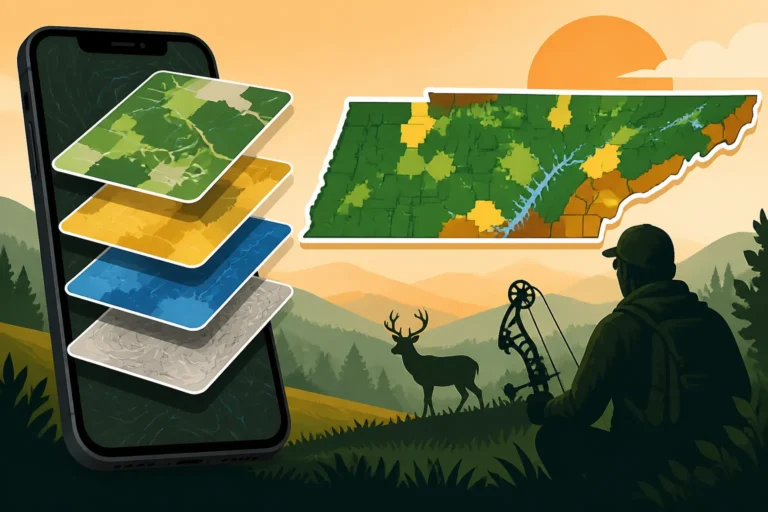
Take the time to walk your property lines, looking for old fence rows, boundary markers, or even just changes in timber stand or ground cover. Use modern mapping technologies to your advantage. Tools like onX Hunt have revolutionized how hunters understand land ownership. You can download maps right to your phone, showing property lines, landowner names, and even different habitat types, even if you lose cell service deep in the Cherokee National Forest Hunting or on the Cumberland Plateau ridges. Knowing precisely where you are in relation to the property next door can help you position yourself for a shot that keeps the animal on your land, or at least gives you a clearer idea of where it might go. Nothing ruins a hunt faster than realizing you're playing a guessing game with property lines, and this kind of preparation helps prevent that gut-wrenching feeling.
Building Relationships with Neighbors
This might sound like a simple piece of advice, but it's arguably the most powerful tool in your game retrieval arsenal: build relationships. Don't wait until you've got a wounded deer teetering on the property line to knock on your neighbor's door. Introduce yourself long before the season starts. If you're new to an area or simply haven't had the chance, take an afternoon in the summer or early fall to drive around, identify adjacent landowners, and make friendly contact.
A simple, honest conversation can go a long way. Explain that you hunt the adjacent property, and politely ask what their stance is on game retrieval. "Hey, I'm John from next door. I hunt deer on my place, and sometimes, even with a good shot, they'll run a ways. If one happens to cross onto your property, would you mind if I called you to ask permission to track it?" Offer to provide your phone number and even ask for theirs. This builds trust and shows respect. Many landowners are perfectly fine with retrieval if approached respectfully and proactively. You might even offer to share some of your venison or help them with a small chore. That simple handshake and conversation can transform a potential trespass incident into a cooperative effort, saving you immense stress and preserving the meat. This proactive approach is key, especially when you're Scouting Tennessee Public Land Before Season and identifying those critical borders.
Using Technology for Property Line Identification
In today's hunting world, mapping technology isn't just a convenience; it's practically a necessity for responsible hunters, especially those navigating land boundaries. Gone are the days of relying solely on paper maps or vague recollections of where old fence posts used to be. Modern apps like onX Hunt and GoHunt provide highly accurate, real-time property line data right in the palm of your hand.
These platforms allow you to see exactly where the property lines are, often displaying them in vivid color overlays on satellite imagery. More than that, many will show you the landowner's name and, in some cases, even contact information. Imagine being able to confirm the exact property line in a dense thicket after a shot, knowing for certain that the animal crossed onto John Smith's land, and then having his phone number readily available. This kind of precise information is invaluable for both planning your hunt to avoid boundary issues and for making those critical, respectful contact attempts if an animal does cross. These tools help you understand Finding Tennessee Property Lines with unprecedented accuracy, ensuring you’re always hunting legally and ethically. They empower you to make informed decisions in the field, reducing guesswork and preventing accidental trespass. They can also help you identify optimal stand locations to try and keep deer on your side of the line, minimizing the chances of needing to even make that call to a neighbor.
When the Game Crosses: Steps for Retrieval
Despite all your best efforts and proactive planning, sometimes a deer or turkey just doesn't cooperate and crosses onto land you don't have permission to be on. When this happens, it’s critical to resist the urge to immediately rush in. Taking a calm, methodical approach will not only increase your chances of successful retrieval but, more importantly, ensure you stay within the bounds of Tennessee law and maintain good relations with landowners.
Immediate Action: Mark the Spot and Assess
The moment you realize your game has crossed a property line, your first priority is to stop. Do not cross that line. It’s incredibly tempting to follow the blood trail or the last visible sign, but doing so without permission makes you a trespasser. Instead, mark your exact position at the boundary. Use a waypoint on your GPS or mapping app, or even tie a piece of surveyor's tape to a tree if you’re using more traditional navigation. This spot marks the legal limit of your pursuit until permission is granted.
Once you’ve marked the boundary, take a moment to assess the situation. Observe the direction the animal took, the nature of the terrain, and any visible sign from your side of the line. Does the blood trail look promising, indicating a quick recovery? Or is it sparse, suggesting a longer track? This information will be vital when you speak with the landowner. While you’re doing this, be mindful of your surroundings. Are there any houses nearby? Are you on a busy road? Knowing these details can help you formulate your request to the landowner more effectively. This initial pause, while difficult, is a critical step in a responsible retrieval attempt. It allows you to gather your thoughts and prepare for the next, most crucial step: contacting the landowner. This is also where skills like Tracking a Deer Through Tennessee Leaf Litter become vital on your side of the fence.
Contacting the Landowner (The Right Way)
This is the most critical juncture in the entire process. How you approach the landowner can make all the difference between securing permission and being firmly denied. If you’ve done your proactive homework and already have a relationship and contact information, use it. Call them immediately. If not, this is where those mapping apps like onX Hunt become invaluable for finding landowner names and phone numbers.
When you make contact, be polite, respectful, and honest. Start by introducing yourself and stating clearly that you are a hunter. Explain the situation concisely: "Hello, Mr./Ms. [Landowner's Name], my name is [Your Name], and I was hunting on the property next door. I just shot a deer, and unfortunately, it appears to have crossed onto your land near [describe location]. I have a good blood trail, and I'm very committed to recovering it ethically. Would it be possible for me to get your permission to cross onto your property to retrieve it?" Offer to walk with them, or have them observe your efforts, to show you respect their property and aren't trying to hide anything. Avoid being demanding, emotional, or making any assumptions. A panicked, demanding tone will shut doors faster than anything. If they agree, clarify any stipulations they might have, such as specific entry points or areas to avoid. Thank them profusely for their generosity. If, by chance, you cannot reach the landowner, you are in a very difficult spot. You can try leaving a polite note with your contact information, but understand that doing so does not grant you permission to cross. If they are unreachable, legally, your hands are tied without risking trespass.
What to Do If Permission is Denied
This is the hardest part. Despite your best efforts, a landowner may still deny you permission to retrieve your game. It's an incredibly tough pill to swallow. You’ve put in the work, made a clean shot, and now the animal you ethically pursued is lying just out of reach, potentially to spoil. However, if permission is denied, you must respect that decision. Legally, a "no" means no. Ignoring a direct denial is a clear act of trespass, and it can carry significant legal penalties, including fines, potential jail time, and the revocation of your hunting license. More broadly, it damages the reputation of all hunters, making it harder for others to gain access in the future.
While the emotional toll of leaving a harvested animal is immense, the legal and ethical consequences of trespassing outweigh it. You may feel a strong ethical obligation to recover the animal, but that obligation does not supersede the legal rights of a private property owner in Tennessee. If you are denied access, consider contacting the Tennessee Wildlife Resources Agency (TWRA). While TWRA officers generally cannot force a landowner to grant access, they may be able to mediate the situation or, in cases involving certain species or CWD concerns, they might have specific protocols or options for dealing with carcasses on private land. This is not a guarantee of retrieval, but it is a legal and responsible step to take. Facing a denial is a true test of a hunter's character, requiring respect for property rights even in the face of deep disappointment.
Here's a quick overview of how proactive and reactive approaches often play out:
| Approach | Description | Pros | Cons |
|---|---|---|---|
| Proactive | Establish contact and permission with adjacent landowners before hunting season. | Builds trust, streamlines retrieval, avoids conflict, higher success rate. | Requires effort and planning pre-season, not always feasible with every neighbor. |
| Reactive | Seek permission after game has crossed onto private land. | Less pre-planning required if you don't have many adjacent private tracts. | High stress, potential for outright denial, risk of losing game, strained relations. |
Legal Considerations and Respecting Property
Navigating the aftermath of a shot animal crossing onto private land involves more than just a quick phone call. It touches on legal limits, ethical responsibilities, and the broader perception of hunters in our communities. Understanding these elements is crucial for responsible hunting in Tennessee.
TWRA's Role and When to Involve Them
The Tennessee Wildlife Resources Agency (TWRA) serves as the primary enforcer of hunting regulations and wildlife management in the state. If you find yourself in the unenviable position of having a game animal, particularly a large one like a deer or bear, expire on private land where you've been denied access, contacting TWRA can sometimes be a helpful step, but it's important to understand their limitations. TWRA officers often act as mediators in disputes between hunters and landowners. They can explain the law to both parties and try to facilitate a resolution.
However, it's critical to realize that a TWRA officer generally cannot compel a private landowner to grant you access to their property. Their primary role isn't to enforce retrieval rights, but to uphold wildlife laws and manage wildlife resources. In certain situations, such as when an animal is posing a public health risk or if it's within Tennessee's Chronic Wasting Disease Management Zone, TWRA might have specific protocols for carcass removal. For instance, in a CWD zone, they might be more inclined to assist in retrieving a deer for sampling, which benefits the overall herd health management. But do not view contacting TWRA as a "get out of jail free" card for trespass, or a guaranteed retrieval. It should be considered an option only after you've made a sincere, respectful effort to gain permission directly from the landowner and been denied. They can offer guidance and potentially mediate, but the ultimate decision rests with the property owner.
The Ethics of Game Retrieval
As hunters, we adhere to a strong ethical code, and a core tenet of that code is the responsibility to recover any animal we shoot. Wounding an animal and not attempting to retrieve it is a violation of that ethic. However, this ethical obligation, as strong as it is, does not grant us the right to violate property laws. This creates a deeply frustrating and difficult dilemma when game crosses onto private land and access is denied.
The best ethical practice begins long before the shot: taking only high-percentage shots, knowing your effective range, and ensuring you have a clear understanding of where an animal might run. Should an animal still cross onto private property, your ethical responsibility then shifts to making every legal and respectful effort to retrieve it. This means promptly and courteously requesting permission from the landowner. If that permission is genuinely and firmly denied, the ethical hunter faces a tragic loss, but one that is forced upon them by circumstances beyond their control, not by a lack of effort on their part. To trespass would be to exchange one ethical breach (failing to recover game) for another (disrespecting private property rights and potentially breaking the law), while also harming the broader image of hunters. The true ethical test is upholding respect for laws and landowners, even when it causes personal disappointment. For those who prioritize ethical hunting, Tennessee Hunter Education Requirements covers these principles thoroughly.
Maintaining Good Hunter-Landowner Relations
The actions of one hunter can, and often do, impact the perception of all hunters in a community. How you conduct yourself when dealing with a game retrieval situation on private land can either build bridges or burn them. Every interaction with a landowner, especially one whose property you need access to, is an opportunity to be an ambassador for hunting.
Always approach landowners with respect and gratitude, regardless of the outcome. If they grant you permission, thank them profusely, and if appropriate, offer to share some of the harvested game. If you recover the animal, make sure to leave their property exactly as you found it, if not better. Close any gates you opened, don't leave trash, and be mindful of their crops, livestock, or manicured areas. The goal is to make their experience of dealing with a hunter a positive one, so they'll be more inclined to grant permission to you, or another hunter, in the future. Conversely, being rude, demanding, or disrespectful can sour relationships for years and make access nearly impossible for everyone. Remember, a reputation for integrity and respect goes a long way in the hunting community, and it's something we should all strive to uphold, especially when Hunting Small Private Tracts in Tennessee where neighborly goodwill is essential.
Disclaimer
This article is for general informational purposes only and does not constitute professional advice. Laws, prices and regulations vary by location and change over time. Consult a qualified professional for guidance on your specific situation.