Nest Predation and Tennessee Turkey Hatches
Every spring, Tennessee turkey hunters eagerly anticipate the sound of gobbling, but behind that excitement lies a harsh reality: successful turkey hatches are a fragile endeavor. The journey from an egg to a thriving poult is fraught with peril, especially from the ever-present threat of nest predation, which significantly impacts the future of our wild turkey populations. This guide dives deep into the challenges faced by nesting hens, identifies the most common predators, and explores the critical role nest success plays in the overall health of Tennessee's cherished turkey flocks.
The Harsh Reality of Turkey Nesting in Tennessee
It’s easy to romanticize spring turkey hunting—the crisp mornings, the distant gobble, the thrill of the chase. But for the hen turkeys, spring is a time of immense vulnerability and effort, as they dedicate themselves to continuing the species. Their survival, and by extension, the future of our hunting seasons, hinges almost entirely on successful nesting. It’s a delicate balance of camouflage, timing, and sheer luck in a world full of hungry eyes.
The challenges are far more complex than just finding a secluded spot. Hens must contend with fluctuating weather, human disturbance, and an array of opportunistic predators that are constantly on the prowl for an easy meal. The energy expenditure is enormous, and a failed nest isn't just a loss of eggs; it's a drain on the hen's resources, potentially impacting her health and future reproductive efforts. Understanding these struggles gives us a deeper appreciation for every turkey we see in the woods.
Early Season Nesting Attempts and Their Vulnerability
When a hen lays her first clutch of eggs, usually around late March or early April in much of Tennessee, she's placing all her bets on that one location. These early nests are often the most critical for overall reproductive success because they tend to produce the largest clutches and often coincide with optimal weather conditions before the heat of summer sets in. However, they are also incredibly vulnerable. The woods are just beginning to green up, meaning less concealment for the nesting hen and her precious eggs.
Imagine a hen tucked into a sparse patch of briars or at the base of a hollow tree, trying to remain absolutely motionless for weeks. She's relying on her natural camouflage, but without dense overhead cover or thick ground vegetation, her profile might be more visible to a soaring hawk or a sniffing coyote. The early spring can also bring unpredictable cold snaps or heavy rains, which can chill eggs or flood low-lying nest sites, adding another layer of threat even before a predator enters the scene.
The Drive for Renesting: Why Hens Keep Trying
The good news for turkey populations is that hens are incredibly resilient. If their initial nest is destroyed—whether by a predator, a natural disaster, or human disturbance—many hens will attempt to renest. This is a crucial biological adaptation that helps buffer the population against single-event failures. However, these subsequent nesting attempts often come with their own set of challenges that impact their overall success rate.
Renests typically involve fewer eggs, and because they occur later in the season, the poults hatch later. This means they have less time to grow and develop before the onset of winter, making them more susceptible to disease, colder temperatures, and other environmental stressors. The hen herself is also more depleted from the energy demands of the first nesting attempt, potentially making her less vigilant or less able to choose an ideal, predator-proof site. It's a testament to their strong maternal instinct that they keep trying, but each subsequent attempt often carries diminished returns.
Who Are the Culprits? Common Nest Predators in Tennessee
When you're out scouting for turkeys, perhaps using a mapping tool like GoHunt to pinpoint likely roosting areas or food sources, it's easy to focus solely on the turkeys themselves. But the woods are a complex ecosystem, and a host of other creatures view turkey nests as a vital food source. Identifying these common nest predators helps us understand the pressure our turkey populations face and why Poult-to-Hen Ratios and What They Mean are so closely monitored by wildlife biologists.
The sheer variety of animals that will readily raid a turkey nest is astonishing, from stealthy mammals to opportunistic birds and even slithering reptiles. Each species has its own methods and preferred nesting situations it exploits, making it incredibly difficult for a hen to truly secure her clutch. It’s a constant battle for survival that plays out unnoticed by most human eyes.
Mammalian Marauders: Raccoons, Skunks, and Coyotes
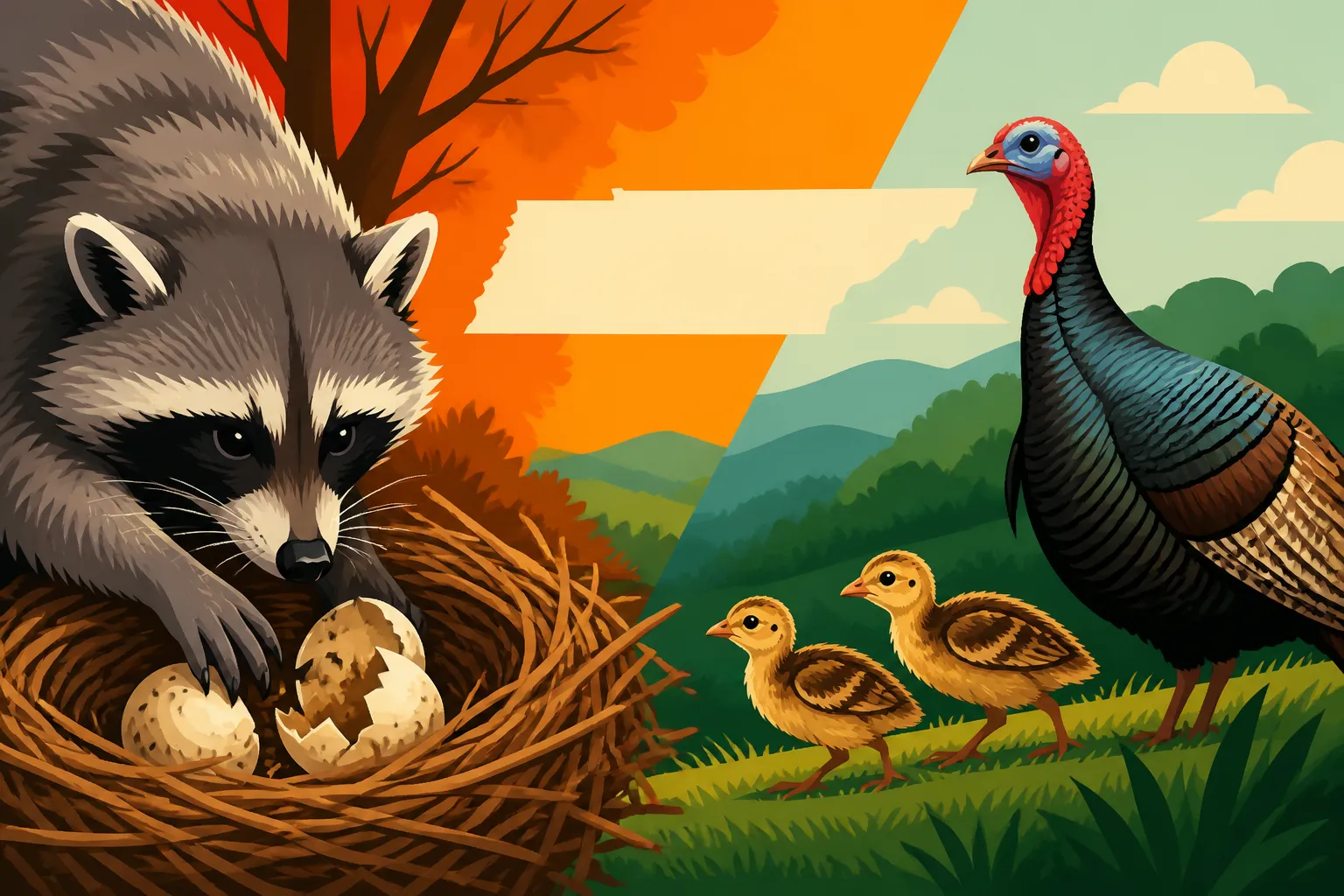
Among the most significant threats to turkey nests in Tennessee are various mammals. Raccoons, with their incredibly dexterous paws and keen sense of smell, are notorious nest predators. They are highly opportunistic, often patrolling creek bottoms and forest edges at night, systematically searching for anything edible. A hidden nest, no matter how well concealed, is often no match for a raccoon's nose.
Skunks are another major problem. Like raccoons, they are nocturnal and use their sense of smell to locate nests. While perhaps not as destructive as a raccoon, a skunk can quickly decimate a clutch of eggs. Coyotes, now widespread across Tennessee, are also adept at finding nests. They are generalist predators, and a turkey nest represents a high-protein, easily accessible meal. When scouting with tools like GoHunt, look for areas with high predator sign like scat or tracks, as these areas could be particularly challenging for nesting hens. Tennessee Coyote Range and Density has expanded significantly, putting more pressure on ground-nesting birds.
| Common Nest Predators in Tennessee | Primary Method of Predation | Impact on Nests | Hunter Observation (Sign) |
|---|---|---|---|
| Raccoons | Smell, dexterous paws | High, total destruction | Tracks, scat, chewed eggs |
| Skunks | Smell | High, total destruction | Tracks, characteristic odor |
| Coyotes | Smell, opportunistic hunting | Moderate to High, eggs/hen | Tracks, scat, howls |
| Opossums | Smell, opportunistic | Moderate | Tracks, sometimes chewed eggs |
| Snakes (Black snakes, Rat snakes) | Smell, ambush | Moderate, eggs ingested whole | Shed skins, direct sightings |
| Crows/Jays | Sight, opportunistic | Low to Moderate, partial/full | Cawing, visible scavenging |
| Foxes (Red/Gray) | Smell, opportunistic hunting | Moderate to High, eggs/hen | Tracks, scat, dens |
Avian and Reptilian Threats
While mammals often get the most attention, other groups of animals pose significant threats to turkey nests. Birds like crows and jays are highly intelligent and opportunistic. They often use their keen eyesight to spot a hen leaving or returning to her nest, or they might simply stumble upon an exposed clutch. Once discovered, they can quickly peck through eggs or carry off individual ones, causing partial or complete nest failure. They might not destroy an entire nest as systematically as a raccoon, but they are still a significant drain.
Then there are snakes, which can be particularly insidious given their stealthy nature. Large black snakes and rat snakes are well-known for their ability to swallow turkey eggs whole. They leave very little evidence behind, making it hard to determine the cause of a nest's failure. A hen might return to an empty nest with no obvious signs of a struggle, completely unaware of the slithering thief that visited. While perhaps less impactful than mammalian predators on a population scale, their presence is a constant low-level threat that hens must contend with.
Factors Affecting Nest Predation Rates
Understanding who is predating nests is only part of the equation. It's equally important to consider why certain nests are more susceptible than others and what environmental factors play a role. Nest predation isn't a random act; it's often influenced by the surrounding habitat, weather patterns, and even human activity. These elements combine to create a dynamic landscape where a hen's success can vary wildly from one season to the next, and even from one ridge to another.
For hunters keenly interested in the long-term health of our flocks and perhaps trying to predict future Tennessee Turkey Harvest Numbers, looking beyond individual encounters to these broader factors is crucial. We must recognize that every component of the ecosystem, from the smallest insect to the largest tree, indirectly influences the fate of those fragile clutches hidden on the forest floor.
Habitat Quality and Nest Concealment
The quality of nesting habitat is paramount in mitigating predation. A hen needs dense, protective cover to hide her nest from prying eyes and sniffing noses. This typically means areas with thick undergrowth, briar patches, regenerating timber cuts, or dense stands of native grasses. When such cover is abundant, it provides both visual and olfactory concealment, making it harder for predators to locate a nest. Conversely, areas with poor, sparse, or fragmented cover leave nests highly exposed.
Poor habitat quality can result from various factors, including aggressive timber harvesting practices that remove understory, over-grazing by livestock, or even simply a lack of management that promotes healthy ground cover. In regions where suitable nesting habitat is scarce, hens are forced to nest in less secure locations, dramatically increasing their chances of predation. This is why conservation efforts focused on improving turkey habitat are so vital, aiming to give hens every possible advantage.
Weather Events and Their Impact on Nests
Tennessee's weather can be notoriously unpredictable, especially during the spring nesting season, and these weather events can have a profound impact on nest success. Prolonged periods of heavy rain can lead to localized flooding, washing out nests or chilling eggs to the point where they are no longer viable. Cold snaps, particularly early in the season, can also be detrimental, especially if a hen is temporarily off her nest.
Conversely, extended dry spells can also have indirect negative effects. Dry conditions might lead to a decrease in insect populations, which are a crucial food source for newly hatched poults. While not directly linked to predation, a lack of food can weaken poults, making them more vulnerable to predators later on. Hunters tracking Tennessee Turkey Brood Survey Results often see a correlation between harsh spring weather and lower poult numbers later in the summer.
Human Influence and Habitat Fragmentation
Even our own activities, often unintentional, can contribute to nest predation. Habitat fragmentation, where large tracts of contiguous forest are broken up by roads, developments, or agricultural fields, creates more "edge" habitat. While edge habitat can be beneficial for many wildlife species, it also provides easier access for many generalist predators like raccoons and coyotes, allowing them to penetrate deeper into what would otherwise be more secure nesting areas.
Additionally, seemingly innocuous outdoor activities can sometimes disturb nesting hens. Hiking, mountain biking, or even scouting too aggressively off-trail can inadvertently flush a hen from her nest, leaving eggs exposed for a period, or even causing her to abandon the nest entirely. Responsible land use and mindful outdoor recreation are essential for minimizing these unintended impacts on nesting turkeys. Using tools like GoHunt to understand land boundaries and potential high-traffic areas can help hunters be more aware of their impact.
What Successful Hatches Mean for Tennessee's Turkey Population
Ultimately, all these factors—habitat, predators, weather, and human influence—boil down to one critical outcome: successful hatches. A strong year for poult production is the lifeblood of our wild turkey populations, directly influencing the number of birds available for future hunting seasons. Without consistent, healthy hatches, even the most robust adult population will eventually decline, underscoring the delicate balance of nature.
For anyone who cherishes the experience of Spring Turkey Hunting in Tennessee, understanding the importance of the hatch is fundamental. It's not just about the adult birds we see or hear, but the unseen generation struggling to emerge from the eggs, overcoming immense odds to join the flock. This ecological dance dictates the vibrancy of our woods for years to come.
Poult Survival and Recruitment
A successful hatch doesn't guarantee a thriving turkey population; it's merely the first step. Once the eggs hatch, the tiny, vulnerable poults face a whole new gauntlet of challenges, including a continued threat from predators, disease, and adverse weather. The term "recruitment" refers to the number of poults that survive to adulthood and are successfully integrated into the breeding population. This is the real measure of success for a turkey season.
Early poult survival is highly dependent on the hen's ability to lead them to insect-rich areas for food and provide adequate protection from the elements and predators. Young poults are extremely susceptible to cold, wet weather, and without proper brooding from the hen, they can quickly succumb. The goal is always to see a good number of healthy poults survive to the fall, ensuring a robust population for the next spring's breeding cycle and for hunters looking ahead to Tennessee Spring Turkey Season Rules.
TWRA's Role in Monitoring and Management
The Tennessee Wildlife Resources Agency (TWRA) plays a critical role in monitoring turkey populations and managing habitat to promote successful hatches. Biologists conduct brood surveys throughout the summer, often relying on citizen science reports, to estimate the number of poults per hen. These Poult-to-Hen Ratios and What They Mean are key indicators of reproductive success and help the agency make informed decisions about season lengths, bag limits, and conservation priorities.
TWRA also implements habitat management practices on public lands, such as prescribed burns and timber stand improvements, to create and maintain the dense nesting cover that hens desperately need. They work to educate landowners on best practices for managing their own properties for wildlife, understanding that private lands play an enormous role in supporting turkey populations. Their efforts are a constant, long-term commitment to ensuring that the wild turkey remains a prominent and healthy part of Tennessee's natural heritage.
Disclaimer
This article is for general informational purposes only and does not constitute professional advice. Laws, prices and regulations vary by location and change over time. Consult a qualified professional for guidance on your specific situation.